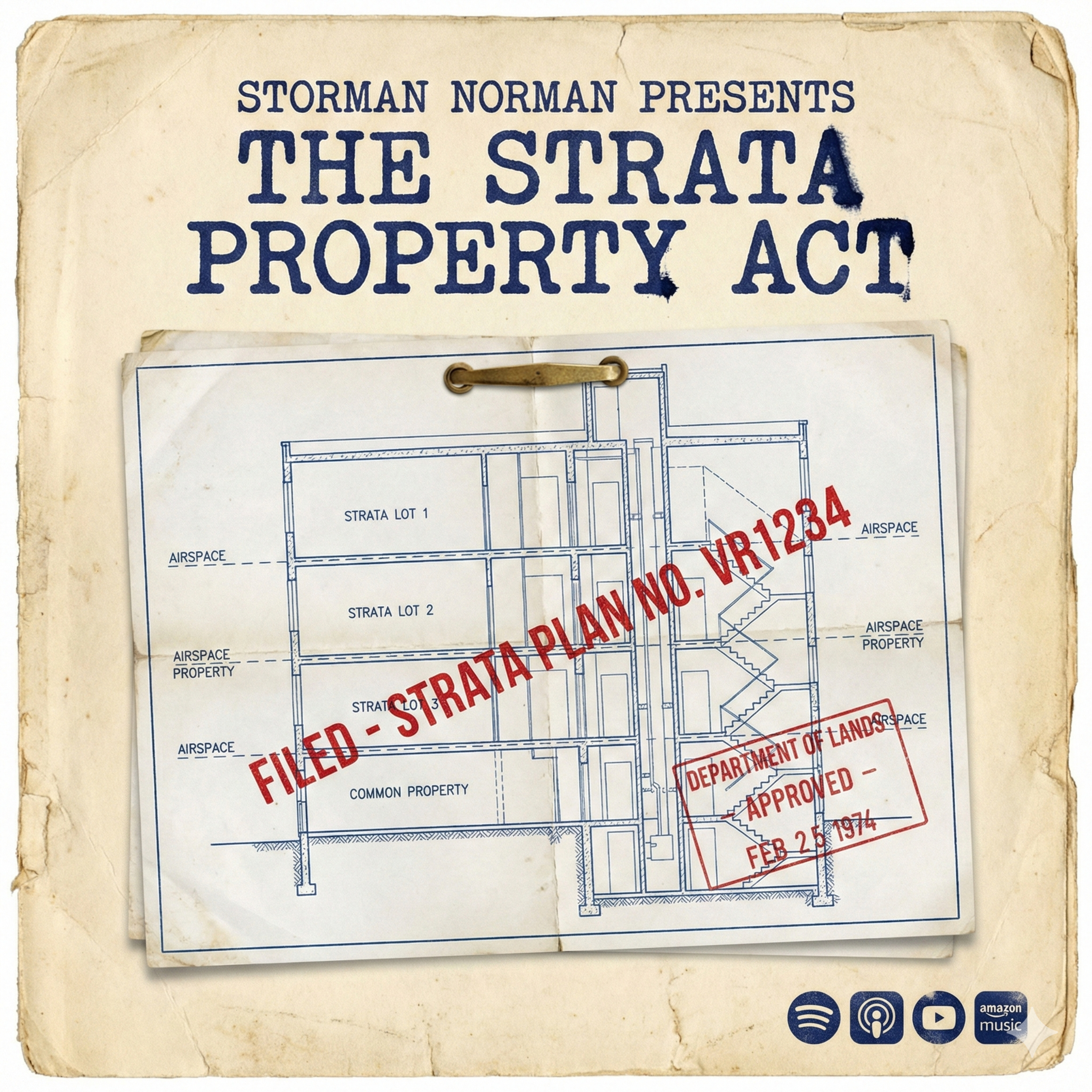
In this episode of Storman Norman Presents, we break down the legislative engine behind one of the most common development types in British Columbia: the Strata Property Act.
We focus on the surveyor’s pivotal role in defining the horizontal and vertical limits of ownership, the technical nuances of phased developments, and the high stakes of certifying previously occupied buildings.
Delineation of Boundaries (Section 244):
The strata plan must show a "heavy outline" for the perimeter of the land and must clearly distinguish between strata lots and common property.
Exam Note: Nothing outside the parent parcel can be designated as a strata lot or common property.
The Certification Process (Sections 241 & 242):
New Construction: Requires a surveyor to certify that the building has not been previously occupied (Form S).
Conversions: Requires approval from the municipal council or regional district (Form T) if the building was previously occupied.
Phased Strata Developments (Sections 221–225):
A developer must file a "Phased Strata Plan Declaration" (Form P) with the first phase.
Surveyor’s Duty: Each phase must be a separate strata plan and must be integrated into the existing strata corporation upon registration.
Limited Common Property (LCP):
LCP must be designated on the plan and measured by the land surveyor. It is not defined by the physical improvements (like a patio), but by the dimensions shown on the plan.
Infographic:
https://drive.google.com/file/d/1dGCceJWJqFNIIjV7MIVqwZeYktdbsiG9/view?usp=drive_link
Source:
https://drive.google.com/file/d/1SevHmKBka_Iihlr_FPXJwS8Wnh04F1KU/view?usp=drive_link