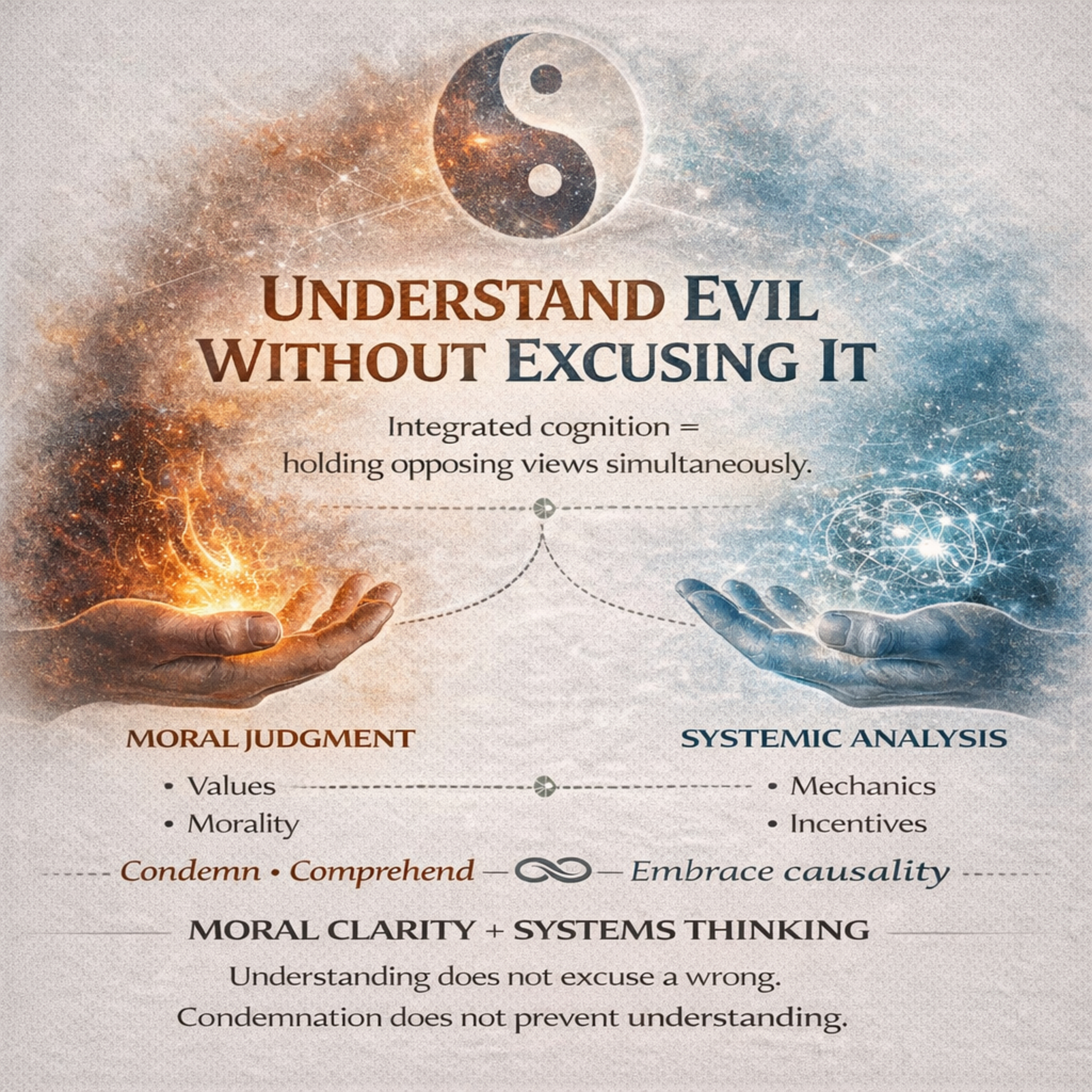
This episode explores a rigorous form of integrated cognition designed to resolve the tension between moral judgment and systemic analysis. Rather than viewing holism as a "mushy" blending of ideas, the source defines it as the orchestration of dual structures, allowing an individual to hold opposing classifications simultaneously without compromising either. This framework uses the metaphor of "hands" to synchronize the left-hand relational assessment (values and morality) with the right-hand structural assessment (mechanics and incentives). By refusing to choose between being a judge or a mechanic, one can achieve a coherent unity that prevents the intellectual laziness of either blind condemnation or amoral explanation. Ultimately, the text argues that understanding does not absolve a wrong, and conversely, condemnation does not preclude understanding its cause.