Welcome to Behavioral Intelligence with Mara Sánchez, presented by Amethyst Therapy Services — where we turn RBT exam concepts into patterns you can recognize, remember, and apply.
We continue Section C with:
🎯 C.3. Implement discrete-trial teaching procedures.
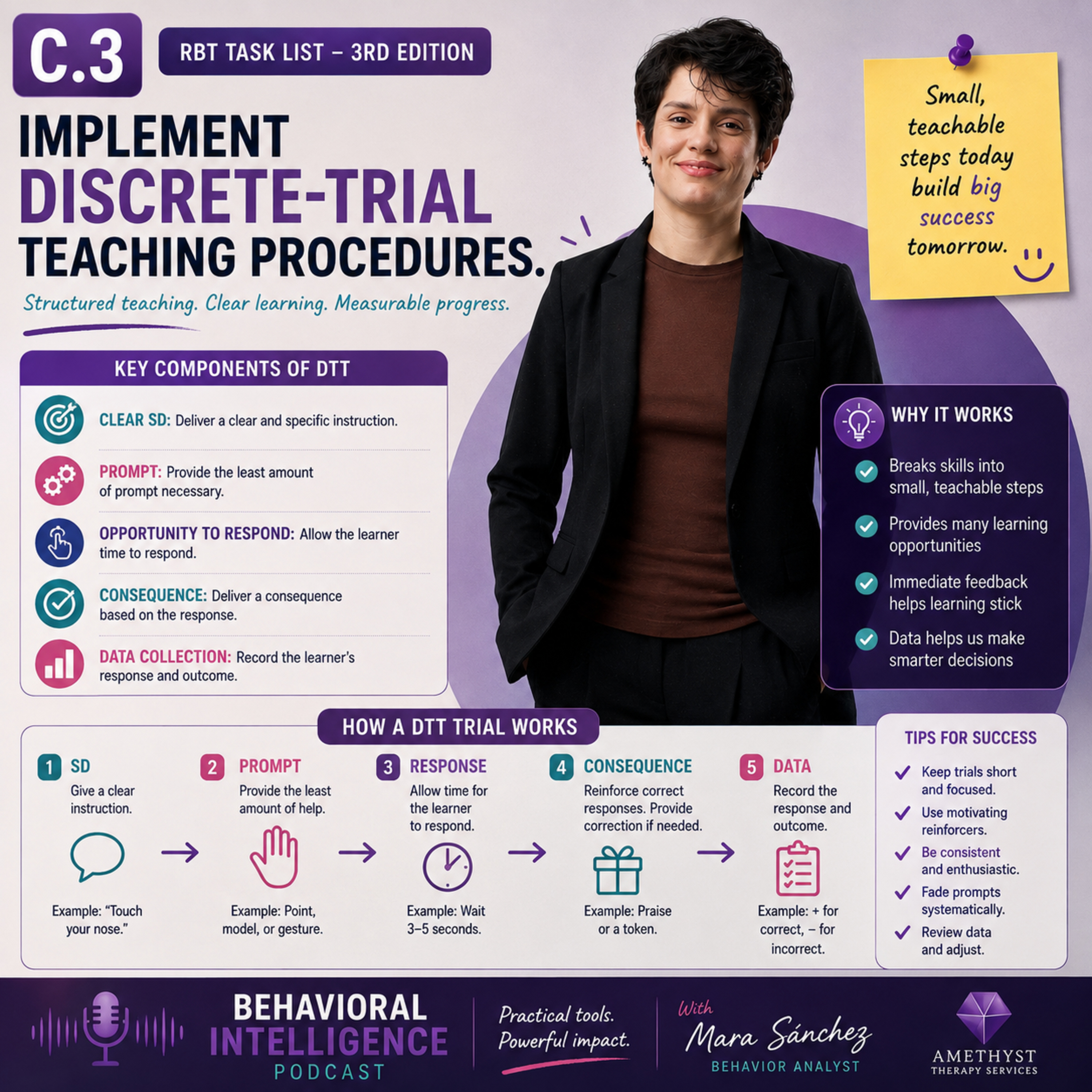
Discrete-Trial Teaching, commonly called DTT, is a structured teaching method in which skills are broken into clear, teachable units called trials.
Think:
🧠 Clear instruction → Response → Consequence → Repeat
🔬 WHAT DOES A DISCRETE TRIAL LOOK LIKE?
A typical trial includes several components:
1️⃣ Antecedent / SD
The RBT presents a clear instruction or stimulus.
Example:
👉 “Touch red.”
2️⃣ Learner Response
The learner responds to the instruction.
👉 The learner touches the red card.
3️⃣ Consequence
The RBT responds according to the teaching protocol.
Correct response → reinforcement may be delivered.
Incorrect response → the established error-correction procedure may be implemented.
4️⃣ Intertrial Interval
A brief pause occurs before beginning the next trial.
Then…the next learning opportunity begins!
🧠 RECOGNIZE THE PATTERN
Imagine:
RBT: “Point to the dog.”
Learner points to the dog.
RBT: “Great job!” + delivers the programmed reinforcer.
Brief pause.
Next trial.
🎯 That structured sequence should immediately make you think:
DTT — Discrete-Trial Teaching
🚨 EXAM TRAP: DTT ≠ JUST REPEATING QUESTIONS
DTT is systematic.
The RBT must follow the established teaching procedure, including:
✔️ Presenting the SD correctly
✔️ Providing prompts when programmed
✔️ Reinforcing according to the plan
✔️ Using error correction as specified
✔️ Recording accurate data
✔️ Following the appropriate intertrial interval
Simply asking the same question repeatedly is not automatically DTT.
🆘 WHAT ABOUT PROMPTS?
A learner may not initially respond independently.
Example:
RBT: “Touch blue.”
The learner does not respond.
The RBT provides the programmed prompt.
The goal is not permanent dependence on prompts.
As the learner develops the skill, prompts may be systematically faded according to the treatment protocol to transfer stimulus control to the appropriate stimulus.
🚨 EXAM TRAP: The RBT should not randomly add, remove, or change prompts.
Follow the established procedure.
❌ ERROR CORRECTION
What if the learner makes an incorrect response?
The RBT does NOT simply say:
❌ “No! Wrong!”
Instead, the RBT follows the established error-correction procedure.
Depending on the program, this may involve providing the appropriate prompt and another opportunity to respond correctly.
🧩 EXAM CHALLENGE
An RBT says, “Show me the spoon.” The learner selects the spoon. The RBT immediately provides praise and a token, records the response, waits briefly, and begins the next trial.
Which teaching procedure is being implemented?
A. Free-operant preference assessment
B. Discrete-trial teaching
C. Functional analysis
D. Extinction
🎯 Answer: B — Discrete-Trial Teaching
Look for the pattern:
Instruction → Response → Consequence → Brief interval → Next trial
💎 BEHAVIORAL INTELLIGENCE TAKEAWAY
For the exam, remember:
📣 SD/Instruction
⬇️
👤 Learner Response
⬇️
🎯 Consequence
⬇️
⏱️ Intertrial Interval
⬇️
🔄 Next Trial
And remember:
🚨 Structured does NOT mean robotic.
The RBT implements DTT consistently while following the individualized teaching protocol and responding appropriately to the learner.
🎧 Follow Behavioral Intelligence with Mara Sánchez as we master the RBT 3rd Edition, one task-list item at a time.
💜 Presented by Amethyst Therapy Services
Study smarter. Recognize the pattern. Understand the behavior.