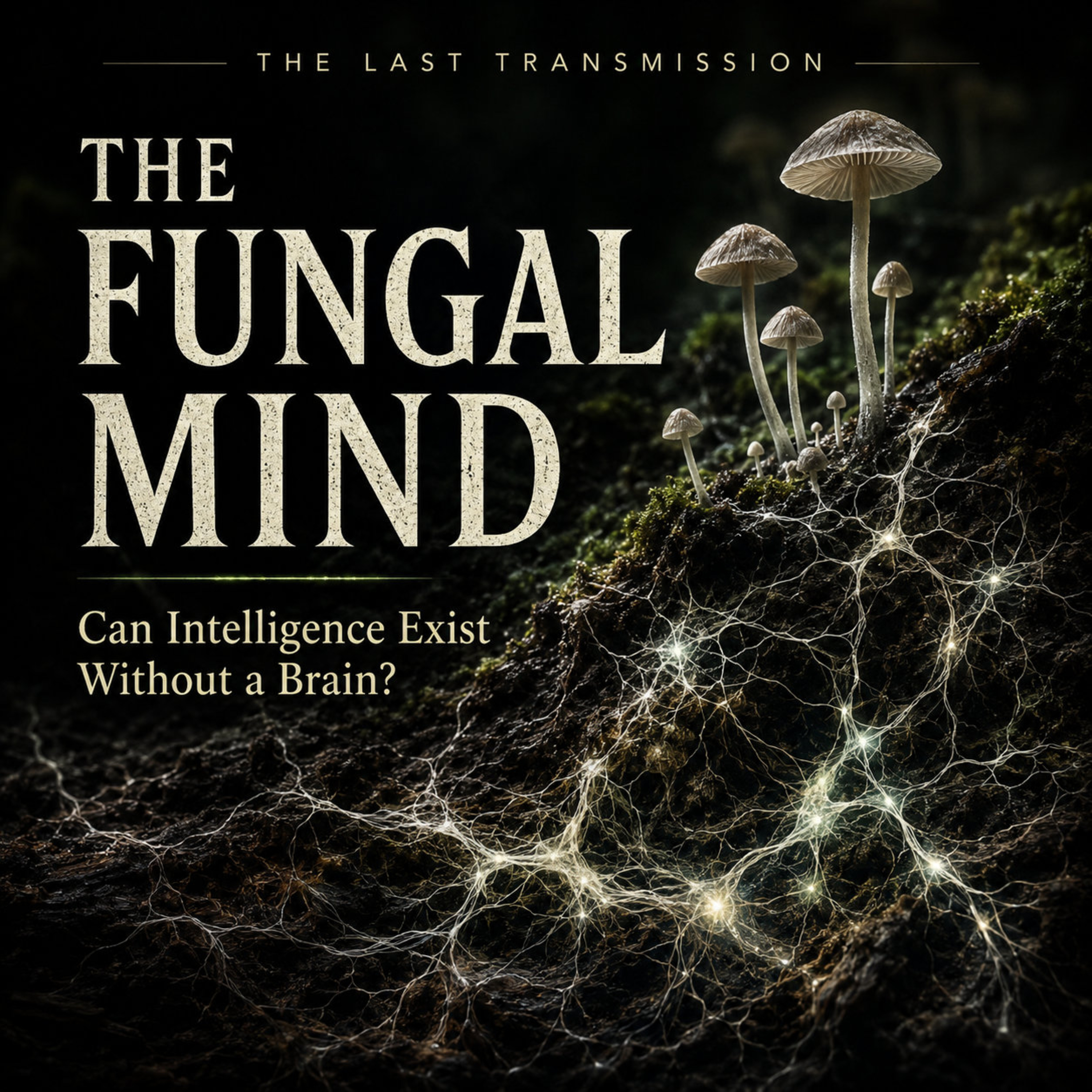
What if intelligence does not require a brain?
Beneath forests, grasslands, and gardens exists an ancient biological system made from fungal mycelium, microscopic networks capable of electrical signaling, adaptation, resource exchange, and behaviors that increasingly resemble memory and problem-solving.
In this episode of The Last Transmission, we investigate the strange emerging science of fungal intelligence, quantum coherence, mycelium computing, fungal electrical signals, quantum biology, memory, consciousness, and intelligence without a nervous system.
Researchers have detected spike-like electrical activity in fungal tissue. Experiments suggest that mycelium can retain the effects of stress, preserve information about its surroundings, navigate through space, and allow past conditions to influence future behavior, despite possessing no brain, neurons, or centralized nervous system.
Scientists are also turning fungi into technology.
Mushroom-based memristors, fungal logic circuits, neuromorphic systems, and mycelium-based computing chips are already being investigated as alternatives to conventional electronics. These biological systems may eventually offer forms of computing that can adapt around damage, operate in hostile environments, and return harmlessly to the soil when their work is finished.
Then comes the deeper and far more speculative question.
Quantum biology has already challenged the assumption that useful quantum effects cannot survive inside warm, noisy living systems. If quantum coherence is eventually demonstrated to play a functional role within fungal networks, it could force us to reconsider some of our oldest assumptions about biological organization, computation, intelligence, and perhaps even consciousness itself.
But the most unsettling implication may have nothing to do with technology.
For centuries, humans searched for intelligence by looking for reflections of ourselves: eyes, voices, tools, language, brains, and nervous systems. Fungi possess none of those things.
And yet beneath forests we have crossed our entire lives, these ancient organisms may have been sensing change, preserving the effects of previous events, exchanging signals, adapting around damage, and organizing themselves in ways we are only now developing the tools to detect.
Some of those forests are already gone.
Their trees were cut down, their soil disturbed, and fungal networks shaped across decades or centuries may have disappeared before anyone knew what information or biological history they contained.
Perhaps the greatest discovery will not be that fungi are more human than we imagined.
Perhaps it will be that life has always been far stranger, deeper, and more capable than the human definition of intelligence allowed.
And once you understand what may be happening beneath your feet, the silence of a forest can never feel empty again.
Chapters
0:00 The Fungal Mind: Hidden Intelligence Beneath Our Feet
2:06 Mycelium: The Hidden Network Beneath Forests
2:48 Suzanne Simard and the Wood Wide Web
3:57 The Wood Wide Web Debate
5:22 Fungal Electrical Signals
7:25 Quantum Coherence and Quantum Biology
9:17 Could Quantum Effects Exist in Fungi?
11:01 What Quantum Fungi Could Mean for Forests
12:20 Fungal Computing and Mushroom Computers
14:03 Mycelium Chips and Neuromorphic Computing
15:25 Can Intelligence Exist Without a Brain?
16:14 Fungal Memory and Spatial Navigation
18:44 What Anesthesia Does to Fungi
20:44 Quantum Coherence and Consciousness
21:48 What Does Intelligence Really Mean?
24:25 Humanity Arrived Late
25:09 The Hidden Life Beneath Every Forest
26:20 What We Destroy Before We Understand
28:12 The Living World Was Never Silent
29:59 The Memory Beneath Our Feet