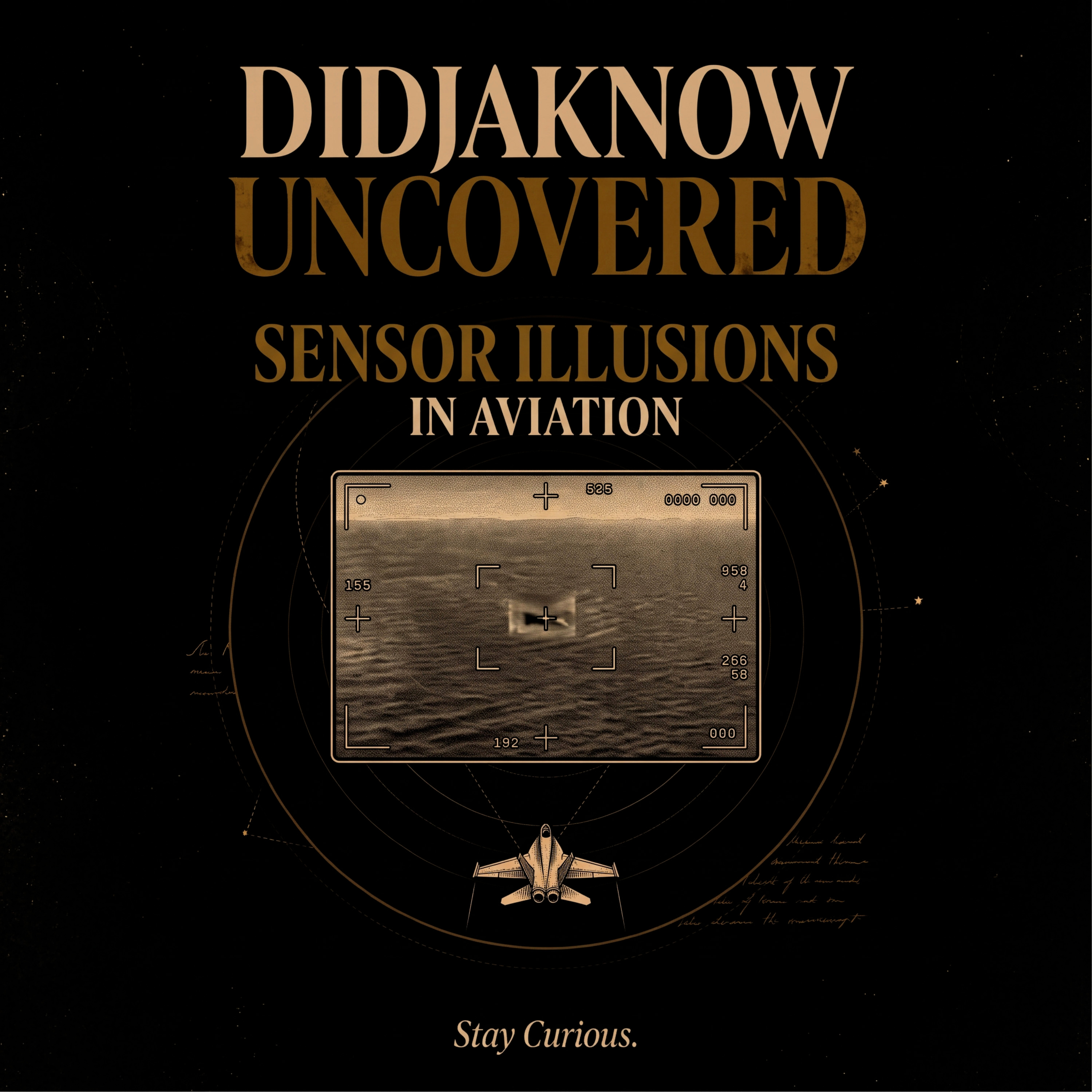
How can an object appear to race across the ocean or vanish from an infrared display? Using the Navy’s GoFast video and examples from aviation, this episode shows how a moving aircraft can exaggerate apparent speed and how a target can fade when its temperature is close to that of its surroundings. It also asks what evidence investigators need to tell whether either effect explains a particular sighting.
IN THIS EPISODE
• Spatial disorientation, autokinesis and missing visual reference points.
• How radar and infrared systems process and display signals.
• Thermal crossover and a target’s apparent disappearance.
• Parallax, aircraft motion and AARO’s GoFast analysis.
• AARO’s reconstruction of the 2013 Puerto Rico footage.
• Why some LED approach lights can be difficult for infrared vision systems to detect.
• The measurements needed to test an explanation against a specific event.
SOURCES & FURTHER READING
• Federal Aviation Administration — Aeronautical Information Manual, Chapter 8, Section 1: Medical Facts for Pilots.
The “Illusions in Flight” section explains spatial disorientation, false horizons and autokinesis.
https://www.faa.gov/air_traffic/publications/aim_html/chap8_section_1.html
• All-domain Anomaly Resolution Office — “Go Fast” Case Resolution, 6 February 2025; methodology updated 20 February 2025.
Explains the reconstruction of altitude and possible speeds, the role of motion parallax and the limits imposed by missing aircraft position and heading data. AARO did not definitively identify the object.
• All-domain Anomaly Resolution Office — “The Puerto Rico Object” Case Resolution, 20 March 2025.
AARO’s analysis of the 2013 infrared recording, including viewing geometry, thermal crossover and the apparent water entry. It assessed with high confidence that the objects displayed no anomalous behaviour, and with moderate confidence that they were sky lanterns.
• Federal Aviation Administration — LED Approach Lighting System Installations.
Explains that pilots using infrared-based Enhanced Flight Vision Systems may experience reduced visual performance with LED approach lights.
A known visual or sensor effect is an explanation to test against the recording conditions, rather than an automatic answer for every unresolved observation.
RELATED EPISODES
CREDITS
Narration: Daryn.
A DidjaKnow Media production.
EXPLORE MORE
DidjaKnow Media website
A Curious Vantage on YouTube
https://www.youtube.com/@ACuriousVantage
DidjaKnow Media on YouTube