Hello and welcome to my weekly video-podcast on art & architecture in the news.
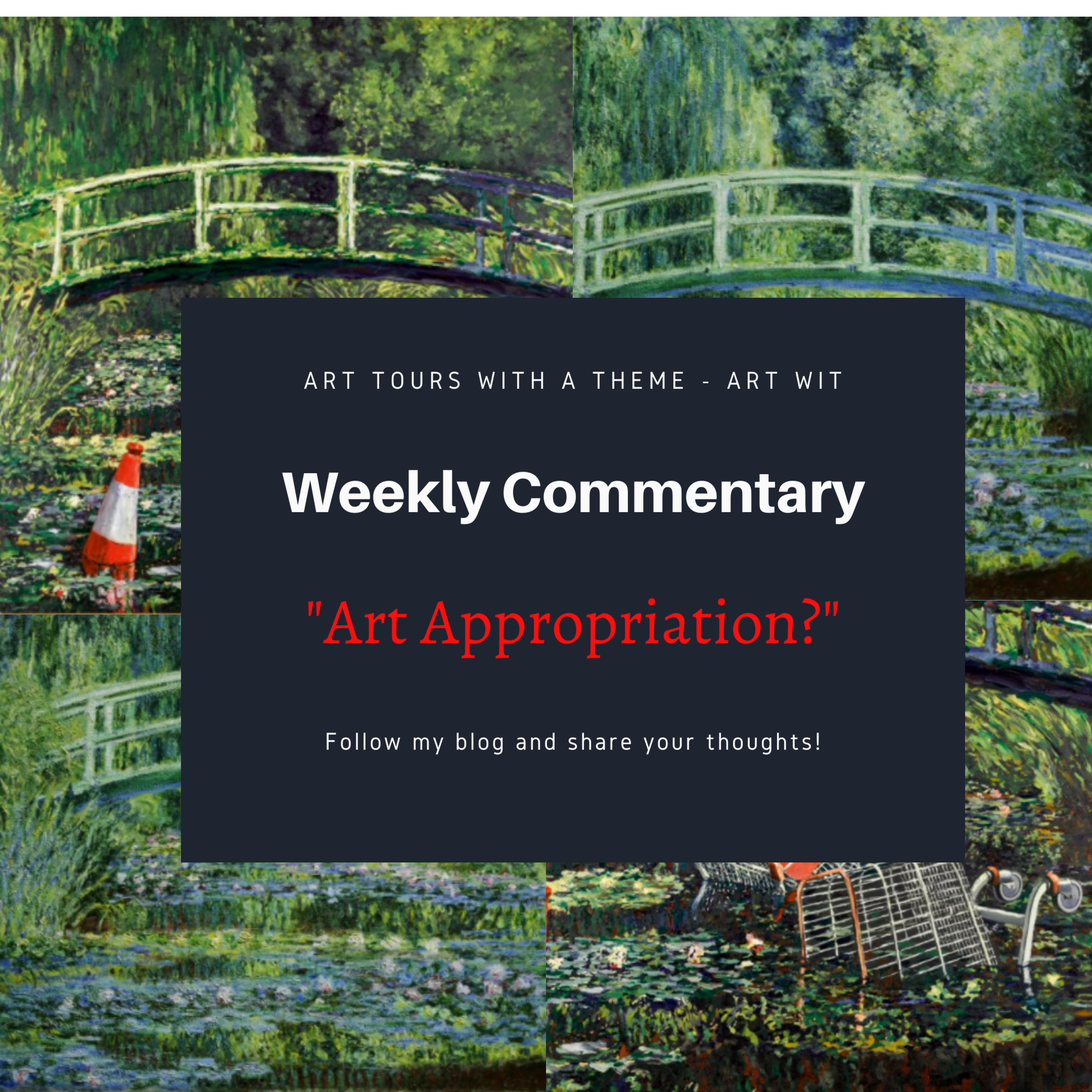
The news of this week is about a Banksy painting called "Show me the Monet", created in 2005, which has been recently sold at auction for more than double its estimated valuation.
It is ironic, as the title Show me the Monet! plays with the wording ‘show me the money’, and money has indeed been shown.
It represents an interpretation of the Water Lilies series by Monet, where the pond here becomes a polluted canal, with abandoned shopping trolleys and orange traffic cones.
This exercise by an artist who reproduces somebody else’s art is called “art appropriation”, and this is our topic of the day. “Art appropriation”, is when art comes after other art already produced, which is used as inspiration and starting idea, and then adapted for other purposes and different messages. This is not plagiarism, as although the original artwork is clearly mentioned, it is not identically reproduced. This is something European artists have been doing for centuries.
Could the Banksy painting exist without the original idea by Monet? Can this interpretation by Banksy be considered a tribute to Monet? Or has instead Banksy used the Water Lilies in an opportunistic way, just because he needed a famous painting to capture our attention? After all he needed just a pond, but he chose the most famous pond of the world. Was that to channel through a famous artwork his anti- capitalistic message against consumerism?
My view is that not only he needed to denounce we are polluting and destroying nature, but perhaps he wanted to denounce we are destroying art itself, including the masters of the past, with an art market that only looks at money and not at Monet, the beauty and the values it represents!
There are countless examples of art appropriation, for example the Rembrandt’s self portrait, with a striking pose borrowed from Titian’s unknown man. This use of art appropriation was an emulation, a tribute, a key technique in Europe from the Renaissance in 1300 to the second part of 1800’s. It was a way of learning a previous method, and creating an artist’s own style as a reply, as interpretation, of previous works.
In other cases art appropriation had a fun connotation on top of a way to learn the past better. For example Picasso interpreted Manet's "Le Déjeuner sur l'herbe", which is itself a playful, mocking restaging of Titian's (or maybe Giorgione's) Concert Champêtre.
More recently, we are witnessing playful photo recreations of iconic paintings as lockdown pastime. But this has also been done as remake by famous photographers who interrogate the power of images in our era, where we are bombarded by internet images without their original context, appearing as all the same, wi
What is your favourite image? What does it communicate to you? Which famous and iconic painting would you buy as a replica for your home? Let me know your thoughts!
This is Roby, from ART Tours with a Theme – ART wiT. I hope you enjoyed this podcast!
This video is on FB and IGTV. The audio podcast is available on 7 platforms under “Art Tours with a Theme”: including Google Podcast and Spotify.
Thank you for listening and share this blog with your friends! Bye!