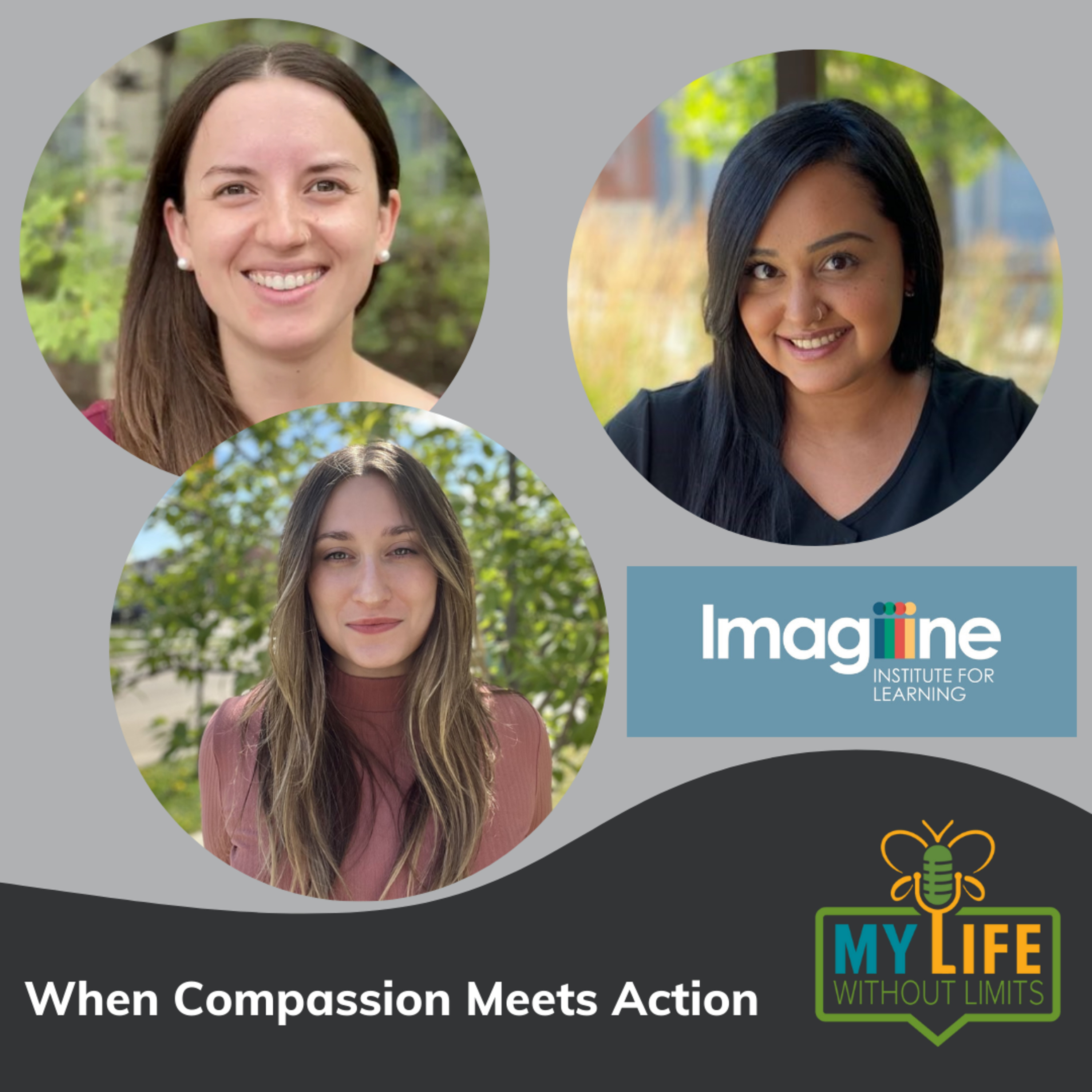
Imagine Institute for Learning invites professionals across sectors to imagine what is possible in a world where compassion meets action. They use evidence-informed practice and research to create immersive learning opportunities that will ignite the potential and inspire the hearts of participants who work to support human beings in different settings. Whether you are a social worker, educator, first responder, health practitioner, or community worker, their trainings provide the necessary catalyst to up your game and be the best version of yourself in practice.
Angela, Senior Facilitator, is a female with long brown straight hair parted in the middle. She is wearing a white long sleeved shirt with patches of black stripes. Angela has a small hoop nose ring.
Diana, Community Engagement Coordinator, is a female with light brown wavy hair parted in the middle and has large framed glasses. She is wearing a black shirt.
Nanditha, Curriculum Developer, is a female with long wavy black hair parted in the middle. She has a nose piercing on her septum and is wearing a black shirt.
My Life Without Limits is a podcast from Cerebral Palsy Alberta.
Music: Positive Fuse by French Fuse
Carlos is a Hispanic male with cerebral palsy. He has short dark hair, dark eyes, some facial goatee hair, and uses crutches/canes to help him walk. In this episode he was hearing a black tshirt and green headphones.
Leah is a white female with chin length brown hair, freckles, green eyes, wears glasses and is able bodied. In this episode she was wearing a burgundy short sleeved top.
Follow us on Instagram @mylifewithoutlimitspodcast
Support our podcast by buying us a coffee here: https://www.buymeacoffee.com/mlwlpodcast
lison@cpalberta.com for any questions!
We acknowledge that what we call Alberta is the traditional and ancestral territory of many peoples, presently subject to Treaties 6, 7, and 8. Namely: the Blackfoot Confederacy – Kainai, Piikani, and Siksika – the Cree, Dene, Saulteaux, Nakota Sioux, Stoney Nakoda, and the Tsuu T’ina Nation and the Métis People of Alberta. This includes the Métis Settlements and the Six Regions of the Métis Nation of Alberta within the historical Northwest Metis Homeland. We acknowledge the many First Nations, Métis and Inuit who have lived in and cared for these lands for generations. We are grateful for the traditional Knowledge Keepers and Elders who are still with us today and those who have gone before us. We make this acknowledgement as an act of reconciliation and gratitude to those whose territory we reside on or are visiting.