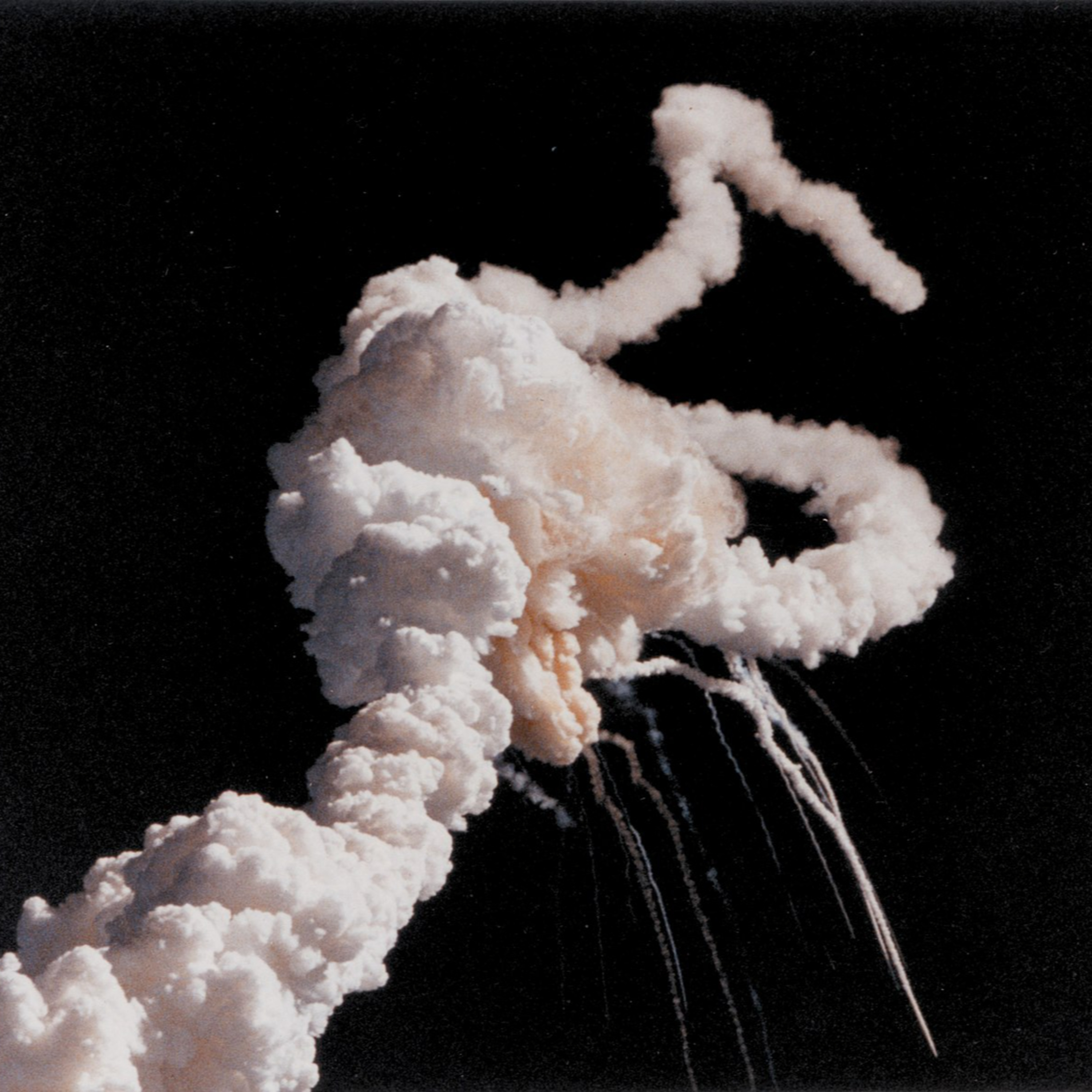
The Space Shuttle Challenger disaster was a fatal accident in the United States' space program that occurred on January 28, 1986, when the Space Shuttle Challenger (OV-099) broke apart 73 seconds into its flight, killing all seven crew members aboard. The mission carried the designation STS-51-L and was the tenth flight for the Challenger orbiter and twenty-fifth flight of the Space Shuttle fleet. The crew was scheduled to deploy a communications satellite and study Halley's Comet while they were in orbit. The spacecraft disintegrated over the Atlantic Ocean, off the coast of Cape Canaveral, Florida, at 11:39 a.m. EST (16:39 UTC).
The disaster was caused by the failure of the two redundant O-ring seals in a joint in the Space Shuttle's right solid rocket booster (SRB). The record-low temperatures of the launch reduced the elasticity of the rubber O-rings, reducing their ability to seal the joints. The broken seals caused a breach in the joint shortly after liftoff, which allowed pressurized gas from within the SRB to burn through the wall to the adjacent external fuel tank. This led to the separation of the right-hand SRB's aft attachment and the structural failure of the external tank. Following the explosion, the orbiter, which included the crew compartment, was broken up by aerodynamic forces.
The crew compartment and many other vehicle fragments were recovered from the ocean floor after a three-month search and recovery operation. The exact timing of the deaths of the crew is unknown; several crew members are known to have survived the initial breakup of the spacecraft. By design, the orbiter had no escape system, and the impact of the crew compartment at terminal velocity with the ocean surface was too violent to be survivable.