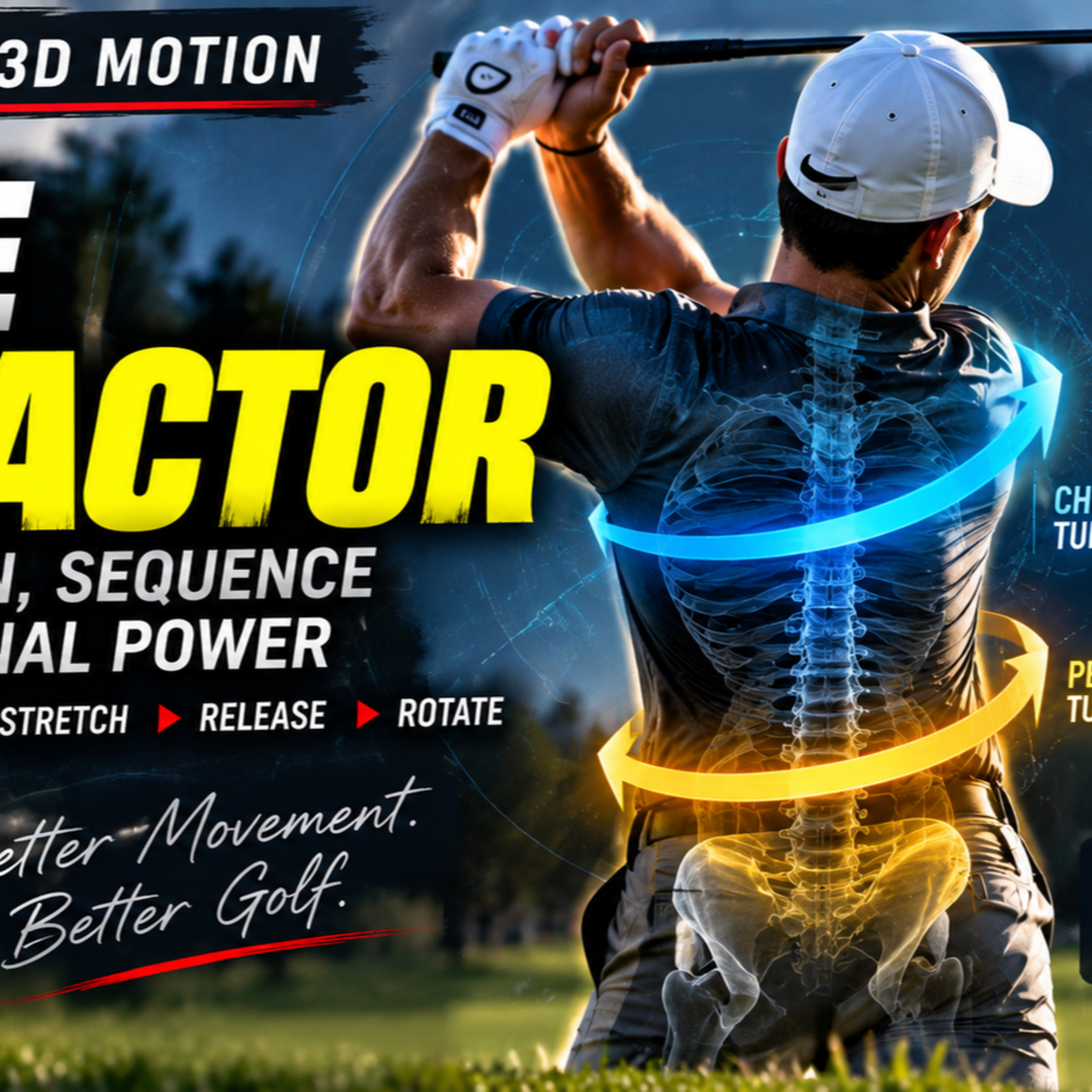
Many golfers try to create distance by turning harder, using more arm strength or increasing muscular effort. Efficient golf swings work differently. Speed is created through the coordinated interaction of the pelvis, chest, arms and club. A key part of this is the X-Factor.
The X-Factor describes the rotational separation between the pelvis and upper body. The pelvis should not be artificially locked during the backswing. It rotates naturally while the chest rotates farther, creating functional separation. A golfer might demonstrate approximately 45° of pelvis rotation and 90° of upper-body rotation, but these numbers are examples, not universal targets.
Importantly, the X-Factor is a 3D movement. Rotation interacts with forward bend, side bend and the orientation of the pelvis and torso.
LOAD → STRETCH → RELEASE
During the backswing, separation helps load the body. But maximum separation may occur during transition rather than at the top. As the pelvis begins rotating toward the target, the chest can briefly remain behind. This momentary increase in separation is known as the X-Factor Stretch and relates to the stretch-shortening cycle.
PELVIS GOES → CHEST RESPONDS → CLUB FOLLOWS
This leads directly to the kinematic sequence:
PELVIS → CHEST → ARMS → CLUB
Sequence matters more than simply rotating faster. If everything turns together, separation and potential energy transfer are reduced. But deliberately holding the chest back too long can also disrupt the sequence and leave the club stuck.
At impact, the pelvis is typically more open toward the target than the chest because the body is still dynamically unwinding.
There is no perfect X-Factor number for every golfer. Functional separation depends on mobility, body structure and individual movement capabilities.
SEPARATION + SEQUENCE + TIMING = FUNCTIONAL POWER
The X-Factor is not only about distance. Effective sequencing organizes the swing and can reduce last-second compensations with the hands and arms, creating a more repeatable motion.
1. Backswing: Rotate the pelvis naturally while allowing the chest to turn farther.
2. Transition: Start the pelvis toward the target while the chest briefly remains behind. Feel the separation increase.
3. Release: Allow the chest, arms and club to follow dynamically into a balanced finish.
TURN → SEPARATE → STRETCH → RELEASE → ROTATE
Stop trying to manufacture speed with muscular effort. Create functional power through separation, sequence and timing.
FEEL THE X-FACTOR DRILL