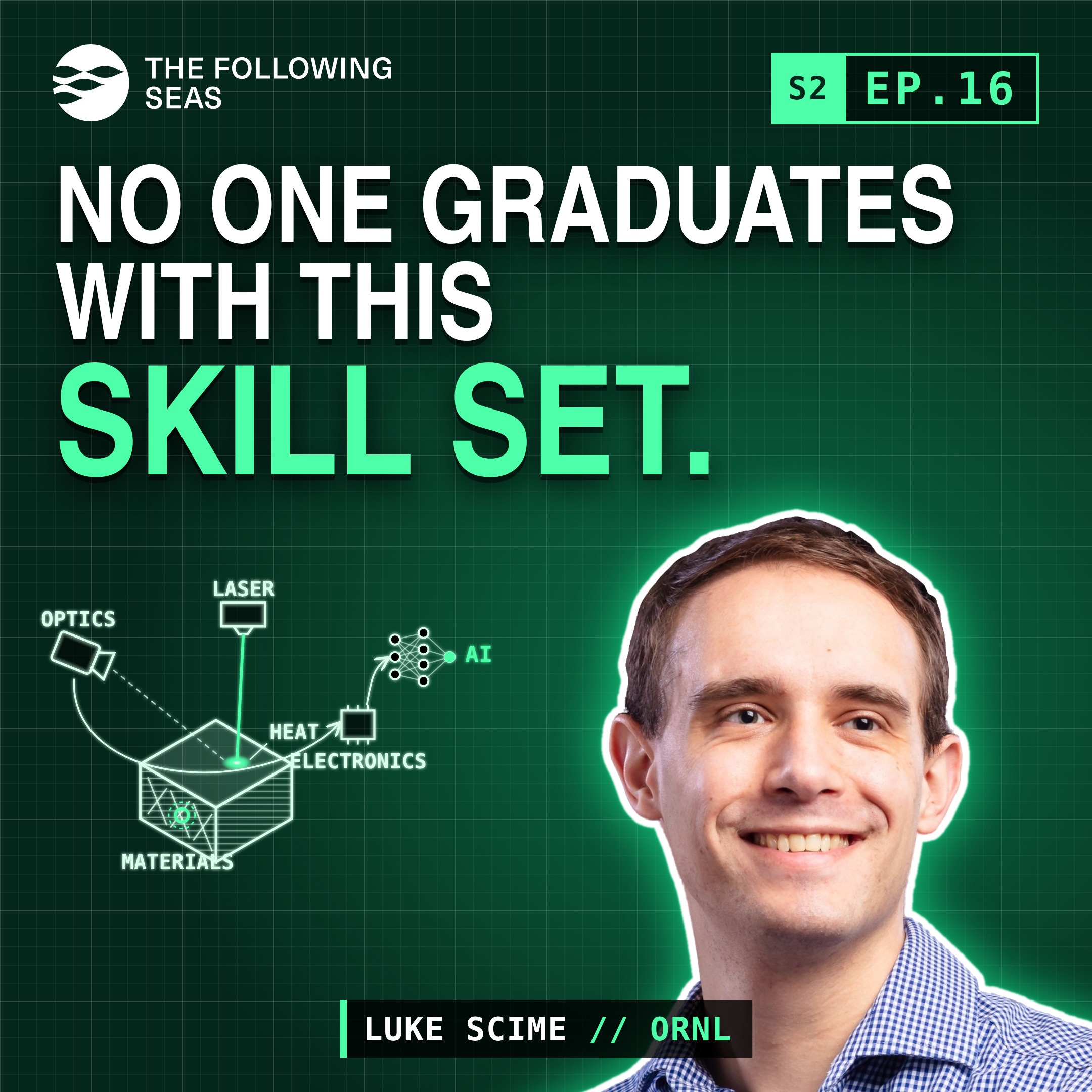
Luke Scime of Oak Ridge National Laboratory
In this episode of Following Seas, Luke Scime discusses how advanced sensing, data analytics, and AI are helping solve one of additive manufacturing's biggest challenges: ensuring that complex 3D-printed parts are safe and reliable for critical applications in aerospace, defense, and maritime environments.
Key Takeaways
- Scime explains his work at Oak Ridge National Laboratory, where he develops methods to qualify laser powder bed fusion parts by detecting flaws and defects during the printing process rather than only after a build is complete.
- The conversation explores how sensors, imaging systems, and AI-driven analytics can correlate anomalies observed during printing with actual flaws found through post-build inspection techniques such as X-ray computed tomography.
- Scime highlights the highly interdisciplinary nature of additive manufacturing, combining mechanical engineering, software development, optics, electronics, materials science, and data science to solve complex manufacturing challenges.
- Looking ahead, he discusses emerging capabilities such as real-time defect detection and "flaw healing" during printing, as well as the potential of large-scale manufacturing datasets to accelerate qualification, improve quality, and reduce barriers to adoption across industry.