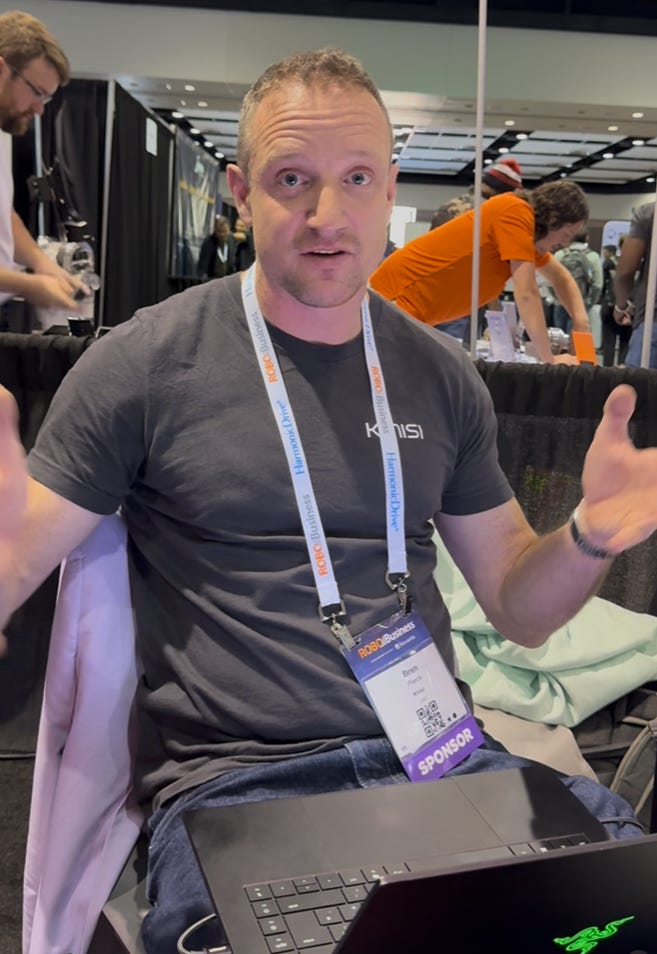
At RoboBusiness2025, I met Bren Pierce, CEO of Kinisi Robotics. This interview was recorded on October 16, 2025
“We’re starting with simple tasks to bootstrap our foundational model.”– Bren Pierce, CEO and Founder of Kinisi Robotics
In an era where humanoid robots are drawing headlines for dancing, sprinting, or flipping switches with eerily human hands, Kinisi Robotics is charting a different course — one grounded not in spectacle, but in reliability.
Their flagship robot, KR‑1, isn’t designed to wow audiences. It’s built to show up, lift crates, and do the work — safely, efficiently, and without a marketing team on standby.
“Our KR‑1 humanoid robot is designed for the warehouse and factory space,” says CEO Bren Pierce, who believes the future of robotics is less about human mimicry and more about human utility.
A Humanoid That Moves with Purpose
KR‑1 walks the line — metaphorically — between form and function. Its upper body takes design cues from humans, making it naturally suited to environments built for people. But instead of legs, KR‑1 moves on a wheeled base — a choice driven by engineering pragmatism.
“Warehouses are flat,” Pierce points out. “We don’t need 14 motors if two will do.”
That simple equation shapes the entire robot. KR‑1 is engineered for tasks like lifting and delivering crates, picking objects, and navigating complex indoor spaces — not to imitate human movement, but to solve real problems quickly and affordably.
Field-Tested, Factory-Tough
Where many robots are still making the leap from lab to warehouse, KR‑1 is already being tested across pilot facilities in Europe and North America. These trials are more than checklists — they’re stress tests, designed to challenge the robot’s autonomy, perception, and endurance in messy, real-world environments.
This field data is central to Kinisi’s iterative design process. Instead of engineering in a vacuum, the company is learning from operators on the ground — and adapting quickly.
“Robots are in pilot facilities in Europe and America,” Pierce confirms. “We’re learning what’s needed, not just what’s possible.”
#robotics #droidsnewsletter
Learn more at www.droidsnewsletter.com