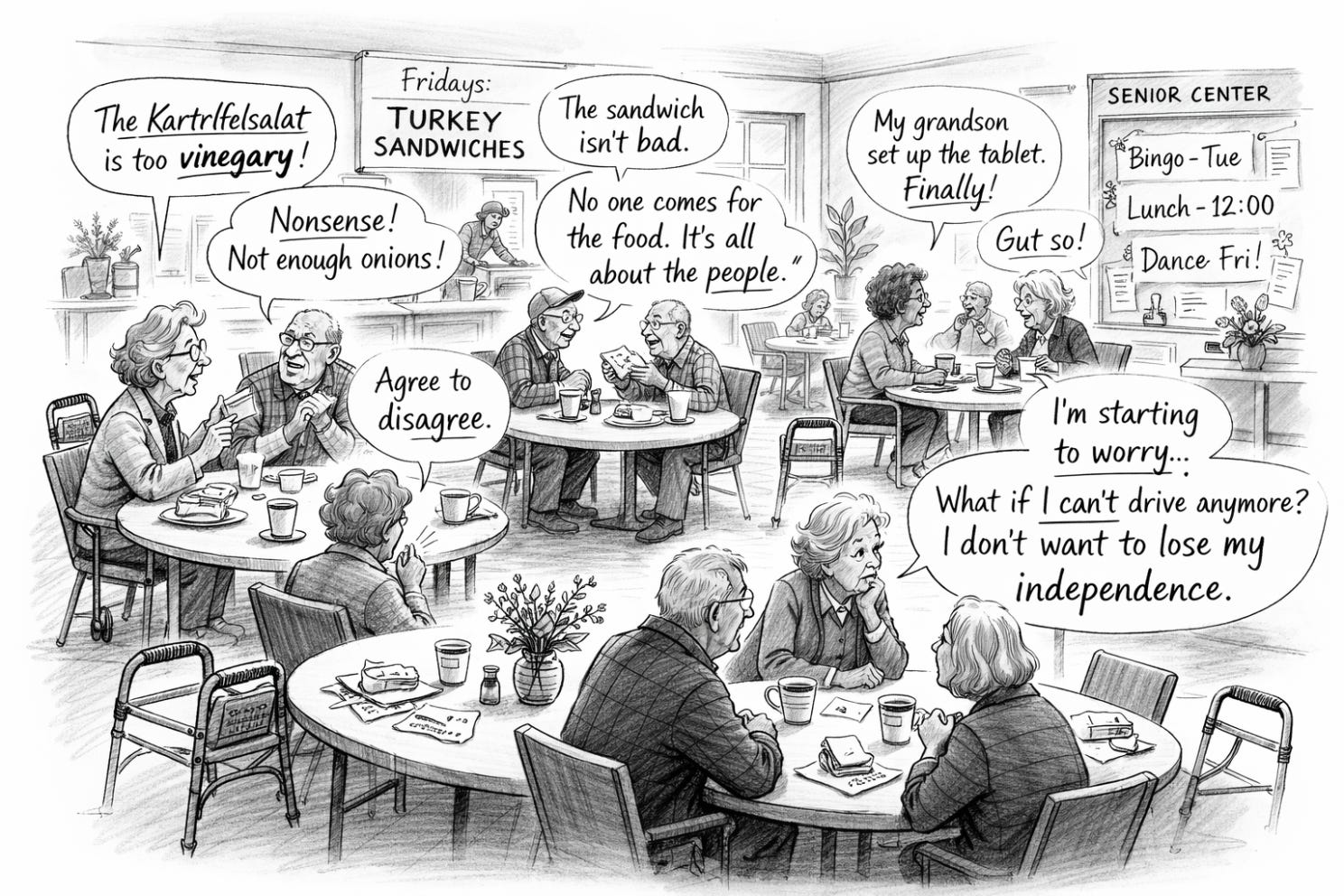
Stories about aging, for me, always begin with my own aging parent.
She is in remarkable health. Intellectually sharp. She still corrects my German grammar with the patience of a retired schoolteacher.
“Ganz genau,” she says when I finally get it right.
She chose a secure senior community designed for safe living. She has a dog. She still meets friends at the senior center. The food is mediocre. The people matter.
But beneath the humor runs a shared understanding.
It is not the open-faced turkey sandwich served on Fridays. Not even the Kartoffelsalat debate that erupts every month.
It is the possibility of losing independence.
Quiet conversations. “I’m starting to worry...”
What Families Worry About
A missed call.
A forgotten appointment.
A pause before asking for help.
These are not emergencies. They are signals.
Families see them before institutions do. Eventually, someone asks:
Could a robot help?
For decades, robotics companies have suggested that it could. The logic is appealing. Machines do not fatigue. They do not call out sick. They operate continuously.
But according to Anthony Nunez, the obstacle is not technological ambition.
“Care isn’t a gadget problem. It’s a systems problem.”
What People Actually Mean by “Robot”
When families ask whether a robot could help an aging parent, they are rarely imagining the same machine.
Some picture a humanoid assistant moving through the house. Others imagine a wheeled device that checks in and monitors routines. Increasingly, the term has stretched to include AI companions and software systems that never physically move at all.
With each innovation cycle, the definition expands. The care problem often does not.
A system designed to reduce loneliness addresses a different need than one built to prevent falls. A platform meant to support professional caregivers operates under different constraints than a device marketed directly to families. Lumping these together under the single word “robot” obscures the trade-offs involved.
As Nunez explains, aging care does not revolve around one person. It involves family members, professional caregivers, certified nursing assistants, physicians, and administrators. Care is a system.
Seals and Robotics Dogs
Humanoids tend to dominate headlines. But in private homes, locomotion may not be the primary constraint. What matters is reliable, safe operation in lived-in environments. The form factor is secondary to the function.
In fact, some of the most successful robotics deployments in aging care do not walk at all.
Consider Paro, the robotic seal used in senior living facilities around the world. It does not navigate hallways or lift patients. It provides social and emotional interaction. It responds to touch. It reduces agitation. It lowers anxiety in individuals with dementia.
Similarly, Tombot is designed to replicate the comfort of a live animal for people who can no longer safely care for one. It looks and behaves like a small puppy. It addresses loneliness and anxiety without introducing the risks associated with live pets.
Neither system walks. Neither promises full autonomy.
Both solve specific problems well.
That may be surprising to readers who equate robotics with humanoids. But in aging care, focused tools often outperform generalized ambition.
DROIDS is published by Diana Wolf Torres.
Connect via LinkedIn or visit droidsnewsletter.com.