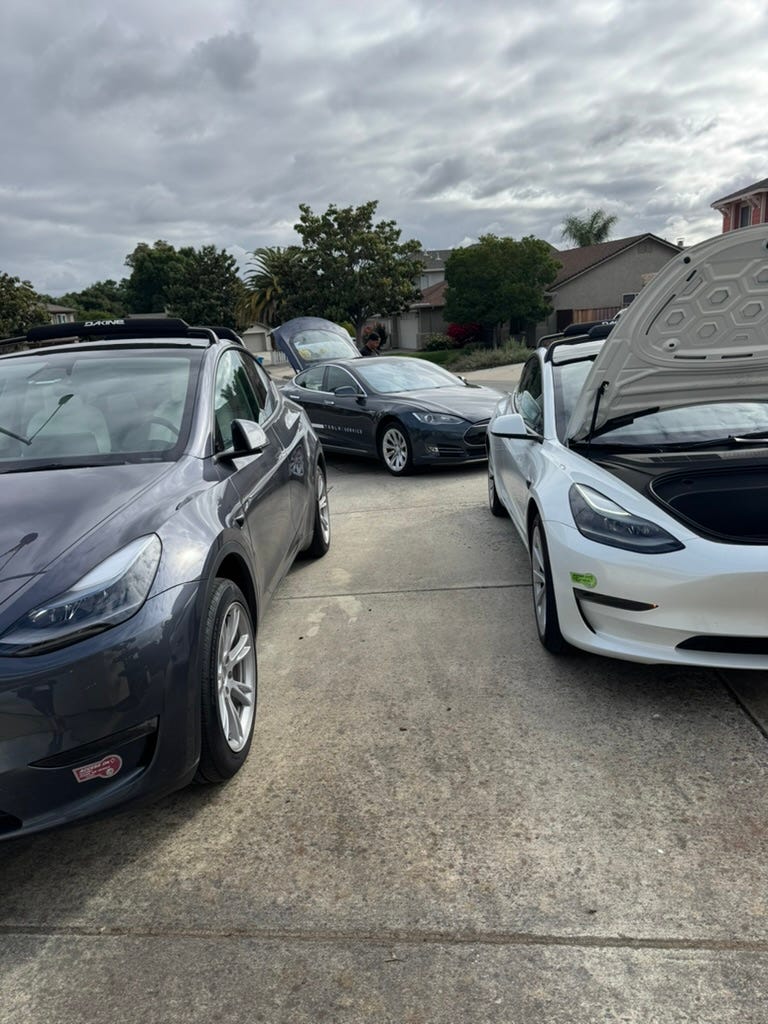
It’s a crisp Tuesday morning, and the Tesla mobile service technician shows up at 8:32 AM—just two minutes into his time window. He’s smiling, friendly, and remembers both my husband and me from a previous visit.
In that moment, I’m reminded why we’ve kept our Teslas. Service that comes to you, without upsells or stress. It’s seamless, personal, and quietly revolutionary.
And then—like a software update that erases your favorite feature—I remember who runs the company. The moment feels surreal: a service so flawless and human-centered, contrasted with leadership that often feels erratic and out of touch.
The Service Is Still Revolutionary
Tesla’s mobile service is one of the company’s most underrated innovations. According to Tesla’s 2023 Impact Report, over 30% of its North American service visits now happen remotely. I’d heard about this “perk” before we purchased our first Tesla, but never looked into it. If I had, I probably would have purchased an EV years earlier for this one benefit alone. Beyond the extraordinary luxury of car service in your driveway, EVs require less service. (Unless you own a Cybertruck and you’ve had been tortured through eight recalls in six months. But, we won’t go there.)
EV Maintenance: Fewer Parts, Fewer Problems
Electric vehicles have a mechanical simplicity that dramatically reduces service needs. Most EV drivetrains contain just 20–25 moving parts, compared to 200–2,000 in an internal combustion engine. That translates into fewer failure points, no oil changes, and simplified transmissions. Regenerative braking also reduces wear on brake pads, extending the lifespan of the braking system. And without tailpipes, mufflers, catalytic converters, or oxygen sensors, there’s no exhaust system to service or replace.
The U.S. Department of Energy confirms that EVs “typically require less maintenance than conventional vehicles,” while multiple industry analyses estimate a 40% to 49% reduction in service costs compared to gas-powered cars. Ford, for example, reports that scheduled maintenance for its F-150 Lightning is 49% cheaper than for the combustion-powered F-150 over five years or 75,000 miles.
(Full disclosure: I have serious concerns about the public safety impact of turning massive pickups into even heavier battery-electric vehicles. While some call the F-150 Lightning a “marvel of engineering,” I nervously see it as a 6,000-pound battering ram in traffic. That said—Ford isn’t wrong about the maintenance savings.)
While EVs still require tire rotations, cabin air filter changes, and the occasional software or coolant update, the overall cost of ownership remains significantly lower—often offsetting the higher sticker price within a few years.
These design advantages eliminate entire service categories—spark plugs, mufflers, timing belts—and cut down on shop visits. Paired with Tesla’s remote diagnostics and over-the-air software updates, EV ownership becomes not just cheaper, but far more convenient.
How much does it cost for all this driveway convenience? Our last service cost $65 per car. We’ve spent more than that on vegan burgers and drinks. On a scale of one to fun, watching the Tesla service tech work out our [home] office windows never gets old.
#teslamobileservice #tesla #robotics #droidsnewsletter
www.droidsnewsletter.com