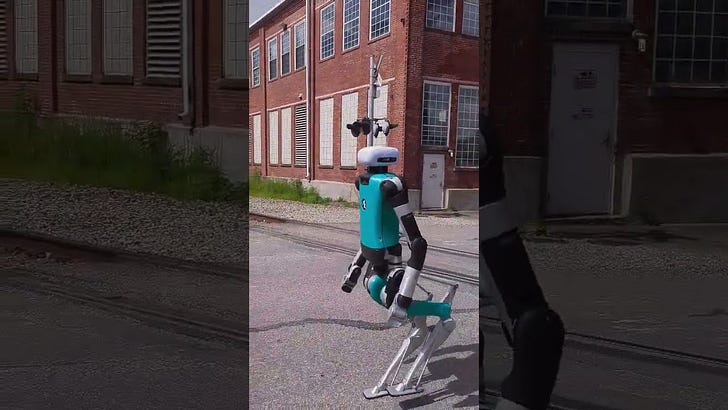
Your delivery driver now has bionic legs.
A robot springs from a Rivian van and strides up your driveway. It’s carrying a package and maybe… your future? Amazon’s latest humanoid experiment is a bold bet: that bipedal bots can tackle the most chaotic leg of delivery—the part between the curb and your porch.
Inside a modest-sized testing space in San Francisco—nicknamed the “humanoid park”—Amazon is training delivery robots to navigate obstacle courses designed to mimic suburban yards. Think hoses, stairs, and errant toys. The company is pairing its AI software with robot bodies from partners like Agility Robotics and Unitree. These bots may one day leap from electric Rivian vans to deliver packages while their human coworkers handle other stops.
This could be the next frontier in last-mile logistics. But don’t let the smooth stride fool you. Your driveway is a battlefield.
Delivery, Meet Dog
Ask any delivery worker about dogs, and you’ll hear stories worthy of epic poems. My cattle dog is convinced that every delivery is an attempted burglary. Now imagine that dog’s reaction to a metallic humanoid silently approaching the front door.
Humanoids, for all their processing power, don’t yet come with a canine-calming module. They’ll need to manage not just pets, but people, children, and the chaotic unpredictability of real homes.
The Obstacle Isn’t Always the Curb
Amazon’s bots train in a coffee-shop-sized test arena, but the real world is less forgiving. It’s not just stairs or slippery grass. It’s the coiled garden hose, the newspaper you forgot to pick up, the “present” left by a neighbor’s Great Dane. These aren’t props—they’re hazards.
Yet, the Amazon bots will also encounter the flip side—dogs so friendly and enthusiastic they will not leave them alone. There are dogs so thrilled to see delivery drivers that entire social media pages are devoted to them, showing heartwarming encounters where UPS drivers hand over biscuits to placid Golden Retrievers who’ve been waiting all day for their arrival like they’re a member of the family. The point? It is a case-by-scenario. Dogs are unpredictable.
Can these machines adapt on the fly? Amazon hopes reinforcement learning will help robots react to novel terrain. But roboticists agree: complexity scales fast when you leave the lab.
“If the environment is tightly controlled, like clear driveways and standard door layouts, it’s feasible,” says Prof. Subramanian Ramamoorthy of the University of Edinburgh. “Add pets, kids, or unexpected objects, and things get trickier.”
Why Bother With Bots?
Despite the messy reality, the prize is clear. Humanoid delivery robots could someday shave minutes off each drop-off by allowing drivers to stay in the vehicle. With more than 20,000 Rivian vans on the road and plans for 100,000, Amazon is building a fleet-ready future. Analysts estimate that humanoid delivery could save Amazon over $7 billion annually by 2032.
There’s also potential upside for workers. In Amazon warehouses, robots like Agility’s Digit allow human employees to shift into coordination roles—a kind of robot management. Bringing that synergy to streetside delivery might reduce injury risk and fatigue while keeping humans in supervisory positions.
Digit is well-suited for carrying payloads like packages, and is already working in factories.
#robotics #agility #digit #factoryrobotics #droidsnewsletter
www.droidsnewsletter.com