Episode show notes
Credits
Host: Maggie BlahaTheme music: “Thanks for the Memory” written by Leo Robin and Ralph Rainger, performed by Bob Hope and Shirley Ross in the 1938 film of the same name
In Brooklyn, most people don’t have yards—but they do have stoops, so you’ll often see stoop sales being hosted around the city. For Jess Master, stoop sales act as a physical storefront for her vintage clothing business, Miss Master’s Closet. And she hosts them right outside her apartment in Bedford-Stuyvesant.
Maggie talks to Jess about the ups and downs of selling vintage clothes online, and why it’s so hard to manage a brick-and-mortar store in New York City.
Be sure to check out Miss Master’s Closet on Instagram @missmasterscloset and on Ebay at https://www.ebay.com/str/missmasterscloset.
You can find Thrift: What Your Garage Sale Says About You in a few different places on the internet. Choose how you want to follow and engage with us:
Instagram: @thriftpodcast Facebook: @thriftpodcast Twitter: @thrift_pod
And please be sure to rate and subscribe to the podcast on Apple Podcasts, which will help other people find Thrift.
Check out photos from the stoop sale
Episode transcript
OPENING. [Clip of Jess Master talking about why she started thrifting at a young age, and how she found herself through it]
Maggie: You’re listening to Thrift: What Your Garage Sale Says About You, a podcast that explores the stories behind the things we once loved and are ready to let go of.
THEME MUSIC. [30 seconds]
INTRO.
Maggie: Hello everyone! I’m your host Maggie Blaha, and I have to say that I’m excited that the week is almost over. As many of you know, I juggle this podcast with a full-time job and a few other creative projects, so I’m always in a constant state of exhaustion. But I’m passionate about the stories I’m able to tell on each episode of Thrift, and that keeps me going.
Before I introduce my guest, Jess Master, who you heard speaking in the opening clip, I want to take a moment to run through a few changes that will be happening this season.
First of all, I’ve recently launched an online thrift store, where I’m selling anything in my closet that I haven’t looked at or worn in at least 6 months. It’s not just clothing; I’m selling lots of jewelry and bags and shoes, as well, so please go check it out. Any amount you spend in the store will help me keep creating this podcast. Apart from my blood, sweat, and tears, I do have to spend money to put out new episodes of the podcast, so any support you can give would be greatly appreciated.
Other ways you can support the podcast? Starting in January 2020, the Thrift newsletter will be switching to a paid subscription model, which means that I’m going to start publishing content that only paid subscribers can access. This content will include full unedited interviews from each episode, early access to new episodes before they’re released in the general podcast feed, and updates on what’s new in the thrift store. Subscriptions cost $3 a month, but if you’re already a subscriber or sign up any time before the end of January, you’ll only have to pay $1 a month to access this content.
Don’t worry, I’m going to continue to send and publish free content, as well. And if you can’t afford to financially support the podcast right now, spreading the word on social media or by leaving a review on Apple podcasts would greatly benefit this little passion project of mine.
THE STORY
PT. I
Maggie: Thanks for letting me get all that out. Actually this is the perfect segway to introduce the theme of this week’s episode. I interviewed Jess Master, the owner of the online vintage clothing store Miss Master’s Closet, about how she turned her love of thrifting and all things vintage into a profitable side hustle.
I met Jess through Instagram, which seems to be the social channel to be on if you want to sell second-hand or vintage clothes online. It makes sense: Instagram makes thrifting easier, eliminating the hassle of browsing through crowded clothing racks. That’s why stores and apps like ThredUp have become so popular. That’s why online shopping, in general, is so popular. To encourage people to buy second-hand more often, thrift stores have to sell online.
Jess posts on Instagram at least once a day, highlighting the latest vintage finds she’s spent hours restoring and bringing back to life. I can tell you right now that there are at least 6 pieces I’ve been eyeing on her Instagram feed, which may or may not include a Gothic Victorian cape and a 1950’s style lorgnette. But my first purchase from Miss Master’s Closet now hangs over my mantle in my 1-bedroom Carroll Gardens apartment. If you follow the podcast on Instagram, you might have seen it: It’s the Rembrandt painting ‘Young Woman at an Open Half-Door.’
Jess doesn’t only sell her stuff online. In true Brooklyn fashion, she hosts regular stoop sales from her apartment in Bedford-Stuyvesant (or Bed-Stuy for short). Stoop sales are the yard sales of New York City—pretty much no one has a yard, but lots of people have stoops.
PT. 2
Maggie: I went to check out a Miss Master’s Closet stoop sale one windy Saturday in late August. You will definitely hear the wind blowing in the background a few times during this interview. Jess lives on a lively street in Bed-Stuy that’s lined with beautiful, old brownstones. Her neighbors were having a big barbeque that Saturday, too, so you’ll also hear some laughter and music in the background.
The first question I asked Jess was simply, “What is vintage?”
[CLIP]
Jess: So technically, and it depends on who you ask, vintage will be 15-20 years old, and then antique is 100 years or older. So those are the technical… and I’m a little loose with it, I do have some 90s things that I will go ahead and call vintage. It’s fine, it’s vintage now.
[END CLIP]
Maggie: 15-20 years seems pretty young for something to be considered ‘vintage,’ but a lot can change in that period of time. Though, to me, an article of clothing that’s 15 years-old usually looks more dated than vintage.
I love the fact that stoop sales are a part of Jess’s marketing strategy. The stoop sale I attended had a very boutique feel.
I wanted to know more about the business.
[CLIP]
Jess: Let’s see, do I need to give you a year or can I just talk about it? I have no idea what year it was, I just know that I had a lot of time free during the day and a little bit of money burning a hole in my pocket because I was bartending at night, and I would kill some time by going to my local Salvation Army and spending literally 2-3 hours combing through that store from wall to wall. And any time I found something I thought a friend would like I would pick it up, and then eventually a conversation with a close friend gave me the idea…
[Sound of neighbors yelling, having a good time]
Maggie: Love the background noise. [Laughs]
Jess: Welcome to Bed-Stuy! Um, and then eventually a conversation with a friend gave me the idea to turn what I love doing as a daily hobby into an actual business. Ebay was the first stepping stone for that.
Maggie: So, it sounds like you’ve been doing this as a hobby for a while, but it also sounds like it was a business for a while?
Jess: Definitely. [I] sold on Eay for several years, had random pop-ups on the sidewalk in Fort Greene where I lived at the time, and [I] always had the, you know, the goal in mind to open up a brick and mortar because that seemed to be the kind of the plateau, the big step. I eventually did that in 2011, had the store Miss Master’s Closet here in Bed-Stuy for 5 years, and shut it down and decided to simplify things and just sell online, which is what I do today.
[END CLIP]
Maggie: Running a brick and mortar in New York City is not easy. In fact, I think it takes a tremendous amount of courage to open one in the first place. Plus, a vintage clothing business comes with some unique challenges. I had recently read an article about all the time that goes into simply finding pieces to sell in a vintage shop, and I wanted to know about some of the challenges Jess has faced over the years, like the decision to give up her brick and mortar.
[CLIP]
Jess: Basically, just to be perfectly blunt, having a business in New York City, especially when you’re just 1 person, can be extremely difficult. After doing it for about 5 years I realized that it wasn’t where my happiness was, and I needed to take my vintage clothing business and find my happiness in a new and different way.
Maggie: And is it your main business would you say, or is it kind of a side hustle?
Jess: I wish it to be my main business. I certainly need to work another job in order to support myself, but every day I work towards the goal of making this business my entire life.
[END CLIP]
Maggie: While giving up her brick and mortar has brought Jess more happiness, I’m sure it wasn’t an easy decision. But stoop sales make it possible for Miss Master’s Closet to remain a permanent fixture of the Bed-Stuy neighborhood.
[CLIP]
Jess: At this point, yeah, I’ve lived in Bed-Stuy for 15 years, I love this neighborhood and have definitely become a part of it. There’s always a lot of beautiful noise and action going on, and I just discovered through happenstance that having a stoop sale was actually a really amazing way to not only get to meet and get to know other people from the neighborhood a little bit better, but also bring my business outside and have people know that I’m here.
[END CLIP]
Maggie: But there’s so much work that goes on behind the scenes before Jess can even post items to sell. I asked her to walk me through the process of finding and restoring vintage clothing and accessories.
[CLIP]
Jess: Well the process is the best part. It’s so much fun the hunt, the thrill of the hunt, actually. Anywhere I go my eyes are just always open to opportunities to pick up vintage things or to learn about vintage things. And as [I] buy and collect things, I will always research them when I get home with them because I’m just filled with so much excitement to learn about the piece, and basically begin the process of giving it a new life.
[This is] really how I feel about doing this as a business. I’m taking some trash, I’m turning it into treasure, and [I’m] just giving it a new life for someone that’s going to appreciate it. It’s just thrilling every step of the way. A lot of mistakes are made, especially when you’re cleaning and repairing these pieces, and it can be a headache but…
Maggie: So you do have to repair them sometimes?
Jess: Oh, absolutely! There’s so much repair involved. People usually really do not understand the lengths to which someone like me goes to so that every piece is brought back to its original beauty and looks as good as possible for the new life it’s going to live.
Maggie: How do you decide what to bring out for a stoop sale?
Jess: For the stoop sales it’s definitely going to be a lot more wearable items, stuff that people can mix up with modern pieces, or just completely go vintage all together. Obviously I like color and texture and patterns, so I try to come up with a good mixture of that to bring buyers in.
[END CLIP]
Maggie: Since these stoop sales act as a storefront for Jess’s business, I questioned whether they’re a reflection of who she is, the way most yard sales reflect the people who have them.
[CLIP]
Jess: Whenever I get a weekend day off is when I basically pop up and am here. And the inventory rotates; as I get new items in a week or two, I will bring some new things out. But yeah, the price point is definitely different for the stoop sale. I’m definitely not going to bring out a 1920s dress, but those are upstairs is anyone wants to take a look or play dress up. So this is really just the wearable stuff to lure [people] in and get them to learn about the business.
Maggie: How do you go about pricing things?
Jess: There are so many factors that go into it: the rarity of the piece, the sizability, wearability, the condition it’s in, the era it’s from, and how much work I have to put in. As an example, there’s a dress upstairs that everyday I think I’m done with, and then I find one more little thing to fix. It’s a dress from the 1930s [and] it had been through a lot.
Maggie: So that will probably cost a lot once it’s ready?
Jess: Yeah, I mean the price is a justification of the amount of time put into it and the beauty and rarity of the piece. It’s a 1930s gown brought to fairly good condition, well, excellent condition if I do say so myself. But I do have kind of a high standard, some people might call me a perfectionist, but I just want it to be the best that it can be, so if that means working on it for just 1 more week before listing it or putting it out there, it’s worth it for me.
Maggie: The pieces you have out here today, have you ever owned them or worn them yourself?
Jess: Oh, yes, that’s one of the perks of having this kind of business is that you get to take things for a test drive, and because all items are gently worn and I’m very careful with all of my clothing, sometimes I’ll wear something a few times and decide it’s not for me or the fit isn’t quite right or the color is not right, and then it goes out for the next life that it’s going to live. But, yeah, you can see that I really like color, because when you look at the rack it’s bursting with color.
[END CLIP]
Maggie: Throughout the interview, Jess occasionally had to stop to talk with shoppers. There was one woman who walked by Jess’s stoop twice because she couldn’t get a bright-yellow caftan that looked so magical blowing in the wind out of her mind. The 3rd time this woman walked by, she decided to buy it.
Part of the fun of Jess’s job is that she gets to come up with stories for people she thinks would love to buy certain pieces. They’re kind of like personas for her ideal customers
[CLIP]
Jess: Well, this yellow caftan that everyone loves…
Shopper: It’s so pretty!
Jess: Isn’t it? So, I made up a story about [the caftan]. In my head I like to imagine where these things come from, where have they been, and what kind of person wore them, or in this instance created them because this caftan has an entirely hand-painted print on it with earth-toned arrows running in different directions and wavy lines in the middle.
When I looked at it for the first time, I immediately got the sense that this was a pattern or print to represent power and energy, and that the person wearing it would be increasing their energy flow based on this print and the colors that are on this caftan. So it feels magical to me, it feels like someone kind of witchy or sorcery-ish would particularly enjoy it and appreciate it, and perhaps created it.
Maggie: It definitely looks magical blowing in this wind right now. Were there any other pieces you wanted to talk about?
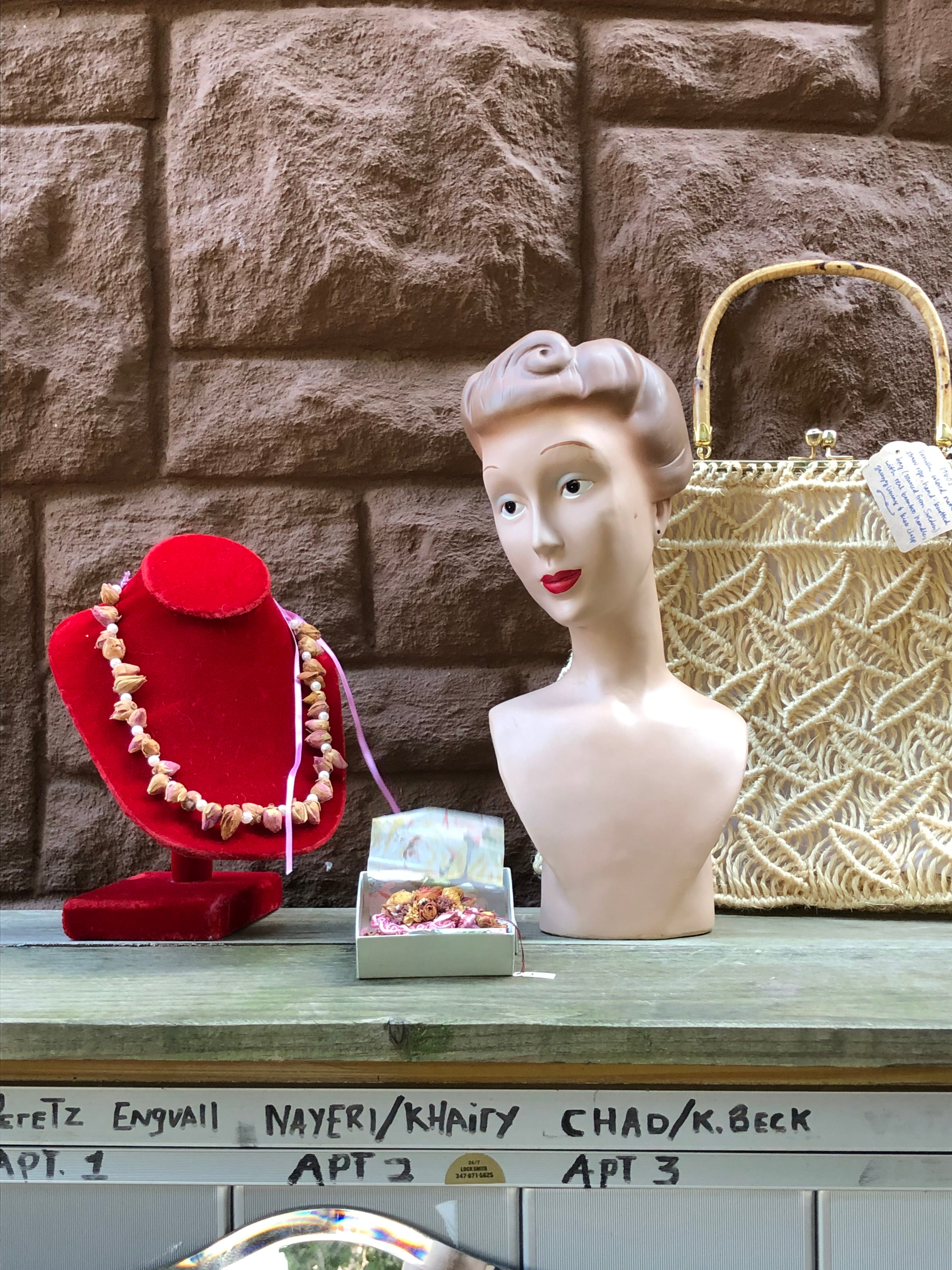
Jess: This is an interesting [jewelry] set. I sometimes am called in to go to a person’s personal space when a loved one has passed away, and the family member is ready to finally let go of the deceased member’s personal items. It’s a very sensitive, beautiful process, and I had gone to this gentleman’s house after his wife died, and she had such an amazing and whimsical sense of style. We went through item by item, and anything that peaked some sentimentality in him I just ignored, and then anything he was absolutely ready to let go of came back with me to the store.
So this a hand-made rosebud necklace, pin, and earring set. You have the whole little pamphlet still inside, copyright 1990, and the entire set is available for $25.
Maggie: How did you get involved in that, going to talk to people who have lost a loved one?
Jess: When I had the brick and mortar there was definitely a lot of interaction with the neighborhood, and this gentleman had come into the store, had kind of noticed that I had a good appreciation for vintage and older things, and so a lot of the time when people are ready to let these things go that once belonged to their deceased loved ones, it really helps them to know that these items aren’t just going to a Salvation Army or Goodwill but are actually kind of being passed on to people who will appreciate them. I think that really helps with the process of letting go.
It’s really tough because you have to be very patient and very sensitive, but it’s really a beautiful thing to be a part of that process, and I was able to do that a couple of times for people.
[END CLIP]
CONCLUSIONMaggie: I wasn’t expecting this episode to end on such a beautiful, poignant note. Letting go can be hard for all of us, but it’s especially tough when you’re letting go of something that once belonged to a deceased loved one. But it’s also a big step for making peace with loss.
That’s it for this week’s episode of Thrift: What Your Garage Sale Says About You. You can find this week’s guest Jess Master on Instagram @missmasterscloset, where you’ll also find a link to her eBay store. As for me, you can find the podcast on Facebook and Instagram at the handle @thriftpodcast, and on Twitter @Thrift_Pod. You can also drop me a line at hello@thriftpodcast.com, and please don’t forget to check out my online store.
You’ve all be wonderful. Thanks for listening.
OUTRO
[10 seconds]