This morning I highlight another case where the 30-30 rule adhered to by both National and Labour means infrastructure growth can’t keep up with population growth. In essence, despite the claim over the years by MPs, Mayors and councillors, growth doesn’t pay for growth.
Elsewhere in the news this morning: more MPs are exposed for taking accommodation allowances for living in Wellington, and there’s a striking case of how staffing and infrastructure shortages are crippling the health system. (See more below in my Picks n’ Mixes)
Where growth isn’t paying for growth
Today I wanted to focus on the idea that growth pays for growth. You may have heard this phrase used, particularly in council meetings and around the discussion of how we deal with the growth of our population and in particular the growth of housing. A home can’t be built until there are water networks underneath it, and they’re expensive.
You have to build not only the pipes and the interconnectors to the rest of the network, but you often need to build brand new sewage treatment plants. And as we’ve seen, particularly in Wellington and in Christchurch, these things don’t often work and need to be maintained regularly and upgraded.
Before 1990, a lot of these networks were funded by councils and by the government through debt. This is plain old government debt. The government or a council would borrow overseas or locally and service the debt from taxes and rates.
That means a developer wouldn’t necessarily have to pay a huge development charge to connect to that network. And the networks grew as fast as the population grew, particularly through the 40s, 50s, and 60s. You could argue it was easier then because there was more easily available space on the edges of cities and people were comfortable living in standalone houses on reasonably large sections, and it was easier to jump in the car and commute away.
That’s obviously more difficult now and certainly more expensive. And since the 1990s, governments and councils have argued that it shouldn’t be the taxpayer that pays for growth, it should be whoever buys that marginal new house. And often that is restricted because every time a developer has to pay a larger charge, that makes it more difficult to build a new house or build a new subdivision.
The numbers get much larger, particularly when you start talking about large-scale subdivisions. The upfront costs are very high, and various attempts to try to create financial vehicles just haven’t worked.
I wanted to focus on a particular story that came out in The Press in Christchurch on Saturday, which illustrates this problem and shows how growth doesn’t pay for growth within the current system of the 30-30 rule, which restricts government borrowing to no more than around 30 percent of GDP and restricts central government spending to no more than around 30 percent of GDP. You can’t build all this extra water infrastructure for all these extra people and maintain it unless you’re able to allow the state to have a higher share of GDP.
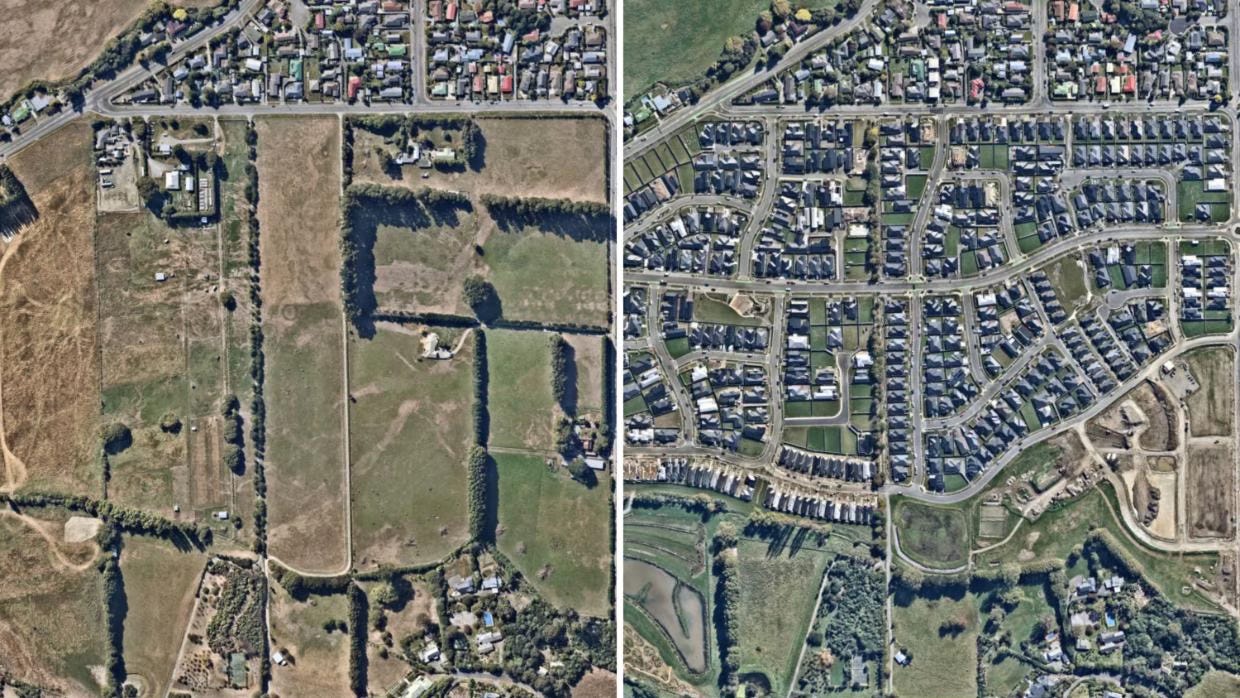
I wanted to point you to what’s going on on the fringes of Christchurch particularly in the Selwyn District Council and around the area of Hallswell. Increasingly, those sections are getting quite small, and the houses are taking up a larger chunk of them. And that’s because buyers want as much land as they possibly can, but can only afford a certain amount. And that really packs in a lot of people into a small space, which of course means you have to really beef up your order networks.
Christchurch sprawls
So you can see that how Christchurch has sprawled out. This is partly because of the earthquake. There was a real drive to develop new suburbs, build new houses to replace the ones that were broken, if you like. And Christchurch has increasingly seen its ability to build lots of new houses fast as a competitive advantage to pulling people into the the region. And that certainly helped. It helped because it was it was it was helped by the government effectively paying for the and underwriting the redevelopment of water networks across Christchurch after the earthquake.
That broke the normal 30-30 rules and of course the effective suspension of the Resource Management Act in many of those areas. But it’s meant there’s been very strong growth in the number of houses. It means now the growth isn’t paying for that growth.
Mike Blackburn, a consultant who deals with the building sector in Christchurch, is quoted in Th Press on Saturday as hearing from builders that they are being told by the Selwyn District Council and Selwyn Water that there’s now no more space for new developments in and around Christchurch because they don’t have the water network and treatment.
He’s spoken to 15 builders that have confirmed the same thing. They’ve been told by Selwyn Water that there are capacity restrictions, particularly in the east of the district.
Selwyn District Council’s executive director for planning and building, Robert Love says that Selwyn’s growth has been among the fastest in the country. This has put enormous pressure on infrastructure. And that as he points out is in large part because the government has intervened to force councils to open up areas/
They’ve been fast track tracking, but the government isn’t providing additional funding for the extra investment. So the 30-30 rule, is stopping these new houses from being built.
Government won’t share fruits of growth
The larger problem, of course, is that the government benefits from the extra population growth through income and GST receipts, but doesn’t pass that on to councils. But councils are the ones who have to pay at least half of the infrastructure costs for population growth but aren’t given the funding for it and are restricted in their growth of debt.
That’s because the local government funding agency is owned by the Crown Government. And so, in effect, that 30-30 rule applies not just to the government but to councils.
My Picks n’ Mixes
Today’s Top Six Scoops and Breaking News
* Chris Knox for NZ Herald-$: MP Housing Perks: See how the number of MPs claiming the full allowance has skyrocketed
* Michael Morrah for NZ Herald: ‘Standing room only’: Nurse describes worst day in 18 years at Waikato ED
* Andrea Vance for The Post-$: Climate activist Mike Smith takes Government to court over bid to halt landmark lawsuit
* Tom Pullar-Strecker for The Post-$: Deadline on future of Clean Vehicle Standard looks set to quietly come and go
* Tom Hunt for The Post-$: ‘Withered on the vine’: New water entity spends as promised users’ group fades
* Kate Newton for RNZ: The big switch: Electrifying NZ homes could save billions
Today’s Top Six Deep-dives
* Emily Simpson for 1News: ‘The cost of living in NZ is so high, we can’t afford children’House and food prices led a Wellington woman and her American husband to make some tough decisions.
* Mildred Armah for Stuff: ‘It’s gonna be a death sentence’: The 16-year-old New Zealand says is too sick to stay
* Isaac Davison for Stuff: What is TOP? A left-wing party in disguise, pure hype, or something else?
* Janika Ter Allen for Stuff: Will Labour cancel ‘tax breaks for landlords’? Here’s what it could mean for rents and house prices
Cartoon of the day: ‘You, sunshine’
Ka kite anō
Bernard