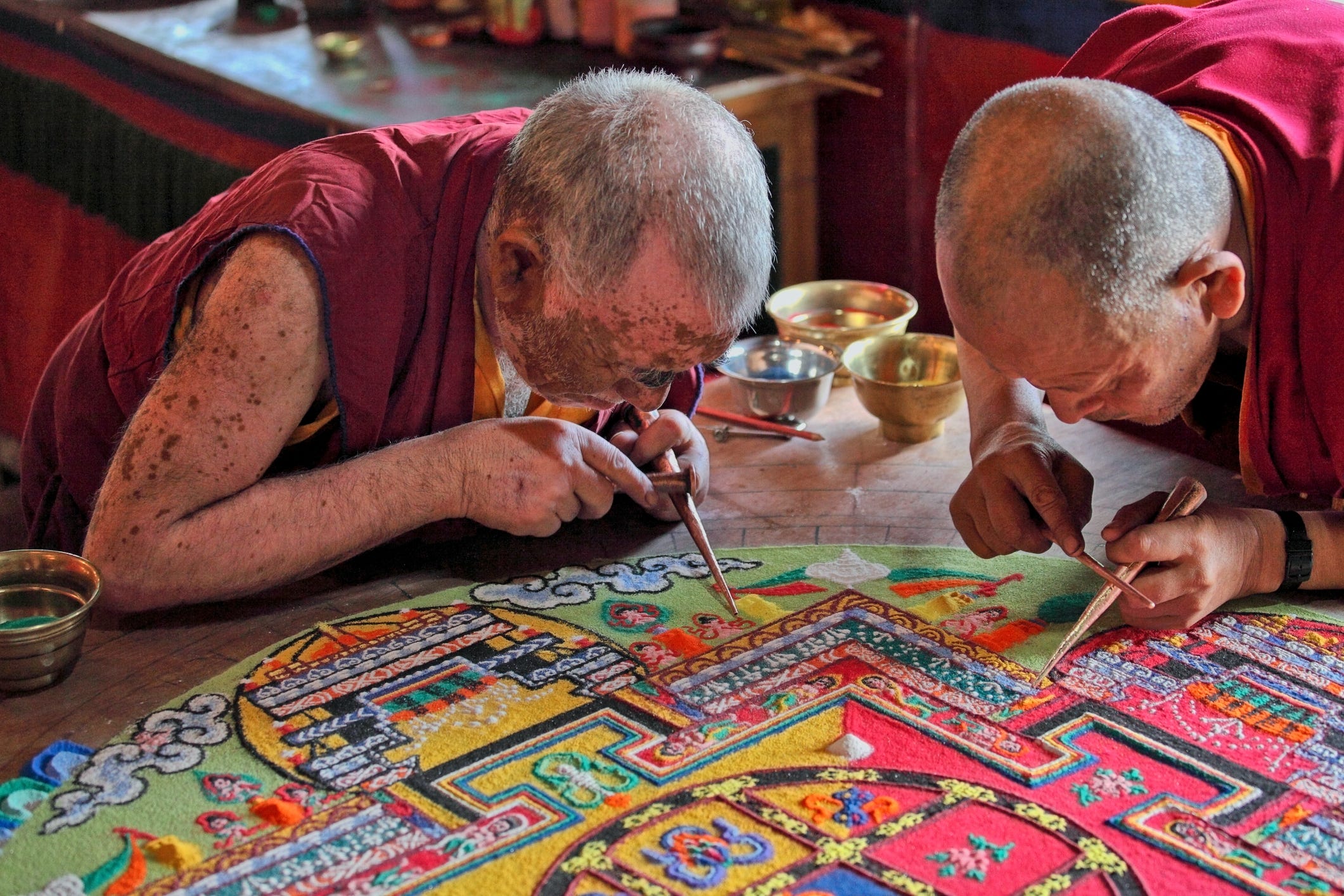
Most of us have witnessed, in person or by video, how some monks work for days or weeks to create detailed mandalas from colored sand and then sweep them away. They’re demonstrating, for their own practice and for ours, the concept of impermanence. If you’ve seen the sand-mandala practice on YouTube, you’ve benefited from the impermanence of technology. More than 200 years ago, even still photography didn’t exist, let alone the ability to stream videos to our smartwatches.
Artificial intelligence is a brush sweeping through our comfort level with technologies. Chatbots writing college essays. Images and videos so realistic the average watcher can't tell they're fake. AI voices that sound exactly like your favorite celebrity. I’ve even created a clone of my voice that’s pretty close to the real thing. You’re hearing it if you’re listening to this post...
Fighting against impermanence, Buddhism teaches, is like trying to hold water in your fist. The tighter you squeeze, the faster it escapes. The suffering comes not from change itself, but from our desperate attempts to stop it...
AI voices and images raise real concerns. Deepfakes can be used for harassment or disinformation. AI art might impact illustrators' livelihoods. Some beings will feel the arrow of pain because of AI. That arrow can’t be avoided. Fretting over the existence of AI adds a second arrow that diverts us from channeling the first arrow toward the outcomes we prefer...
If you’ve read many of my blog posts, you’ll know that I’ve been enthusiastically grappling with ways to learn about AI and ways to adapt it for my mission: spreading whatever wisdom I can offer to help relieve suffering. That led to this post, which I offer as an example of putting AI to work for me, not to replace me.
I gave Claude Opus 4.1 an assignment as I might have given a human research assistant in the days when I had one. I told it to reseaerch and write an informal essay of not more than 1,200 words using Buddhist concepts like impermanence to help people put in a historic context their worries about AI. That took Claude a minute or two. It would have taken a human researcher a day or two.
Then I did what I’d do with a draft from a trusted researcher. I rewrote it from my perspective for From the Pure Land readers, edited it, found a suitable photograph on iStock and downloaded it, ran it through ElevenLabs to create a recording in my cloned voice, and published the result. That took four or five hours. You can read Claude’s draft here.
So, I published this blog post and accompanying podcast the same day as I woke up with the idea. It would have taken several the old-fashioned way. And what’s left of my ego won’t prevent me from saying the result is better than if I had done it on my own. Among other things, the idea to begin with monks creating and destroying a mandala came from Claude’s imagination, if AIs can be said to have one.