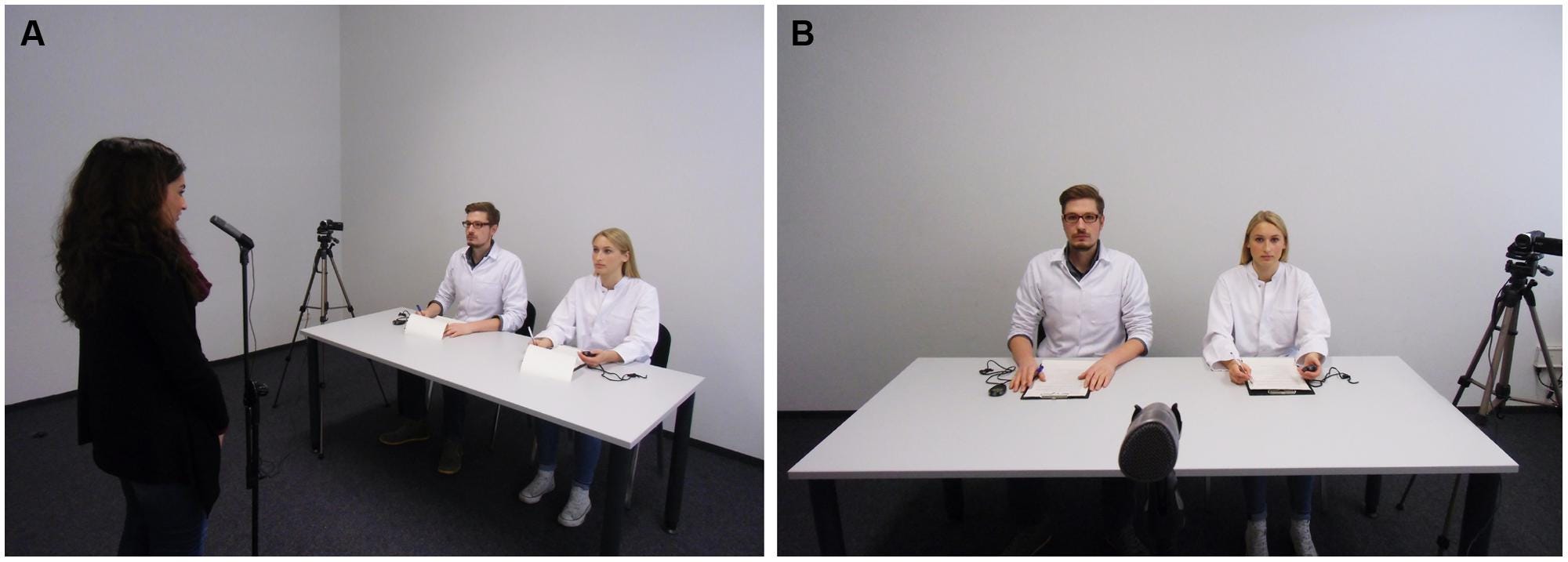
The Trier Social Stress Test (TSST) is every socially-anxious person’s individual purgatory. Used to assess the physiological and psychological stress responses in humans, participants are tasked with delivering a speech to a group of evaluators about their strengths relating to a job opportunity. Immediately following delivery of their speech, they’re made to perform impromptu math problems in front of the same group of evaluators. The catch, though? The evaluators were heavily trained to maintain an aloof, borderline irritable disposition, and were instructed to convey their surliness through noticeable sighing during speaking, replete with occasional remarks as to how poorly a participant was performing. During the surprise math task, a task like counting quickly backwards from 1022 in intervals of 13, the panel of “judges” (who, again, are the trained confederates in the study) said things to participants like, “That’s wrong, you need to start over”, or “You’re going too slow.” This was the only form of “feedback” delivered.
While the presence of an audience for any task seems to induce a psychobiological stress response in most any human, it’s important we remember that events in and of themselves are not stressful. Epictetus reminds us, “What really frightens and dismays us is not external events themselves, but the way in which we think about them. It is not things that disturb us.” This certainly rang true when I began my path toward complete abstinence from benzodiazepines. I misattributed every physiological felt-sense to that of a panic attack, even when the physiological changes were normal and expected ebbs and flows of the human body. The slightest flutter of my heart or even an off-kilter flickering of an overhead light signaled to my brain that a panic attack was festering, and that my only resource to manage this discomfort was a fat dose of Klonopin. It took years (nearly 15, to be exact) to rewire my brain toward a more functional understanding of how “fear of fear” actually works--- and what the human mind can handle if you just allow it to show you, without the crutches.
Thanks for reading honestly unorthodox.! Subscribe for free to receive new posts and support my work.
We’ve been taught from young ages, through modeling via our own parents or in “social emotional” lessons during school, that stress is a potent entity which warrants robust intervention should we hope to manage it. Pharmaceutical ads reveal man’s greatest weakness: our unwillingness to tolerate discomfort of any variety. It is no wonder, then, that Klonopin and other benzodiazepines (the most common and well-known being Xanax) are quickly rising to the notoriety of opioids, with some even claiming benzos to be the “new opioid epidemic”.
The modern method to “stress management” sends a clear message to consumers: stress is threatening, even damaging, and you must rid yourself of its iron grip. There is little mention of an alternative to this swift elimination of feeling, or that the feeling itself is not, in fact, dangerous. To again cite advertisements and mainstream media, stress is referenced as “the ultimate silent killer” and a leading cause of death, trailing close behind heart disease and cancer.
This messaging, to me, misses the mark. And I’m not only referring to pharmaceutical ads, but to the entire language orbiting the American concept of “stress”. It’s ever more urgent that we reappraise our perceptions to those more adaptive and functional should we hope to reclaim resilience in ourselves and our youth. The victimhood mindset, now widely acknowledged as maladaptive and destructive to personal growth, had its rightful days across headlines, but I fear we’re failing to teach others to actively revalue their own capacities for coping. More important than the situational factors which “stress us out” are our beliefs around our resourcefulness, our strength, and our ability to deal with stress. Sure, the identitarian games that are the victim Olympics are profoundly hurtful to emotional development. But elimination of the games without a strong replacement framework will leave people ripe for another damaging mental health trend. The beliefs have to change, not just the words or the circumstances.
To further bring context to the importance of our beliefs, we revisit the hell that was the TSST. The test was used as a baseline assessment for individuals with Social Anxiety Disorder (SAD). All participants with SAD were clinically diagnosed as having the disorder based on a psychological evaluation conducted by a trained professional, and they were chosen specifically because of their sharp aversion to social judgement. In the study, as is the case in most psychological studies, there were multiple treatment groups: a control group, and two groups each given their own intervention.
One of the intervention groups was told to ignore their anxiety and behave as if it were not affecting them negatively---or at all. No further explanation was provided after this instruction. The other intervention group was given a “mindset protocol”. The protocol was simple: embrace the stress. Stress, while uncomfortable, researchers informed them, and I’m paraphrasing, is not harmful, and it’s imperative we remember this when we feel the urge to discharge ourselves of it. Not only will it not hurt us or even our performance, but it may enhance our focus and our attention. Participants in the mindset protocol were essentially primed to respond differently to sensations they had long-since considered warning shots.
The researchers proceeded to explain the phenomenon further, and again I’m paraphrasing: “In this sense, any of the physiological sensations that arise from stress are subtle reminders that your body is preparing for peak performance.”To marvel at the human body and its abilities, and to value the spectacle that is the mind-body connection, participants re-committed to completing the TSST, replete with a new attitude and demeanor. Not only did their “fight or flight response” transform into a “challenge” response (analyzed via samples of cortisol in their saliva that was collected throughout the experiment), their performance was graded by outsiders as exuding confidence and self-assuredness. Nobody knew they had Social Anxiety Disorder. They actually showed fewer symptoms of social anxiety than individuals in the control group, who did not report any clinical diagnoses at the outset of the study. This study stands as a powerful counter to those who believe simple interventions are only for those with mild symptoms or problems. Perhaps the complexity of treatment and the medicalization of common sense is just another belief we’ve adopted without thoroughly analyzing its reliability.
Further, what does this study say about our mind’s stupefying power in altering our physiology? If you’re unconvinced, allow me to demonstrate this miracle with a closer-to-home example than the TSST. Imagine you’re in your kitchen cooking dinner for your family. You rifle through a junk drawer of degraded cooking tools and grab a flimsy, overused oven mitt to retrieve the Dutch oven from the stove. In a slurry of obscenities and squeals, you yank your hand back from the handle. It was hot! Hotter than you thought, especially since you’re at least somewhat protected by the oven mitt. Your body detected threat, and your mind quickly informed your brain and, in turn, your hand to recoil. Ouch.
Now imagine you’re carrying this Dutch oven of shredded beef and garlic potatoes about 15 feet to your dining room table, where 12 hungry guests are now fixed upon what you’re carrying toward them. “Oh my god, that smells sooooo good!” they coo, eyes anchored to the bubbling pot of delicious heat. You feel the handles burning your hands through the tattered threads of the mitts, although the context is different; we’ve added the factor that are several sets of anticipatory eyes and stomachs. Similar to the TSST, they serve as the stimulus which induces a set of psychobiological stress. Because people are relying on you, you’re able to dial down the yank-and-scream response to that of moving fast and holding on for dear life despite the burning. How? Context and reappraisal of your beliefs. To reiterate: you’d be surprised what you’re able to tolerate.
One of the most frequent questions I’m asked is how to better handle criticism, negative feedback, or any adversarial exchange. I do understand the compulsion to reduce the suffering that comes with hearing about how much you suck, but it’s important we realize this is the wrong question to ask--- and it acts to preserve our insecurities. Any time we make a concerted effort to rid ourselves of suffering, we’re relinquishing our control to that very thing, be it a person, an ideology, an idea. The question is not how to suffer less, it is how to suffer better. And if you’ve been a reader since the beginning, you know I’m a major proponent of “baptism by fire”: get out there and share your ideas. I shared this in my last piece! If a clinically socially anxious person can find it within them to stand convicted despite fear, you can too.
Thanks for reading honestly unorthodox.! Subscribe for free to receive new posts and support my work.