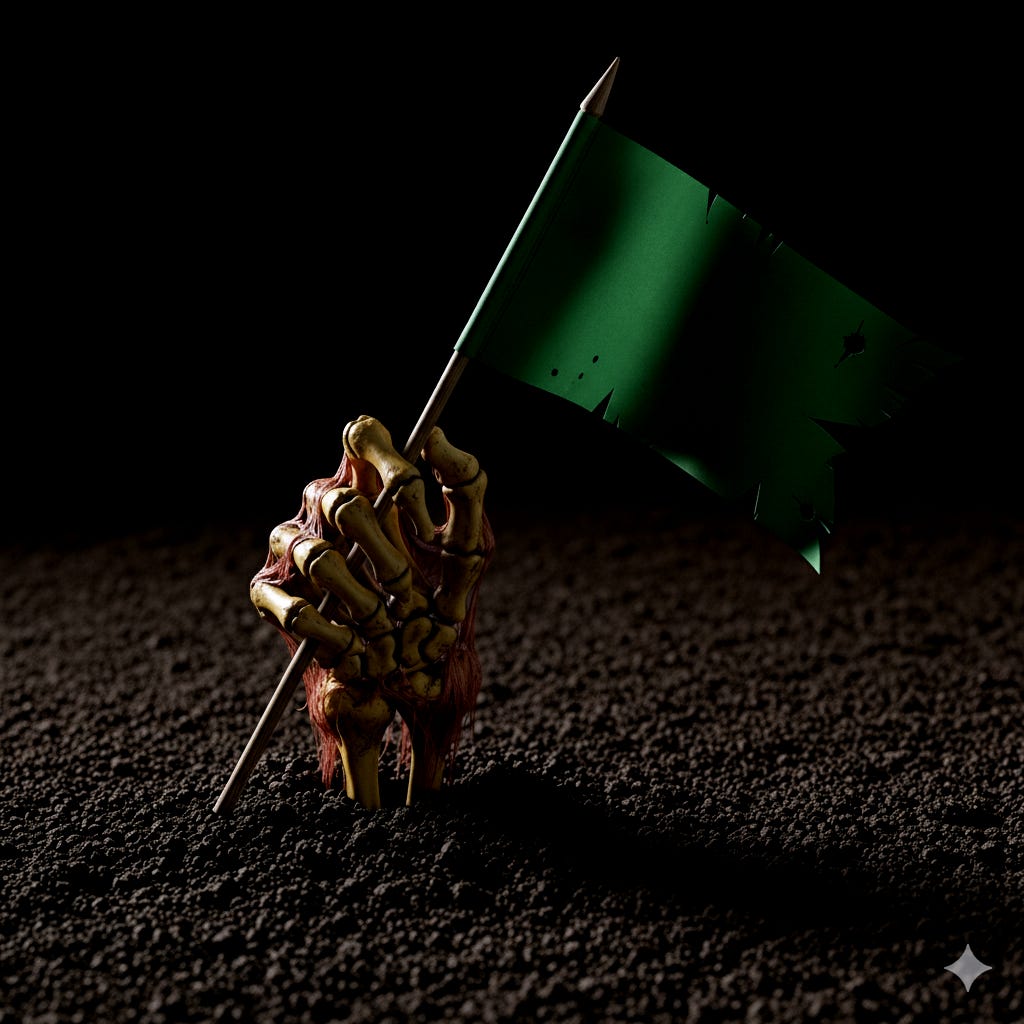
Railing against red flags sterilizes life to that of the Stepford Wives.
Humans are irrational, contradictory, unsound oddballs. And that’s the entire point. Social exchanges aren’t draining because our “social battery is low”, or because people are hyper-sensitive to offense, or even because every person we speak with claims to be a thought leader parroting the doctrine of whatever religion they’ve deified. Conversation is exhausting because it come pre-digested and scripted, making for humorless relationships and predictable exchanges devoid of substance. As I mentioned in my previous piece, nothing can just “suck” anymore; it must be reframed as a teachable moment which imbues our understanding of the world in a positive way, like the individual who must find inspiration in their envy of another, or the woman who is tasked with rising above the supposed-non-tragedy that is her mental illness. It’s a distraction from truth.
Thanks for reading honestly unorthodox.! Subscribe for free to receive new posts and support my work.
At the core of intriguing conversation is an uncertainty about what will be brought to light--- and in what way that will influence our experience of it all. In the spirit of radical honesty, I have a bit of a kink for debate because of its unpredictability. I do tend to have a bit of a high threshold for “friction” or stimulation, which can make most conversations feel boring or overly routine. Ah yes, it’s great to meet you, too, and wow, you love your job because you feel like you’re making a difference and that’s lovely, how wonderful that you’re supported in your healing journey toward self-improvement; so what’s your stance on euthanizing an unwanted animal versus keeping it in a chaotic, miserable shelter, or if it’s ethical to keep someone alive on machines without their “consent”, or if any of us are hardwired for monogamy?
I somewhat understand the compulsion that is purging all “problematic” behavior. But, as I’ve spoken about tirelessly: resilience, purpose, and safety come not from eliminating risk, but navigating it. And finding dealbreakers in every “red flag”, which are mostly just displays of basic humanity? I can’t imagine the outcome being fruitful.
"I never did give anybody hell. I just told the truth and they thought it was hell.”
Reality can feel hellish should another person violate our version of it. I think my boss is rude and lacks tact, she thinks she’s being straightforward and honest just like I asked, I say yeah but you can be straightforward and honest while also being tactful, she says that’s exactly what I’m doing so what’s the problem. We’re not having an argument of factual reality, but a conflict of judgment. Aside from basic physics and mathematics, which most sane people can agree upon as being “reality”, much of human experience is that of perception versus truth.
We interpret events through Lens A, for example, and take this version not as a personal account, but as The Truth. “Nobody ever helps me”, “This is literally the worst day ever”, “You’re a racist.” These statements are “valid” and even “truthful” only in the sense that they’re internal weather forecasts of the person speaking them. As the human brain would have it, though, our forecast may not align with the “true” events of the external world. Such is the purpose of entities like juries or peer reviewers or boards of editors. I’ll demonstrate these varied interpretations using a little experiment below.
In the following sentences, one word will be italicized. The italicized word will be the one that is emphasized for effect when reading each sentence aloud. After you read the sentence aloud, explain what is being implied.
1. I didn’t hit my boss.
2. I didn’t hit my boss.
3. I didn’t hit my boss.
4. I didn’t hit my boss.
It’s easy to see how tones, cadence of speech, and overall delivery can contort a message.
To continue on with the “Lens A” example, those who identify more with Lens B share common ground with Lens A-ers in that they believe their personal account is truthful. What feels real to them must feel equally real to everyone else, right? Wrong.
Something can feel accurate without actually being accurate. I will allow Christopher Hitchens to remind us, “Anything that can be asserted without evidence can be dismissed without evidence.” Further, the burden of proof will reliably fall on the person making the claim--- as it should. It unequivocally demands the person with the flapping lips take the higher ground and support their beliefs with something other than, “I just feel like.”.
Radical honesty is a useful hedge against such misunderstanding-induced rage, rage which comes from banter like the scenarios outlined above. “You’re not listening to me” becomes “I feel like I’m not being heard”. “That’s just the way I am” becomes “It’s become a bit of a habit to do X.” Subtle shifts in language recast us from miserable martyr to that of liberated-person-with-the-humility-to-see-themselves-clearly. Understanding that others are not obligated to see our perspectives as we do makes life not only easier, at least in the wrong run--- but richer.
Blindness is a fiction novel by Jose Saramago, one which tells the story of a society suddenly infected with an epidemic of blindness. One by one, civilians lose their sight. All but the main character’s wife are infected by this elusive, unknown pathogen, painting her character as that of a moral voice of reason. Because she can see, her blind counterparts understand her as threatening, similar to the plot of The Allegory of the Cave. Perhaps they’re fearful not of darkness or lapse in vision, but of the uncertainty which grips a person stripped of their senses, of their comforts, of their “green flags”. Her reality is a “red flag” because it deviates too far from what they think they know.
The novel goes on to describe this society rapidly devolving into savagery akin to the boys in Lord of the Flies. When a people are stripped of their vision, they’re apparently stripped of order. When authority and order are absent, it’s scary how easily civilization breaks down to primal instincts, violence, and fractured morality. While vision loss was the plague which contributed to such cruel acts as starving, raping and physically assaulting people, the true pandemic was that of an unwillingness to see what was directly in front of each character. Their lives, at least their perception of it until that point, was a fragile veneer quickly shattered the moment a society is no longer being observed. We’d all be shocked at how quickly we abandon basic kindness and humanity should we feel threatened. And that being so self-absorbed is its own form of blindness.
It resonated so strongly with what I write so often about that I had to find a way to integrate it into my idea of neurotic overinvestment in green-flag hunting.
People and relationships are not checklists. What kind of depth can exist in a partnership if it’s maintained by proof-checking and emotional surveillance? How can we expect to build competence in any skill if we’ve only ever filtered for those environments or pursuits which we’ve labeled as safe?
It’s entirely possible for a person to make a terrible employee but a wonderful friend. A wicked individual can still generate thoughtful ideas. “Good” people, by all societal standards of that which is “good”, can commit atrocious acts of hatred, or demonstrate any of the checklist items that are “red flags”.
It isn’t about spotting every green flag and clinging to it like a life raft. It’s about being a person of virtue who doesn’t need to hoard them in the first place.
Thanks for reading honestly unorthodox.! Subscribe for free to receive new posts and support my work.