*THERE ARE SPOILERS IN THIS PIECE, SO IF YOU PLAN TO WATCH BLACK RABBIT, SAVE THIS FOR WHEN YOU’RE DONE!
It was a weeknight when my family wedged ourselves into the car to pick up my brother from jail.
Thanks for reading honestly unorthodox.! Subscribe for free to receive new posts and support my work.
Conner had served for just under a year for reasons I still don’t quite understand. He’d been caught stealing on multiple occasions, all of which were attempts to supply his then-heroin-and-every-substance-known-to-man addiction. By the time Conner was sent to the pen, he’d already been addicted to heroin for several years, and this involuntary traverse from home would be his first stint in jail.
Cook County Jail occupies what’s known as a dangerous, sketchy section of Chicago, and is notorious for overcrowding and squalor. Up until the day of Conner’s discharge, we had visited him a handful of times, with my Mom being the only one willing to make the weekly trip throughout the course of his term. We’d heard that morning that it was Conner’s “official” day of discharge; we agonized for nearly 12 hours for his paperwork to process and we were given the green light to pick him up.
Our car lurched into the jail’s main entrance, our eyes hopelessly scanning each gate until we found Conner pacing under a streetlight. There was something about his gait, an unease to his steps, that signaled some kind of desperation. And it wasn’t the anticipation of leaving the prison’s walls behind him to re-integrate back into his unsettled, everyday life; it was something… else. It was as if the old Conner had been stretched and strained, and his new place in the world just didn’t fit correctly.
It was obvious when Conner was high on heroin, on his custom cocktail of speed and booze and Walgreens cough medicine; this restless dance under the stoplight was not intoxication. Spotting our car, he picked up a jog, flinging the back door open to load himself beside me. I was scared to look at him, but immediately noticed out of my periphery his hands trembling.
“We need to get out of here, like, right now. There’s people I know around here and I don’t have my knife.”
These were our welcoming words from Conner. Of course they were; nothing could ever be normal with him, with us. As a unit, the Perrys have functioned as each other’s tangled roots: feeding and choking each other at the same time. Dependency and resentment are closely intertwined with our expressions of love and stability- they’re life-giving and constraining, all in a single breath.
Following Conner’s warm greeting, in typical Perry fashion, we obeyed his request to flee Cook County’s staggering gates. By this point, we’d rehearsed our responses to Conner’s fuck-ups. I’m unsure how other families have managed “Welcome Home From Jail!” or “Congrats On Graduating Rehab!” get-togethers, but I’m sure the Perrys have mastered the craft that is compelled indifference, the kind which bypasses the niceties and profound reflections and instead anticipates whatever difficulties lie ahead. Maybe we’re just desensitized to these sorts of challenges.
With the same nonchalance as driving back from Target, we made our way back to the suburbs to endure what would become a completely hellish few years until Conner died. We stopped asking questions, as we frankly had heard enough. Conner earned his 3-month sobriety chip only to celebrate with a handle of vodka and a full syringe of black-tar-heroin. He’d call me and only me, his personal confessional, to atone for his sinful but very predictable behavior, to which I’d listen, wondering when the next fault would kill him.
I couldn’t fathom sharing this with my parents, but a thought tugged at me in the years leading up to Conner’s death: that we’d be better off as a family if he died. The bottomless worry that is caring for an addict, the kind which forms a rust over what once was your beating heart, ends in death more often than not. And Conner wouldn’t even be the victim in it all. He’d have evaded the worst possible outcome the way he always found a way to, leaving my family and I to spend our time mining our own grief.
When does loyalty to our family warp into enabling, when love becomes blindness?
Modern advice reminds us to turn relationships into number figures easily plugged into formulas, as if doing so guarantees frictionless relationships. Cut off “toxic” people, they say, and ghost any exchange which fails to meet the criteria for “vibes”. This advice is especially appealing in pop-psychology and self-help circles, despite typical relationships, particularly familial bonds, failing to fit into the framework. Although my family deviates pretty far from the norm, all families are fucked up--- and few problems are solved by such simple means as severing ties.
Netflix’s Black Rabbit portrays siblings, in particular, as dysfunctional, as flawed and nonsensically enmeshed, forever tied and with an unwritten duty to protect one another, even at great personal cost. This is what it means to love another person, whether that be familial or romantic. You can’t always “protect your peace”, and your problems inevitably weave themselves together.
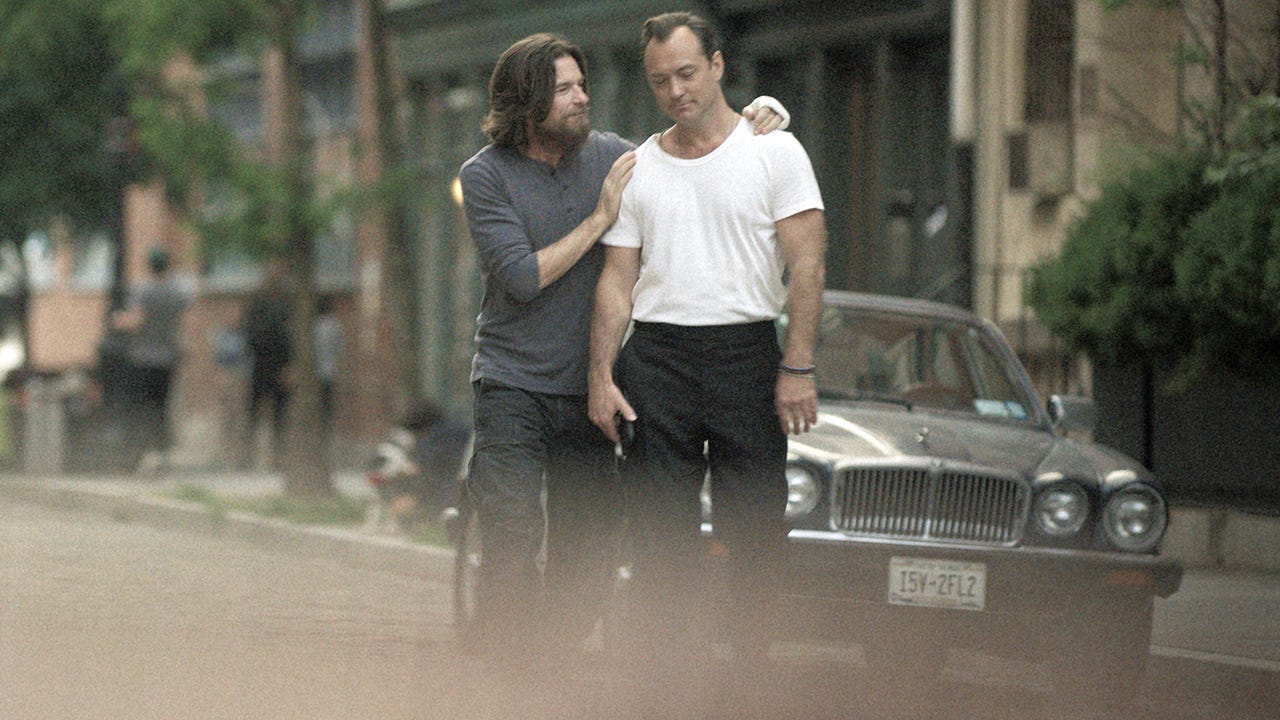
In Black Rabbit, Jason Bateman’s ‘Vince’ is the Freidken family’s permanent crisis. In and out of the life of Jake, his brother played by Jude Law, Vince has managed to destroy the family restaurant business through gambling, running with local organized criminals, and abandoning his now-grown daughter. When Vince re-enters Jake’s life after what we assume is an extensive time away, he returns with $140,000 in gambling and loan shark debt, forcing Jake and the Black Rabbit to absorb the cost. The Black Rabbit becomes collateral in Vince’s debt. Like many brothers would do, Jake strains to shield Vince from harm, even at continued personal expense--- he deletes incriminating security camera footage of a rape, lies to law enforcement about a faux-burglary Vince orchestrated, and makes crooked deals with Vince’s loan sharks, only to find himself convincing Vince, “You are not a bad person, and I am not leaving you.” Imagine constructing your life around helping another person, only for them to betray you, betray your faith in them, in humanity, even--- but uplifting them regardless.
In a tear-stricken disclosure, after verbally appointing himself as “a cancer”, Vince tells Jake he was the one who killed their father when they were children, to which Jake softly reassures Vince that he’s known all along. He’s known since he was just a young boy that Vince murdered their abusive father, swearing allegiance to their brotherly bond by not telling a single soul what he’d witnessed---Vince dropping a bowling ball onto his father’s skull, crushing him instantly. The brothers are in their 50’s in this series; I can’t imagine what hauling a decades-long secret does to a person. But Jake is good, almost too good, seeing this stain between them not as a truce, but as his sworn duty as Big Brother. I can relate.
In one of the final scenes, Jake and Vince embrace on the rooftop of the restaurant. Vince is somber. Jake is in tears, but preserves his role as Big Brother by reassuring Vince all is not lost. He wants to slow down, he says, he needs to slow down and start fresh, start anew, this is Vinces chance to take back a life on the straight and narrow. Jake, a decent man with “an addiction to his brother,” begins talking about doing time, together--- they both made bad decisions, Jake says, it wasn’t all Vin’s fault. You live life for the both of us out there, Vince says, I told the cops what I did. You live life for the both of us.
Jake mutters repeatedly that he needs a fresh start, a clean slate; “I should’ve stopped pushing, I should’ve… slowed down”. Vince gently says, “You can now.”
He jumps to his death off of the roof.
Even in death Vince leaves Jake to mitigate the damage, to organize the fragments of his heart now askew before him, to again dirty his hands while Vince fades into the easier matter of course. I occasionally feel this way thinking about Conner’s death. Why did he leave us like that? An accidental Fentanyl overdose in his car, seriously, Conner? What do you expect me to do now with Mom and Dad? I don’t have anybody else. It was just me and Conner. And that fact remained when we went to the crematory and hovered over his dead body. Mom leaned on me while she bawled. Dad gripped me tightly. I did not shed a single tear.
The intricacies of family function in a separate moral order than friendships, co-workers, or even romantic relationships. The modern compulsion to cut family off for reasons wide-ranging, from trivial to quite serious, reduces blood-related obligations down to transactions, down to content, down to crowd-work or skits. I was raised to believe that you cannot just give up on family. You cannot just write siblings off if they’ve transgressed, if they’ve brutalized your boundaries, if they’ve proven themselves undeserving of your patience. Jake found himself convincing his brother he was good, just misguided, just a casualty of shitty hands, much like I supported Conner in understanding himself not as a thief, as a junkie, as a moral failing, but as a person equally worthy of belonging.
Yes, boundaries are necessary. And it’s an imperative skill to be able to not only identify what these boundaries are for ourselves, but enforce them in a manner that’s respectful and reasonable. But family bonds sculpt exceptions and excuses, and they force us to make decisions “when our cup is empty”.
The truest wisdom may not be tidy self-preservation, but the messy choice to love someone even when it hurts.
Thanks for reading honestly unorthodox.! Subscribe for free to receive new posts and support my work.