Hi Friends!
I’m trying something different with this week’s post! A lot of things, in fact.
First, did email-receiversnotice the new banner artwork?! My brilliant friend and incredible artist, Amanda Burnham, did such a great job taking what was in my head and putting it in art form and I just love how it turned out and that you all get to see her work each week!
Second, this week’s post is an interview! And not only that, it is an audio interview. With all of the interviews I’ve been conducting for the book, I was inspired and encouraged by some folks to try my hand at a podcast/audio post format and I’m so happy that Alanna Kieffer was willing to be my inaugural audio issue/Cramming for the Apocalypse podcast guest. You can either listen to the 35-minute interview or read the full (somewhat edited for clarity) transcript below.
Also, a disclaimer: The audio is okay in most parts, but I’m not an audio expert in the least, so some transitions/cuts are a little rough and my intro/outro audio is a bit tinny, so bear with me. As I learn more, refine my skills, and find the time to dive into learning about this stuff, I hope it’ll get better/more professional as we go on, but I know I’m among friends here and you’ll appreciate it nonetheless ;).
In April 2022, I officially launched my research for this book project by taking a clamming class on the Oregon Coast with my friend, Lindsey. In advance of the class, I began to get nervous. It was a really rainy, cold spring in the PNW and I just pictured myself out there in the mud flats, soaking wet and miserable.
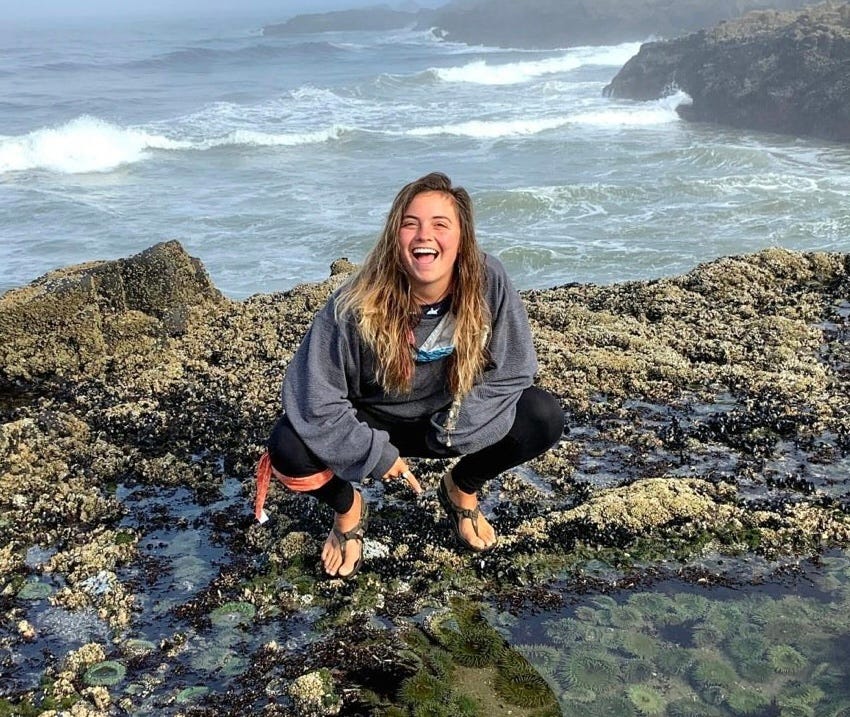
It turned out to be anything but miserable. It was truly an incredible experience, and not just because it was resplendent and sunny. The fun and joy I felt were partially due to the instructor, Alanna Kieffer, who so very clearly had an outsized affection for the ocean and the creatures therein. Her enthusiasm was contagious. And as I approached the year anniversary of launching my immersive research, I thought I’d interview Alanna. And bonus, she agreed to be featured in my inaugural audio issue/podcast episode of Cramming for the Apocalypse.
Elizabeth Doerr: Thank you so much for chatting with! Let’s start by telling me about yourself and your various roles.
Alanna Kieffer: My name is Alanna Kieffer and I wear a lot of hats. But I'm a marine science educator as a whole. I've been working for Oregon seaweed for the past two years. So I'm farming dulse seaweed on the Oregon coast, but also pushing that into communities. So doing a lot of community outreach around seaweed and yeah, just educating people in that world, but on the side do a lot of intertidal for gene and just exploration on my own and have been pretty excited to get involved in that and like more of an educational pulling other people in as well. But yeah, longtime and marine science education.
ED: Tell me a little bit about how you got to where you are today.
AK: It's been a journey. I moved to Oregon about 10 years ago, me and my mom moved from the East Coast to Seaside where I finished high school. I knew forever that I wanted to get involved with marine biology so when we came out here, I immediately started working in intertidal systems. I really knew nothing about the ocean in general. And as a high schooler I was working at an environmental education program down at the base of Haystack Rock in Cannon Beach, which is really focused on protection through education. So in order to teach people about it, I had to learn everything I could, and I really cherish that I was getting this immediate hands-on experience. I wasn't doing anything in the world of academia. But I was in high school spending every day in the intertidal with ID books and with other people who had spent years in this ecosystem and really just learning from there. And I think that sparked my interested. I realized that no matter what I did in marine biology, I needed to be educating people and working on the communication side of things.
So I went to OSU [Oregon State University] and studied marine biology. I went to Australia studied there, and just traveled around and saw different ocean ecosystems. They have warm water coral reefs, which we do not have. I went to Catalina Island, California, and spent two years teaching and working with kids there. It was like a marine science camp where kids would come over from school and do their week-long outdoor Ed camp. We were taking them snorkeling and kayaking and hiking and doing all this like really amazing outdoor adventure stuff it wasn't until COVID that they booted us off the island. So I didn't necessarily choose to come back to the Oregon Coast, but I came back to the Oregon coast.
It just happened to be that this Seaweed Farm [Oregon Seaweed] was being built, which was like a very full-circle dream of mine that I never really expected to happen here in Oregon. I finished helping them build the farm and started working around seaweed. I guess I became this a seaweed salesperson, but it was really just education around seaweed and trying to teach people in the community how to use it, what it is , and why we should be using it.
And then got involved with workshops through WildCraft Studios, which was also just really exciting. I really missed the group education stuff and was happy to jump right back into it.
ED: Tell me a bit about the seaweed journey because one of the things that really stuck out to me when we took the class was how excited you are about seaweed. And I had never heard that seaweed was a potential superfood and could be a solution for sustainable farming and food growing. And so I just want to know where that energy comes from and what excites you about it?
AK: I honestly don't know where it comes from, except that on Catalina Island I was surrounded by kelp forests. My play time in the ocean was diving through kelp. And just being fully immersed in that ecosystem.
I think it's always funny because for people who are in the world of marine biology, you hear about seaweed farming going on. But I realized very quickly that people who are not in that world, it's different. People don't hear about it, nor do they know anything about it. So when I heard that it was going on here, it was through a fisherman who had no idea that I was remotely interested in this. He was kind of like, “This has been like a dream of yours? You know about seaweed farming?”
Oregon Seaweed is the first farm that's popped up here, and it’s picking up steam around the country. I think I was first interested as someone who loves those ecosystems and loves seaweed, in our natural environment, but then to be able to work with it in an industry that's like trying to introduce the general public into it as a food source is also huge.
My whole family works in the food service. So this is a whole other full circle deal where like, you know, my dad owned a restaurant, my mom is a food writer, my brother's now a chef. And so I grew up around food. And now I'm working in the food systems like through the ocean, which is just this whole other track. I just have a general enthusiasm toward anything in the ocean. And I think when it's things that are literally here and helping our planet, and feeding people I can see that there's excitement around it fuels me to keep teaching about it.
ED: Let's talk about the ocean in general and intertidal systems where a lot of your work is involved. For those who aren't involved with the ocean or even have a sense of what an intertidal system is and what the significance of an intertidal system is, can you explain a litt…