Introduction
* Interest in speculation
* Original NewPolity podcast
* Saw mistakes about societas
* Read Aquinas and saw more mistakes
* Discussed with people on Twitter
* Read NewPolity article and started reading citations
Essay
* Four Arguments - ordered by authority
* From Scripture
* From St. John Paul II
* From The Tradition
* From Reason
* From Scripture
A Christian should not own stocks any more than he should pursue individual wealth apart from work in any other area of his life. In 2 Thessalonians, St. Paul recalls:
When we were with you, we gave you this rule: ‘If a man will not work, he shall not eat.’ We hear that some among you are idle. They are not busy; they are busybodies, not doing any work. Now such persons we command and exhort in the Lord Jesus Christ to do their work quietly and to earn their own living.... Take note of those who do not obey what we say in this letter; have nothing to do with them, so that they may be ashamed. (2 Thess 3:10–14)
The Greek word that St. Paul uses, badly translated as “busybodies,” is the participle of περιεργάζομαι (periergazomai). Dictionaries of ancient Greek say this word literally means to “tell others how to buy and sell,”43 or to “bargain, haggle, ‘περὶ τῆς τιμῆς’ ” over, that is, saleable goods in the market.44 If these dictionaries are indeed correct, then the apostle hereby makes plain the Christian orientation toward wealth: a person must engage in productive labor in order to deserve his place in the community.
* Need to read from the tradition and not merely from a dictionary
* First is "busybody" a bad translation
* Chrysostom reading in the Greek tells these men, not to stop trading in the markets, but to be quiet and do their work (https://www.newadvent.org/fathers/23055.htm)
* Oldest Latin Translations - translate as curiose agentes, or curiously meddling
* Aquinas' understanding https://aquinas.cc/la/en/~2Thess.C3.L2.n76
* The precept to work is a precept to care for one's own life
* He admits this can be done through lawful business, which we'll see later includes trading
* Those curiously meddling are those interfering in the affairs of others, namely busybodies
* The idle are condemned because when they have no work, they'll seek unlawful things
* Haydock's commentary is similar citing Chrysostom - https://www.ecatholic2000.com/haydock/ntcomment205.shtml
* Silent Partnerships
* Census Contract
* Purchase a claim against productive property
* Purchaser did not engage in productive labor
* That the purchaser could live off the census without work but approved in spite of this - https://archive.org/details/scholasticanalys0000noon/page/163/mode/1up?view=theater
* Argument from John Paul II
* For John Paul, just because one has a legal claim to a share in a company, and is thus, in some sense, an owner, does not mean that this ownership is just. He categorically denounces pure speculation.[39]
* Two questions
* What does JPII mean by "speculation"?
* Is the condemnation categorical?
* Passages cited:
* These general observations also apply to the role of the State in the economic sector. Economic activity, especially the activity of a market economy, cannot be conducted in an institutional, juridical or political vacuum. On the contrary, it presupposes sure guarantees of individual freedom and private property, as well as a stable currency and efficient public services. Hence the principle task of the State is to guarantee this security, so that those who work and produce can enjoy the fruits of their labours and thus feel encouraged to work efficiently and honestly. The absence of stability, together with the corruption of public officials and the spread of improper sources of growing rich and of easy profits deriving from illegal or purely speculative activities, constitutes one of the chief obstacles to development and to the economic order. (#47)
* Ownership of the means of production, whether in industry or agriculture, is just and legitimate if it serves useful work. It becomes illegitimate, however, when it is not utilized or when it serves to impede the work of others, in an effort to gain a profit which is not the result of the overall expansion of work and the wealth of society, but rather is the result of curbing them or of illicit exploitation, speculation or the breaking of solidarity among working people.87 Ownership of this kind has no justification, and represents an abuse in the sight of God and man. (#43)
* Speculation definition
* In footnote 37, claim that speculation means buying high and selling low
* Because, this is the technical economic definition
* Also, term used in medieval times for usury and unjust trading
* Cites but otherwise ignores the way it is discussed in the Catechism
* speculation in which one contrives to manipulate the price of goods artificially in order to gain an advantage to the detriment of others"
* Problem
* The two passages use different Latin terms for speculation
* There is no reason to assume that JPII is using a technical economic definition is given and none is offered
* In fact elsewhere, he uses "ownership" in a none technical sense when talking about a new form of ownership of skills and knowledge
* Its also not obvious he's using the term "ex questibus faciendas" in its technical medieval meaning either
* Unable to check dictionary since didn't have access
* This was not present in either of Aquinas discussions on usury or trading
* The way speculations is characterized in Catechism seems to fit
* In first, State is to seek the security of the economy and its stability
* This is indeed undermined by manipulating prices to the detriment of others
* In the second, JPII specifically notes using ownership to not use the means of production or impede works
* This could be part of manipulating prices, as we've seen OPEC by reducing production to drive up oil prices
* Conclusion
* We have little reason to believe JPII is using the proposed technical economic definitions
* The Catechism characterization approved by JPII fits
* Is it Categorical?
* In the first, here he discusses activities in so far as they undermine economic stability or development. Even if this is taken as categorical against these sorts of activities, it is not clear that stock trading in itself is part of this
* In the second, he is specifically talking about when the ownership of the means of production is used to stop work or impede laborers
* This is not categorical but under these specific circumstances.
* Even if it is, stock trading is simply and manifestly not part of this activity. Trading stocks does not keep a ship in habor or tear holes in the sails.
* From Essay: But within investments on the stock market, the activity is intransitive; no operation is done to the object and so no dominion, no creative control is expressed over it; and thus he goes even further than Sheen, by stating that this sort of ownership is in itself illegitimate. It is a form of gaining wealth without giving to others.
* Unclear what Jacob and Marc thinks JPII is citing. The "transitive" section is much earlier.
* Seems obvious that JPII is referencing passages such as this: [Means of Production] cannot be possessed against labour, they cannot even be possessed for possession's sake, because the only legitimate title to their possession- whether in the form of private ownerhip or in the form of public or collective ownership-is that they should serve labour, and thus, by serving labour, that they should make possible the achievement of the first principle of this order, namely, the universal destination of goods and the right to common use of them.
* Consistent with the circumstances that JPII is condemning, either not using the means or impeding workers
* From the Tradition
* Here we reach Marc's clarification. I read the original essay too chartiably. My interpretation of Jacob and Marc assumed a possible though implausible misinterpretation of the tradition, but their real position is not only not in the tradition but contradicted by it.
* "The fact that one is able to increase in wealth while not putting in any productive labor to attain that increase—or without dignifying the labor of someone else, leading to an overall increase in productive labor—means that someone, somewhere, is worse off.[41]"
* Two conditions for increasing wealth
* Add productive labor
* Dignify and increase productive labor
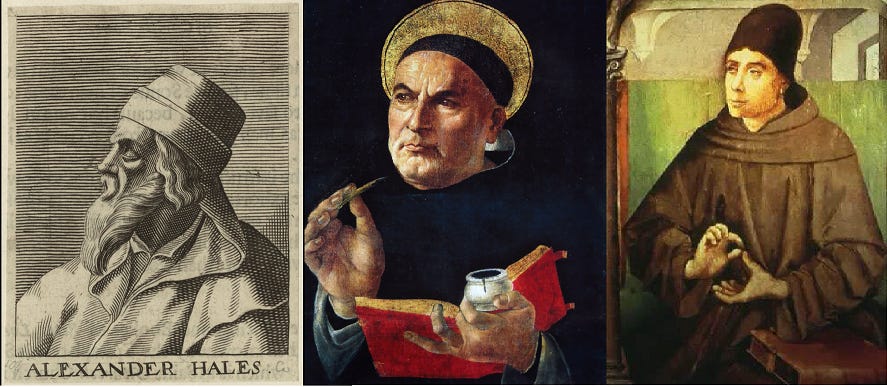
* The tradition cited includes: Pseudo-Chrysostom, Gratian, Cassiodorus, Astesanus, Alexander of hales, and Aquinas
* The second is found in JPII, but not the tradition
* Even in JPII it is far from clear he is proposing a general condition for increasing wealth
* If he was that would put him in conflict with prior Magisterial teaching as we'll see
* The first is only plausibly found in Pseudo-Chrysostom
* "He that buys a thing in order that he may sell it, entire and unchanged, at a profit, is the trader who is cast out of God’s temple." (taken from Aquinas' Summa)
* Here then we may take "productive labor" as bettering the things so that it is not "entire and unchanged."
* First note, Pseudo-Chrysostom is an Arian heretic. The tradition address him, because they think he is the Church Father
* Moreover, as we'll see the tradition interprets this passage in such a way that the requirement of productive labor is removed
* Gratian's passage is merely a quote of Pseudo-Chrysostom that he put in the Decretals
* Cassiodorus is similar to Chrysostom and interpreted similarly as well
* Astesanus - couldn't find a readable copy of his work
* According to secondary sources, he follows Alexander of Hales closely
* Alexander of Hales - Read in the Latin
* On the question of trading, which is buying low in order to sell high
* He says the act is licit, quoting Augustine
* Provides 6 criteria or circumstance where it may not be licit
* Wrong person: clergy
* Wrong time: feast day
* Wrong place: temple or church
* Wrong mode: fraud or deceit
* Wrong cause: avarice
* Wrong association: unclear but seems to be selling at different prices to those passing through
* Comments on Pseudo-Chrysostom
* Focuses on intention of trader
* Seeking profit for good (sustenance of family, provide for poor, etc.) is licit
* Seeking profit for itself is evil
* Include multiple reasons
* Labor: the traveling merchant taking goods from one place to another (notably not "productive" labor)
* Risk: the goods may be lost to fire
* Care: holds the good to sell for the common good
* Comments on Cassiodorus
* Discusses wealthy mean who buy up all the goods (e.g. wheat) causing scarcity
* They then sell back at a profit
* Conclusions
* No discussion of expanding labor, discussing specifically merchants buying and selling
* Says buying low and selling high can be licit
* Explicitly for allows for reasons apart from productive labor, including a traveling merchant, risk and care
* Alexander of Hales stands against Jacob and Marc
* Aquinas - https://aquinas.cc/la/en/~ST.II-II.Q77.A4
* Jacob and Marc oddly do not quote his discussion on trading, but only his commentary on Aristotle discussing trading and usury
* Aquinas is similar to Alexander
* Trading is licit when it is ordered to a virtuous end, such as care of family, or the poor or providing for the common good
* Discussing Pseudo-Chrystotom, he interprets him as referring to those who seek profit for its own sake, which places creature over Creator as one's final end
* He concludes that if the end is virtuous and good, the profits are licit
* In the response to the second objection, he gives several reasons one could licitly profit, among which are changes in the price due to time and place
* No one requires productive labor
* Scotus
* Requires that trading be done for the common good
* Allows for retailer, who buy goods to be sold to the community for a profit (no productive labor)
* Reasons for a profit include labor, risk and care as with Alexander
* None of these authors, nor the following tradition such as Cajetan, Billuart, Liguori
* Strange to wonder where Jacob and Marc even got this idea, since it is contradicted by the very sources they cite
* Logic given by Jacob and Marc
* The shareholder grows in wealth, and so in purchasing capacity, without working, starting businesses, providing jobs, or otherwise improving the world for others. On the one hand, this is a sort of sin of omission: the shareholder does not contribute to the common good. On the other hand, his increased purchasing capacity increases the prices of goods and services in the society in which he is embedded. This can be clearly seen in real estate prices: if he buys houses with the money produced by shareholding, he will raise rents and house prices for his neighbors, without providing them with any social benefit to make up the difference. The fact that one is able to increase in wealth while not putting in any productive labor to attain that increase—or without dignifying the labor of someone else, leading to an overall increase in productive labor—means that someone, somewhere, is worse off.[41]
* Shareholder is blamed for increasing house prices and rents
* Implausible first of all, one house does not move a market
* Blameworthy for a tertiary act by another
* Primary act: sell stock
* Secondary act: buying a house
* Tertiary act: prices go up
* Cuts both ways
* Sells stock, gives to poor/starts business/etc., common good supported
* Support of common good cherry picking
* Exchange in itself supports common good, another can grow his wealth
* Someone is able to sell their house and provide for their own needs
* Ignore the social benefit of company owned
* All else equal, it provides dignifying labor
* It produces goods for society
* If its real value has increased, it has succeeded in this
* The shareholder plausibly falls under the second condition
* Contrary to the Magisterial Approval of Census
* From Reason
* It is difficult to buy or sell stocks in a mutually beneficial exchange—the only way one may licitly earn money. A shareholder sells his shares because he believes that the asset is bad. He may be wrong—but he would not risk it; it is time to get out. He sells to another what he considers to be a liability. Now, the buyer may know more than him—that the company will soon sign a new contract, that its sales will rise, that the impression of the company will duly improve, and thus also the share price. But the seller does not believe this is so; he offloads what he considers to be rotten eggs. The buyer, meanwhile, buys because he thinks the seller is wrong in his assessment. Structurally speaking, both assume that they are getting the better of the other, the seller that the buyer is a dupe, and the buyer the seller is foolish, and so conclude their business in an act of mutual disdain, however impersonal their trading platforms make it.
* An obvious caricature of exchange that could apply to any exchange and so "structurally" all exchange is treating each other as the greater fool
* Two scenarios, you know its worth less or you don't
* In the first case, something like insider trading, you are buying and selling at unjust prices which is categorically evil and selling "rotten eggs"
* In the second, there is risk involved and there may be prudential disagreements
* Even if they agree on the risks, each may have their reasons
* One prefers to get out and pursue other needs or ventures
* The other prefers to get in and grow his wealth
* Bad intentions may be involved about trying to dupe the other, but this isn't "structural" any more than a grocer selling fresh eggs.
* Conclusion
* Argument against buying low and selling high fails in general
* Arguments against stock trading per se also just fail
* There are ways to trade rightly and this is what we ought to aim for