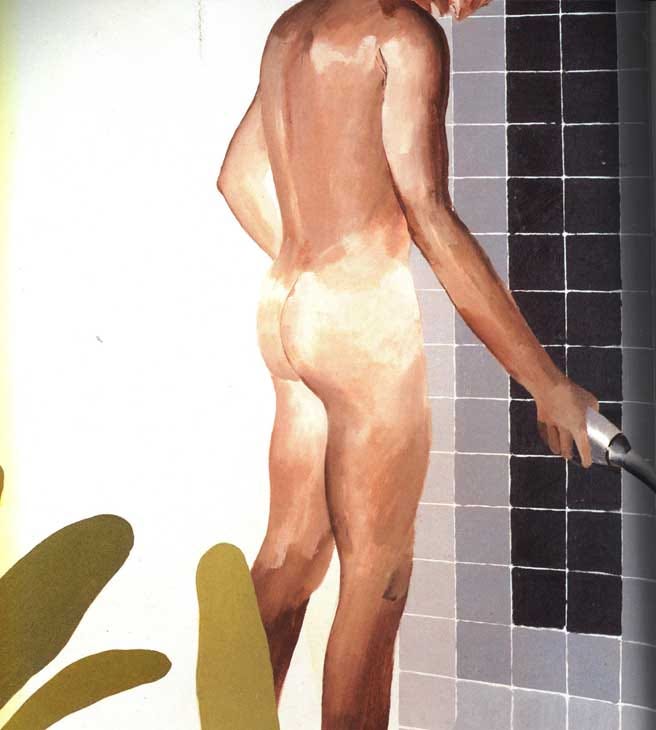
Boy About to Take a Shower (1964) by David Hockney
Content warning: this essay contains a mention of sexual assault.
I was walking to the pool this morning. My gait betrays all the concerns of my mind and body: rigid, or gay-paced, or sloppy-slow as I pass down the wide, palm-lined boulevard that breaks out into a beachside plaza.
I was hot on the tail of two young Americans. Two boys discussing attractive skin. Who can blame them — it's hot, and calves, midriffs, shoulders exposed to the prickling sun raise the sweating spectre of sex, a shimmering ghoul that pants greedily above the beachside neighbourhood, dropping hot beads of perspiration onto all of us. They’re young Americans, why shouldn't they? Skin is a going concern. One remarks to the other on changing trends. Paleness isnt attractive any more. How long ago are we talking, I wonder? They can't be more than 21, 22, and here they remark how darkness is what is attractive now. Can they be for real, I wonder. For real? "But I've never got it" one remarks to the other. "I like white skin". Huh. Now I get it. He clarifies. “Pale girls. I like pale girls too.”
The pool is always refreshingly cold. It is outdoors, and the few palm trees provide more flotsam than shade. I can usually get a lane to myself, or perhaps share on a busy day, and sliding my body in, passing through the muggy atmosphere and being enveloped in the cold water is almost impossibly refreshing. It takes ten lengths before the ticking anxiety disperses into the coolness then I'm there. I'm neither slender, nor graceful, nor particularly muscular like my compatriots in the other lanes, yet as I watch the light crack its watery mosaic against my hands, I am something. Alive. Not just alive, but not degrading.
Peter Getting Out Of Nick’s Pool (1966), David Hockney. Photo: Richard Schmidt; © David Hockney
I'm not like my compatriots, I tell myself. We read onto others the ideologies we imagine from their bodies. How can they not feel anything but complete? And how can they not find us lacking? "I'm not sure all these people understand" a song begins running in my head. "It's not like years ago" Now, I think, I recognise in the power of self-disgust a long-held literacy in disgust in general, an accrual of years of being carefully attuned to what is degrading. A therapist just wants to make sure that I realise that incident outside the changing rooms, the carpet against my cheek, was actually a sexual assault? And what would I say to him now? I tell the empty chair that I am angry but not at him. But really what I want to say is “How can we hold ourselves in self-disgust and not recognise disgust more widely?” I didn’t go back to the changing rooms after that, not for the rest of my time at school or for years afterwards. Michael Stipe continues to sing about "the fear of getting caught / of recklessness and water. They cannot see me naked." It’s funny how bare skin can be such a source of shame, while being such a fuel for desire — the same damn skin. This beautiful skin peels off.
Domestic Scene Los Angeles (1963), David Hockney. © David Hockney
More young men and women arrive by the poolside. My head rises above the water, and I see their skin against the crisp blue canvas of the sky, and I take in breath, and my head falls below the water, and the light caught on the constant ripples moving from one swimming body to the other, clashing, and I blow out. I can’t stand the famous pool paintings of David Hockney. Well, that’s not true. But I find them impossibly sad. And a stark warning on degrading dreams. The deep, elevated passion of Hockney’s work in the early sixties — the pages ripped from athletic magazines, the boys together clinging combined with his rising fame made the move to California a smart one. In his first paintings there, Domestic Scene, Los Angeles,or Boy About to Take A Shower, you can still feel the enormous sense of utopian, Californian hope in the sunlight and the water, a brightness that screams thank god, anything but England. They retain what was so exciting about his early work — the instant, the capture of an impassioned hope in even the fleeting desires, the asses. Yet as his relationship with his lover Peter Schlesinger breaks down (a heartbreaking process caught by Peter Hazan in his 1974 documentary “A Bigger Splash”) his work drifts back into a technically precise beauty of light on water on skin. To me, the pain is palpable in these stiff studies of homo desire, like each one was made through gritted teeth in an attempt to recapture a sense of wanting that is simply out of stock. Paintings of asses wanted to be fucked, driven by provincial expectation that some perfect want is achievable, have dissolved in the acid reflux of heartbreak. “Pool with Two Figures”, produced during the breakdown of his relationship, seems to me (and maybe I’m wrong) as a portrait of, although not necessarily inspired by, disgust.
Hockney painting Portrait of an Artist (Pool with Two Figures) in the film A Bigger Splash
I’m not dirty, but some people are unreasonably neat. Their upholstery is unscuffed, their white cotton underwear is always box fresh. When I see these people I always assume a natural enmity between us. I think a popular feeling is that desire and disgust are at two ends of a spectrum. In reality, they are rubbing up against each other, the difference between them barely skin-thin. I divide the world into those who know this and have accepted it, usually through bitter experience, and those who resist the idea that what repels them is a source of unassimilable desire. And those who resist are driven to great violence, often against those who know.
My best friend died two months ago. If you were wondering why you haven’t heard from me recently, that’s one of the reasons why. He wasn’t ill, and had no underlying conditions. He was 36, and he just died. I won’t talk too much about him here. We were best friends from the age of two, yet I feel like I can’t really speak of him and who he was without permission from someone. Him, perhaps. I have mentioned him and his family here once or twice.
We Two Boys Together Clinging (1961) by David Hockney
One thing I think we shared as teenagers was being subject to the disgust of others, and, in different ways, the way we leant into it. It was not about bearing humiliation, nor ignoring it, but something about our friendship allowed us together to learn from abjection and violence something about who we could be. As a friend I had an admiration for him that felt, somehow, very equal. Yes, a compatriot, but one who simply refused to be anyone but himself, and in doing so gave the small band of weirdos around him permission to do the same. My brother remembered him arriving at my mum’s funeral in a t-shirt, a black leather trenchcoat and New Rocks. I travelled to Manchester to see his sister. His fiancée, she told me, was having his skin removed so that one of his tattoos could be preserved. It’s not something she would do, she said, but he would have loved it.
That’s all I have to say right now. I am tired of feeling it. Disgust seems to be the global sensation of the moment. Body horror seeps through Europe and America. Revulsion and panic at just how close desire comes to the surface with those who push at the edges of the sex-gender system. I would like to talk to you all about it, though, about your own feelings around disgust. Please share with me. Perhaps next time we can discuss not Disgust and its Discontents, but Disgust and its Dominion.
Thanks so much to you, my subscribers, for your support, especially recently. Please feel free to forward this to whoever you’d like. If you’ve been forwarded this and you’d like to support my writing, please consider subscribing to this substack for just a few dollars a month, or sharing my work on social media.
Paid subscribers get access to the entire archive of 90+ ‘utopian drivel’ essays, including posts such as this piece on…