The political landscape of other countries has always been used in the West for a proxy territory to hash out domestic politics, especially in the moments after crisis breaks, when informed knowledge is a little thin on the ground, like now. The wise thing to do, if you are uninformed, is to listen, not speak, but let's give ourselves a break - there is no real dopamine rush from observation online. So instead we see a mixture of good faith, bad faith and ugly faith attempts to read the crisis, as it were, from your standard misguided UK/Ireland or US/Cuba comparisons to a flurry of infographics, from teenage-bedroom-edgelord-Stalinists (I know whereof I speak) to “I could fix him”Putin-mommies to “Is this an aesthetic?” to “my only cultural reference is Harry Potter/Marvel/Star Wars” to the new worst thing on the internet, NFT bros. This is the exhausting economy of the always-online and the internet-poisoned, a toxic mix of the need for attention, novel positions with which to rise above the crowds, and a sludge of irony and sincerity. We all have our lenses through which we read the world, and it’s natural that when something new occurs that sits outside our frames of reference, we try to apply our ideological frames to understand it - usually unsuccessfully. Is the Russian Federation a communist state? Is Ukraine George Floyd? Is Boris Johnson Winston Churchill? Are NATO critics Neville Chamberlain? Is Putin Voldemort? If you only have a hammer, everything looks like a nail.
If it appears I’m mocking this habit, I’m not, or, only the more extreme outliers. In fact, I think I was doing something similar, and it was only on reading a few more pieces from outside my usual ideological frame such as this interview with Anatol Lieven that I could begin to create a new body of knowledge with which to understand how much I knew, and how much I didn’t know. Yet there was one hot take that I saw persistently sprouting up across much of the political spectrum, from wax cocaine drain Don Jr to former revolutionary communist, present clockwork contrarian and eternal forehead Brendan O´Neill. Faced with the most serious conflict in Europe since the Balkan Wars, and maybe even since World War II, faced with a resurgent Russia pushing for regime change or occupation in its sovereign neighbours, faced with potential atrocities, faced with a new sanctions regime crippling the Russian economy, potentially catastrophic fuel shortages, tanking markets, global geopolitical realignment, they asked the big question: did trans people do this?
It would be easy to file this particular hobby-horse alongside the other hottakes, but I think we’d be wrong to do so. To many, this argument might seem absolutely absurd, and on one level it is: of course, when Putin and the Russian military were strategising their campaign to invade Ukraine, the consideration of whether the presence of LGBTQ people within NATO forces might hinder or help their attack surely took up precisely zero minutes of their time. If in some bizarro world they did, then any strategic commander would surely have commented that while queer-bashing is good for domestic politics, in reality there’s no evidence that queers make inferior killing machines. In the immortal words of Mrs Coleman, “You know, that’s what I thought until I found out that Alexander the Great was a fag. Talk about gays in the military!”
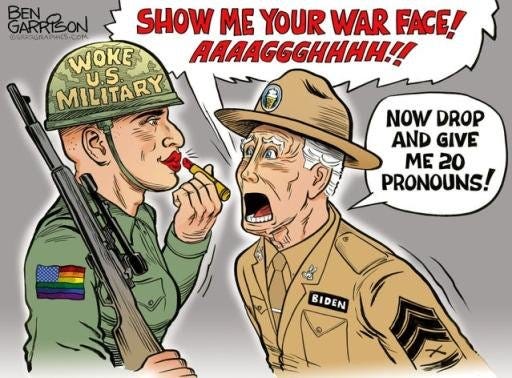
To see the invasion of Ukraine as having any relevance to gender and sexual diversity in NATO military ranks would be an act of truly unhinged projection. But are any of these “commentators” actually making that point either? No, not really. Their attacks on LGBTQ people, and especially on trans people, with tired jokes about pronouns and rainbow-coloured tanks serve other functions. The first is obvious: every handwringing attack and “pronoun joke” aimed at trans people is intended to perpetuate their ongoing culture war campaign against trans rights, a profitable and potent line of attack which can’t be neglected just because of the distraction of geopolitical conflict. In fact, now is exactly the time to double-down on it, for fear that otherwise it might drop out of the headlines or be put in perspective.
But there’s a second and far more serious function of upping these attacks, these “jokes”, at the present moment, a function with a dark history and potentially dangerous consequences. They’re intended to suggest that sexual liberalism and the rights of LGBTQ people are things that fundamentally morally weaken societies, and that in weakening them, leave them open to destruction or conquest. Queerness has made us weak and Russia has seen that weakness and taken advantage in order to strike. They wink at a political position that will later be made explicitly, once the seed is sown: that tolerance for LGBTQ people is a weakness in the good times that becomes an existential risk in the bad. Sure, the queers might look weak, so weak they can’t possibly threaten you, Joe Public, who is just trying to pay your rent and be a nice enough guy - but they can weaken us as a nation so severely that our foes - and specifically our foes to the East - will be able to overrun us.
Perhaps if you’re that Joe Public, mild-mannered, tolerant enough and with no dog in the game, what I’ve just said will seem desperately hyperbolic. But the concept of supposed sexual immorality or gender deviance being an existential weakness within societies that opens them up to conquest from the East is a long and pernicious one in Europe that dates back to early Christian narratives of the decline of Rome. In the Enlightenment and Victorian era, contemporary anxieties around sexual immorality and especially homosexuality were retroactively projected onto the Roman Empire, and the “fall of Rome” attributed to a culture of licentiousness, ease and moral degeneracy of an Empire made weak by comfort and perversion. As history, it’s entirely untrue: Rome was at its most powerful at a time where it had largely adopted the more open Greek models of same-sex relationships, and at its territorial and military zenith under Trajan and Hadrian, who were hardly paragons of heterosexual fidelty. In fact, the fall of Rome occurred under Christian management, after centuries of increasing prohibitions on same-sex desire that started with passive male partners and spread to include all same-sex contact. First they came for the bottoms…
Still, this myth of decadent terminal decline has been persistent, from those early Christian propagandists up to the present day, where the rhetorically enticing but ultimately meaningless meme “Hard times create strong men, strong men create good times, good times create weak men, and weak men create hard times”, seems to have gained new traction in recent years, perhaps a symptom of a crisis in meaning for some heterosexual men about their role in society. Who knows. It’s not like survival, resilience, perseverance and strength in the face of violence are qualities in short supply in our society, it’s just they’re far more likely to be found in the daily lives of women, and especially women of colour and trans women, than in the lives of the rich straight white guys dropping tens of thousands of dollars on expensive combat weaponry and deep-sea scuba watches for the hot tub and tank-like trucks that will only ever see asphalt, all props for the lifelong theatre of “defending my family”. Yet it’s those men who are most concerned that sexual liberty and rights for trans and gender non-conforming people will be the back door through which the Russian Horde will enter.
Perhaps the most egregious example of this story of “depravity weakening the nation” emerged in Germany following not just the German defeat in WWI, but the economic and political crises that ravaged the republic in the decade and a half that came in its wake. Defeat in the war itself was attributed by the right to both weak liberal politicians and their ultim…