On this cold December morning, the witch hazel in our wooded pig pasture seems quite pleased with itself. Long after all our autumn leaves have fallen and every other plant has completely faded, Connecticut’s native witch hazel comes into bloom. The timing seems self-defeating as there are very few cold tolerant insects this time of year that are available to pollinate it. It is, however, the only blossoming game in town, so despite how few pollinators there are, there is no competition for their services. The thermoregulating moths are attracted to witch hazel’s showy yellow flowers and fragrance - and songbirds are attracted to the protein rich moths.
Despite that lack of competition, witch hazel seeds have an abysmally low viability rate. Though pollinated in late fall, fertilization is delayed until spring when the seeds begin to form inside a pod. As summer progresses, the pods dry out and just about the time the new blossoms appear in November, the pod explodes and ejects the seeds 10-40 feet away. Once on the ground, it takes another year, or two, for the seeds to germinate – allowing an exceptionally long window of opportunity for hungry critters to discover them. The fact that the evolutionarily challenged shrub ever successfully reproduces at all is amazing.
Witch hazel has been revered by humans (and moth eating songbirds) for centuries. Its branches were commonly used for dowsing as a means of locating underground water sources. The “y” shaped branches were known as “divining” or “witching” wands and that’s likely how the shrub got its name.
Though dowsing for water has fallen out of favor by farmers and well drillers, distilled witch hazel is still a multi-million dollar industry. Connecticut is, in fact, the witch hazel capital of the world, as the majority of distilled witch hazel used worldwide is grown and produced here. Millions of gallons are distilled each year from CT grown witch hazel bark and twigs. Elizabeth Arden, Este Lauder, Avon and Revlon all use Connecticut witch hazel in their products.
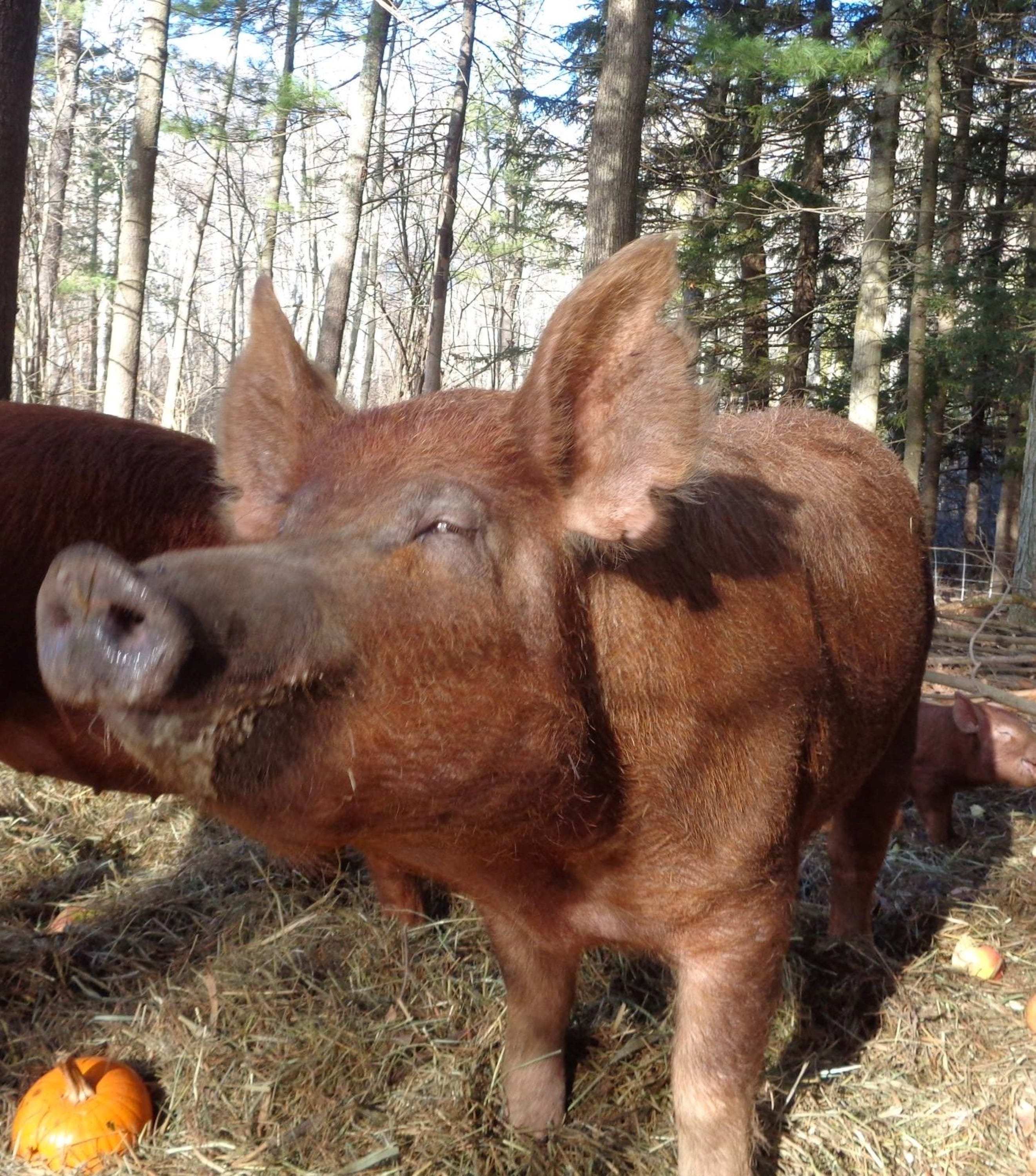
Watching our pigs bathe in the mud beneath this world-famous beauty product, I think to myself “is it any wonder our pigs are so darn pretty.”