The writer F. Scott Fitzgerald (who wrote The Great Gatsby) disliked exclamation marks as “laughing at your own jokes.” I sometimes wonder how Mr Fitzgerald would have felt about the plethora of emojis with which we dot our communications these days but, perhaps thankfully, he was spared that confrontation with self-humour. Especially the dog dirt one.💩
Thanks for reading The Endless Chain! Subscribe for free to receive new posts and support my work.
The exclamation mark is a regular feature of some court submissions that I’ve translated in my time, as if adding one to a refutation adds power and force to the legal argument, or at least gets the judge to elbow his colleague and mutter, “Yeah, getta loada that one, huh!” It’s my firm belief that exclamation marks are most misplaced when inserted into legal communications, if only because they say isn’t it obvious? and law is all about things that aren’t that obvious, to one or the other party.
Settling legal disputes is remarkably simple, because there’s a rule book. Parents and teachers who need to settle playground tiffs have a far harder time of things, because they need to make up the rule book as they go along and cut intractable Gordian knots while trying desperately to recall how Mary Poppins had achieved harmony with such consummate ease. Something like this is classically how it happened in my own youth:
He hit me.
And what did you do to deserve that?
Nothing. I just said he had to give me half his Kit-Kat.
And you, why didn’t you give him half your Kit-Kat?
It’s mine.
Give him half your Kit-Kat.
It’s mine.
Do it.
Here.
Or some such. Now, did you ever see legal pleadings that short? But a parent here is able to cut the Gordian knot while riding roughshod over rights of property, duties of donation and rights of appeal and, in the end, everyone feels that justice is served. Because no one used an exclamation mark.
Note that second sentence: what did you do to deserve that? The one thing that parents and teachers know, acknowledge and recognise that courts of law don’t when a complaint is filed about someone else’s actions is that every action has reaction, and that nothing springs from nothing, or rarely. And yet, we get to read at customer service points the world over signs that announce (I paraphrase) “We have cameras on you and we’re watching you. We know you’re an aggressive son of a bounder, and we are KEEPING OUR EYES PEELED, so don’t you dare be aggressive or we’ll GET YOU.” A rather pale attempt to pre-empt aggression using … well, it’s not far short off aggression, now, is it? And being the first to be aggressive is always a sure way to ensure peace and harmony, innit?
What the customer service points that erect such signs know only too well is that their service sucks. Nothing we can do about that. Not our fault. Take it or leave it. Sorry – next. Because customer service in the conception of a customer is “solving problems”, to which the classic answer is saying it’s not our fault because, in the conception of a service provider, customer service is palming off.
So, an irate customer is an embarrassment, a noise, a nuisance, but anger doesn’t spring out of the ether. It springs from a sense of unfairness. A sense that one is being treated unjustly, and resolving that injustice will usually resolve the anger. Anger management is advocated by people who have plenty of space in which to lean back and say I’m not angry, I can deal with the frustrations of life and there’s not a care in the world that encumbers the tranquillity of my mind. Anger management is for people who cannot keep it in, so who are these people who cannot keep it in, and why do they let it out? I asked one of them:
It’s often said that losing your temper doesn’t solve anything. Is that right? It can be right, and it can be wrong. Take a steam engine, designed to run at 80 pounds of pressure per square inch (lbs/in2). If the pressure in the boiler rises above 80, the operator must use the regulator to slow the engine’s operation so that the pressure again drops below 80. If he fails to do that the boiler will explode.
Because a boiler explosion is not a pretty sight, boilermakers try to avoid them by incorporating a valve called a pop valve or a regulator called a governor, by which either the excess pressure is relieved by making an opening in the boiler side before it can explode entirely or it is relieved temporarily by opening a slider valve, which recloses once the pressure has fallen adequately.
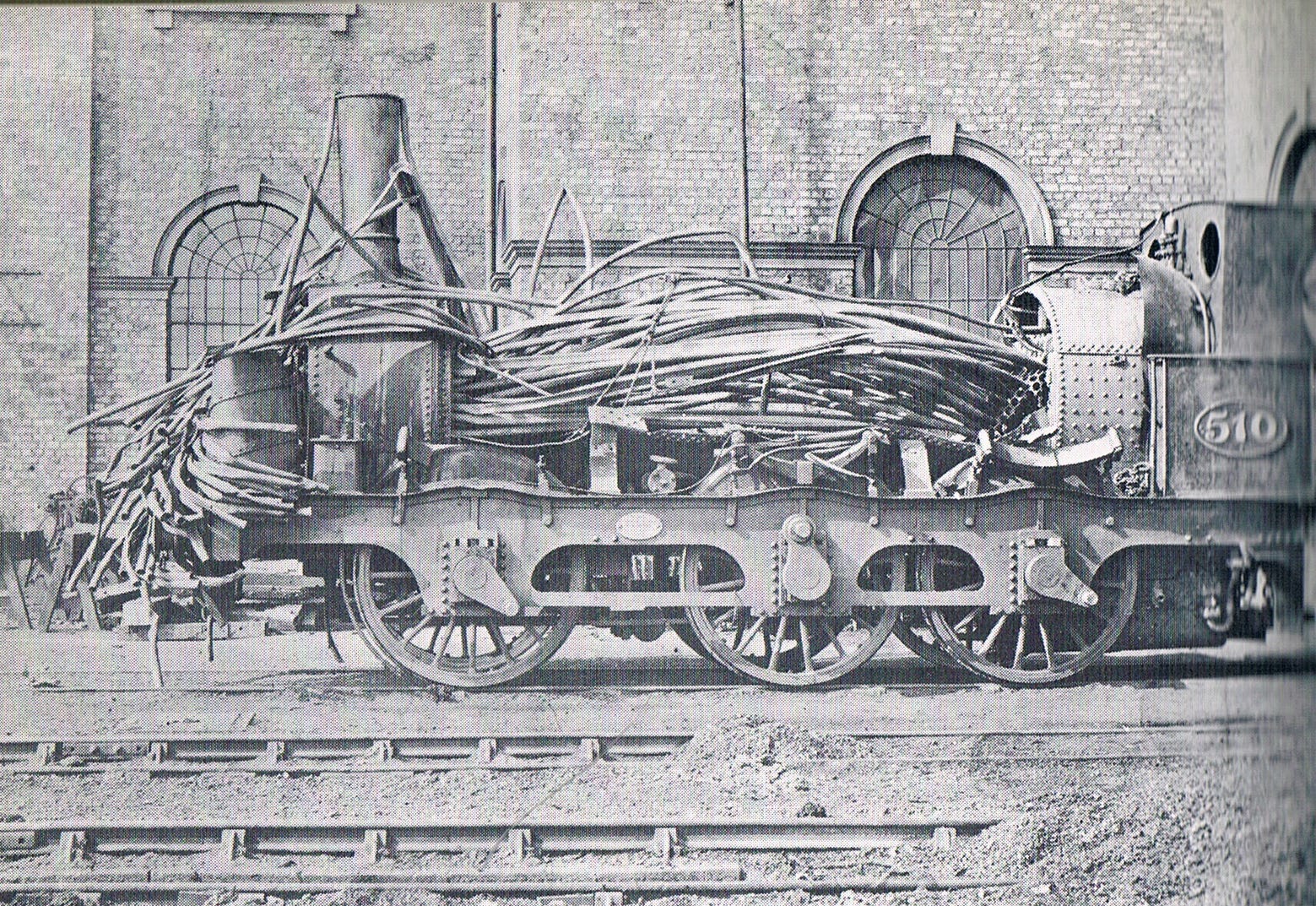
Image: from C. H. Hewison Locomotive Boiler Explosions [North Pomfret, Vermont:1983, David & Charles]
The picture shows a locomotive whose boiler exploded in Alne, on the North Eastern Railway in England, in 1877, and you can see that the destruction is virtually complete. The firebox would have saved the driver from excessive harm, had he been in the cab; but he and the fireman were busy filling the tank at the time, along side. It was sheer luck that saved them, therefore, bits of the boiler casing measuring five feet square having been flung 200 yards distant. Valves save lives.
It was known practice in the age of steam for drivers of some locomotives that lacked performance owing to their design to jam closed the valves atop their boilers in order to augment the interior pressure and exact a greater speed from their machines. But foolish were they that did so without keeping a sharp eye on the pressure gauge, for the margin of safety that was allowed depended on the safe condition of the boiler rivets.
These are theories of mechanics. How do they apply to customer service? They apply to customer service because the provision of a service can be like the creation of pressure within a boiler. If a customer pays for a service and it is not delivered according to contract, then the pressure that builds up within the customer owing to the unfairness being imposed upon him or her is not created by the customer. It is created by those who fail to deliver on the contractual obligation.
The customer then gets het up, and the usual reaction to this by the customer service point, backed as they are by their overbearing sign “DON’T GET HET UP” is to say that the customer is in fault for getting excited about their lack of performance, and this is like telling a steam boiler not to increase its pressure.
A boiler’s pressure will not reduce by your telling it to reduce. You must do something in order to reduce the pressure, because telling it to reduce without doing anything will only cause it to increase, then blow its valve, and ultimately explode. In human relations, when the party at fault tells the other party not to react to that fault, it commits a second fault, and two faults do not result in no fault.
What then happens is that the double faulted customer explodes. Just like on the NER in 1877. The police are called and they certainly don’t care who started it. They are no teacher on a playground. They arrest the one who is shouting. They arrest the one who did nothing to start the argument. They arrest the customer. And the customer service point says to the customer as they’re led away: we told you not to lose your temper.
Isn’t that so? No: they did nothing to prevent them losing it, did they? Temper is a feature of human frustration. Like tapping your feet, or nails, or coughing or a flush of red in the skin, it is a means by which people can keep their violence in check. It is a valid violence-control mechanism. And yet it is treated as if it were violence itself. What those who label temper as violence do is in fact abrogate their own fault ab initio. And what allows them to do that is an array of things that have been put in place to placate the more obvious sources of anger among people:
- Pay indexation,
- Comfortable working surroundings,
- Paid holidays,
- Travel allowances,
- Child benefit,
- Free education,
- Eco-cheques,
- Lunch vouchers,
- Guaranteed work,
- Time…