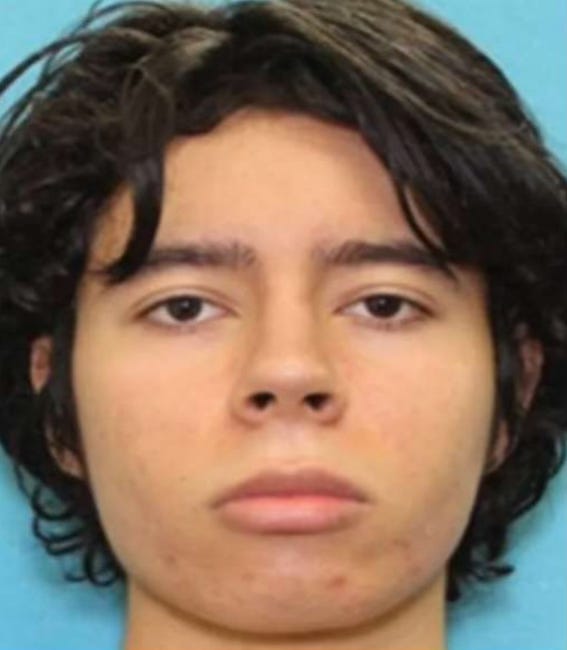
Image: Salvador Ramos, perpetrator of the 2022 Uvalde massacre. https://creativecommons.org/licenses/by-sa/4.0.
Thanks for reading The Endless Chain! Subscribe for free to receive new posts and support my work.
It was, I think, at a reception being held by socialite Dorothy Parker that the hostess, feeling the painful need to do so, let off a rip-roaring fart that echoed around the room and brought all conversation to a mid-sentence standstill. She immediately turned upon the butler and exclaimed, “Jenkins, stop that!” to which the dutiful manservant replied, “Certainly, Madam. Which way did it go?” If it’s true, the humour clearly lies in the two meanings of to stop: to prevent; and to halt or apprehend.
The heroes in the teenager shooting spree at Robb Elementary School in Uvalde, Texas, in May 2022 were not teenagers. They were not the medics. They were not the dispatch switchboard operators. And they were not the police. The heroes were the ten and nine-year-old girls and boys who adhered to training protocols, obeyed their injured—and dead—teachers and did everything right that they had been taught. They kept unheard-of silence whilst in physical and emotional pain, surrounded by their dead classmates and schoolteachers, some bleeding to death and stifling their cries at their fellow students’ behest, lest their location be betrayed to their murderer. They lined themselves up as trained to do so in an L-form, away from the presumed direction of the killer. They did as their schoolmistress bade them. For over an hour in terrifying fear. They were exemplary pupils.
The police, on the whole, did not do what they had been taught, either because they made mistakes, or because they hadn’t been taught it. Only three of the 120 officers dispatched to the emergency would at the time have fulfilled the training requirements that Texas State now, as a result of the Uvalde tragedy, imposes on its police and other response officers. It is one thing to make repeated, almost ad nauseam, calls for gun controls and for more to be done to prevent the extremists who post their hate on line; but if, as is now manifestly apparent, little or nothing can be done to prevent such emergencies occurring, because of inadequate laws, because of the prioritisation of gunmakers’ profit over public safety, for want of political will, because it always happens to other people, then at least something should be feasible in terms of how to respond to an active shooter incident. And training the police is up there.
You might surmise that Texas is a fairly obvious candidate for a school shooting. Its image is one of gun-freedom, easy access even to high-powered war-grade weaponry, and a tradition of sects, cults and gunslinging swashbucklers. It’s a reputation shared by the likes of Illinois, New York, California, Oregon. But, even in the remotest parts of Nebraska, North Dakota and Montana, shooter threats, recriminations, and bullet-sprees are not unknown. Just like hostage situations, shooting incidents are rare enough to credibly posit that it’ll never happen to you; and they’re frequent enough that they can be said to occur with certainty, somewhere, not that far away. As I write these lines, I’m reading of four injuries from gun-shot wounds on a principal thoroughfare of my own Belgian capital this evening. Gun-shot injury is never very far away these days.
In 1985, I paid a visit to the Federal Bureau of Investigation headquarters in Washington, D.C. I remember a display board with a list of typical criminal acts, all the way from murder to shoplifting, each alongside a light that flashed with the statistical regularity of the actual commission of the crime. Theft flashed so that the spaces between flashes were as good as indiscernible. But even murder flashed often enough that a short stay in front of the board would register the crime much more than once. I cannot recall whether there was a separate category for mass shootings, but I guess there will be now.
The tour concluded in the shooting gallery, where a firearms specialist demonstrated to us visitors a rapid-fire gun, suitably protected and behind secure glass. He announced that he would fire the gun in three modes. First, a single shot, several times. Then, three-round volleys, rat-tat-tat, rat-tat-tat-style. Finally, he would empty the magazine. The single shots sounded as if someone had dropped a half-empty box of cardboard files. The volleys were loud and disconcerting. The emptying of the magazine left me cold. Whilst fellow tour-members—mostly men—expressed wows of wonderment, I couldn’t muster a single note of enthusiasm. It was, till now, the only time I ever saw a display of such firepower with my own bare eyes.
What I failed to understand as I quit the tour and headed back out into the Washington sunshine was what earthly use, besides on a battlefield, such a rapid-fire weapon could have in anything like well-meaning hands. Be that as it may, whatever my own concerns might be, they are not necessarily shared by America’s lawmakers, since such firearms are available to purchase virtually over the counter in many parts of that country. And, whether or not they can be purchased, they are in widespread circulation among persons who hold them other than by purchasing them, in the US as elsewhere.
The single biggest cause of death among children up to and including the age of 18 in the USA is motor accidents. Seventy-three per cent of those who die at that age do so as the result of a car crash. The single biggest other cause, unless “accidents” is taken as a collective group, is then homicide. Thirteen per cent of children who died in 2020 were murdered. Not all of them were murdered while at school, but the 19 who died at Uvalde’s Robb Elementary School, along with two of their teachers, were indeed at school when they were taken.
The ProPublica reports on the tragedy, and their reporting of blunders seemingly made by the officials whose job it was to protect these young members of Texas society make for sobering reading. What these reports don’t do is speculate on how the shooter himself could have been stopped, in the sense of prevented, but rather on what failures might have contributed to Mr Ramos’s not being stopped, in the sense of apprehended, earlier than an hour and a quarter after he’d entered the school premises to engage in his killing orgy. However, other agencies do speculate on such matters and it’s worth listening to such speculation, for, without it, one is left somewhat in the dark to know what paths of enquiry might be made, or might be in the course of being made. I have myself already waded in with the above comment about inadequate laws, prioritisation of gunmakers’ profit over public safety, a want of political will, it always happens to others.
Are the laws inadequate? Gun laws are all about the acquisition, possession, safekeeping, carrying and appropriate discharge of firearms. They’re not actually about preventing people being killed. Every time a shooter engages in a mass killing in the US, there is no question but that there is a law forbidding people from engaging in such conduct. There are laws against it. The argument by some members of society is that, by being too liberal and allowing the acquisition of firearms too easily, gun laws increase the chance of somebody who is unsuited to ownership of a firearm acquiring and misusing one. There are other ways to murder people, in respect of which the acquisition of a weapon is less stringently controlled. Knives, for instance. Poison could be reasonably easily acquired. Some teenagers are renowned for their ability to enter, take and use a motor vehicle, and some have even done so in order to commit murder. (I assisted the Federal Prosecutor in Brussels in endeavouring to extradite one from the UK one time. They failed, because he was already in Strangeways for a crime he’d committed in that country. We’ll get him in 20 years, when he’s 36.)