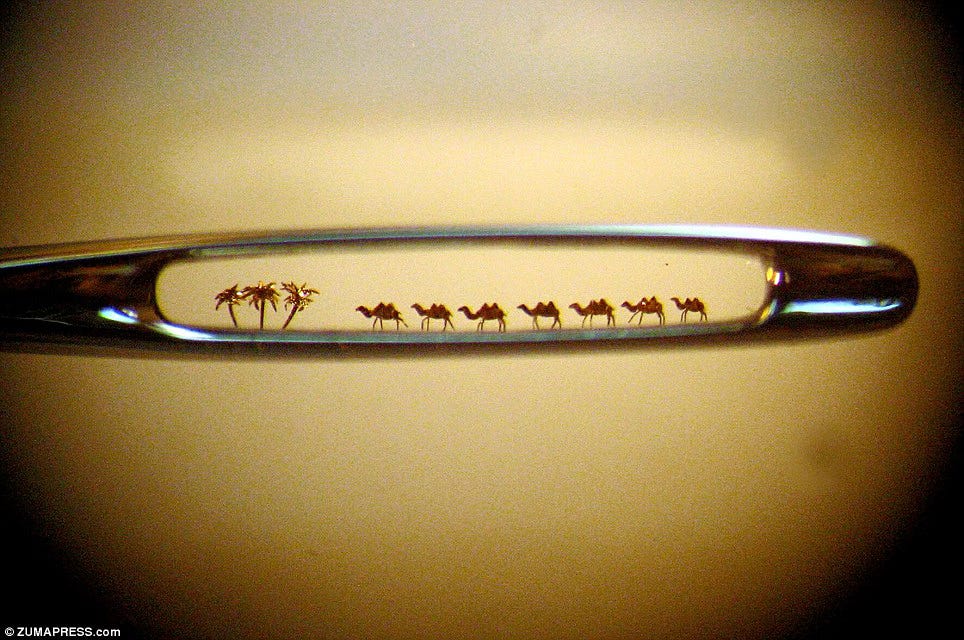
The poor have it. The rich need it. If you eat it, you’ll die. What is it?
A clever riddle is always a good riddle, but not if you’re the object of its sharper point. I’ll leave you to ponder the solution, which is to be found at the foot of the article, just above the “Share” button.
Thanks for reading The Endless Chain! Subscribe for free to receive new posts and support my work.
The Gospel according to St Mark, chapter 14, verses 3 to 9:
And being in Bethany in the house of Simon the leper, as he sat at meat, there came a woman having an alabaster box of ointment of spikenard very precious; and she brake the box, and poured it on his head. And there were some that had indignation within themselves, and said, Why was this waste of the ointment made? For it might have been sold for more than three hundred pence, and have been given to the poor. And they murmured against her. And Jesus said, Let her alone; why trouble ye her? she hath wrought a good work on me. For ye have the poor with you always, and whensoever ye will ye may do them good: but me ye have not always. She hath done what she could: she is come aforehand to anoint my body to the burying. Verily I say unto you, Wheresoever this gospel shall be preached throughout the whole world, this also that she hath done shall be spoken of for a memorial of her.
There are three remarkable things to say about this episode, which is to be found in three of the four gospels. First, the location. It was at Bethany that Jesus was baptised by John the Baptist. It’s symbolically important that this scene, which marks the start of the process that saw Jesus denied, forsaken and betrayed, and involves the application of perfumed oil to Jesus’s skin, just like the oil gifted to Him at His birth, should take place at exactly the same spot.
Second, and third in fact, the line ye have the poor with you always, and whensoever ye will ye may do them good. It is evident from the outset of His mission that Jesus’s entourage were not inhospitable to the poor. Jesus Himself approached social outsiders, hookers, tax barons, lepers, like Simon here in Bethany. He reached out to the underprivileged. And yet, here He speaks of them almost dismissively. Would it be uncharitable to translate Jesus’s words as: there will always be plenty of time to help the poor: they’re not going anywhere? Perhaps we need to consider the words that follow as conditioning this seemingly abrupt construction: me you have not always. Jesus knew, therefore, that His death was approaching.
Elsewhere in the gospels, we encounter the story in which Jesus tells a young man how he might enter the kingdom of Heaven (Mark Ch. 10 v. 21 et seq., edited):
Go thy way, sell whatsoever thou hast, and give to the poor, and thou shalt have treasure in heaven. How hard is it for them that trust in riches to enter into the kingdom of God! It is easier for a camel to go through the eye of a needle, than for a rich man to enter into the kingdom of God.
The Bible is not an easy text. Are we under a moral obligation to liquidate our possessions, in order to give them to the poor, or are the poor plentiful enough that we will always have them to do good by? Are the poor rich men’s playthings, to assuage their sentiments of piety?
Nobody is anybody’s plaything, and any act of giving to the poor that constitutes an act of piety will bring the donor no closer to the kingdom of God. Because it is not the donation that is crucial; it is the frame of mind in which it’s given.
If you read through the Holy Bible and look for logical connections, you’re in for some rare treats, for God’s logic is not man’s logic. One might ask oneself whether much of what Jesus did was in the wisest vein: the confrontations with authority and large public gatherings. But one thing is clear from the gospels: you cannot be led by the nose into the kingdom of Heaven. You must find the way yourself, however you do it. There is no operating manual for Heaven, no step plan, no troubleshooting guide; plenty of FAQs, very few answers. If Jesus had come today, would He have given TED Talks? Spoken at Speakers’ Corner? Published a blog, like this blog? How do you know that I’m not Jesus, returned for the second coming? How did the people of Judaea know that 30 AD was the Son of Man’s first coming? How could they?
When Jesus was born, three wise men from the east remarked a new star in the heavens, and promptly set forth to discover its portent, egged on by some useful prophecies. Their names were supposedly Caspar, Balthazar and Melchior, though this is not information we have from the Bible itself. Open to question is: whether they were kings, where they came from, where they went to, and why they came. Only one gospel writer mentions them at all and he, Matthew, states what gifts they brought with them. We can imagine that the journey was not without its dangers, especially if the contents of their baggage should be discovered. Also in doubt are matters like whether they were alone; we think that they were probably astrologers (they saw a star ...). Only really one thing is certain about them: they were wise.
Why? Why did the Three Wise Men come to wherever it was they came to? (It wasn’t the stable, that much we know.) Much play is made of the symbolic importance of the gifts. Gold, for richness on this Earth (Wikipedia states: “gold is fairly obviously explained” and I beg to differ. It is in no way obvious that the Son of Man should be given gold); frankincense, a perfume, for deity; myrrh, an embalming oil, for death. Scholars have, in fairness, wildly speculated as to what happened to the baby shower subsequently.
The gold—as intimated—and the myrrh are both surprising, given later developments: of course, we don’t know how much gold was brought, but my guess is that it was spent by the time Jesus would have needed to enter through the eye of a needle. Myrrh, symbolic of death, is a macabre christening gift. It’d be comparable to gifting a coffin to a new-born nowadays. For the modern Christian, it is not death that is symbolised by the myrrh, for death itself is an inevitability of life. What this gift represents is the portent of the death of this particular child.
So, there you are, in Tehran or Yerevan (both potential localities for starting out). You’ve seen a star up there, and call a couple of friends, who confirm they saw it too. You all decide to pack a bag, gather together some symbolic gifts and hoist yourselves up onto camels to cross Eurasia and visit a newly born child whose name you don’t even know. One thousand miles. Camels, we are told, can walk a distance of around 30 miles a day. From Teheran to Bethlehem, or Nazareth, is therefore a journey that’ll take you two months, there and back. A modern equivalent would be driving at 35 miles an hour from London to Vladivostok TEN TIMES. Why do you do it?
The answer lies not in the concept of a gift as we know it today. In the law, a gift is a voluntary relinquishment of property in favour of another, third party. It is a property transfer. Right, title and possession, together with risk, pass from the donor to the donee. Upon transfer being consummated, the donor is relieved from all and any duties to insure, protect or maintain the gifted property, and these duties, in so far as of relevance, pass over to the donee. Some people think the Bible is long, but at least it wasn’t written by a lawyer.
The law of donation is permeated with words like “in favour”, “for the behoof of”, “for the benefit of”, “gifter”, “donor”, “recipient”, “donee”. Because the law regards donation as constituting a deprivation by the donor of something that was, and the enrichment of the donee with something that was hitherto not his property. But, in God’s world, property has no value. It simply exists, but no one could tell you that a fish is worth less than a tree if there weren’t markets there to tell you what fish cost and what wood costs. There are no markets in Heav…