Een NL-versie van deze tekst is hier verder beneden te lezen.
Readers who have been with me on this journey for some time may have seen the following sentiments before, but in a different form. The change of form is due to a change in the question that has been put to me, on this occasion from Top Shelf Theology. If a refreshed approach to God, spirituality, theology and “what’s it all about?” enthuses you, then I can recommend my fellow enquirer over at Top Shelf Theology. Even if you’re not religious, Top Shelf Theology will set your brain whirring. Like the New Yorker crossword.
Thanks for reading The Endless Chain! Subscribe for free to receive new posts and support my work.
When I worked in the early 2000s at PricewaterhouseCoopers, part of my work involved pre-publication proofreading and editing of some of the books the firm issued as part of its thought leadership initiatives. One of these was named Substance and the word itself may be hard to grasp if you’re from a sector outside the world of international taxation.
Substance is all about the idea that a transaction or operation that produces some kind of fiscal effect (like the ability to deduct an outlay as allowable expenditure, or routing a transaction through a certain entity or tax jurisdiction, such as to favourably alter the nature of the funds or assets in question) must be shown to also actually change something for the parties: substance is not tangibility, because intellectual property is intangible, but its transfer can have huge effects in terms of substance: imagine buying the rights to the trademark Coca-Cola®: no tangibility; plenty of substance. Substance is the argument by which a tax authority can challenge the form of a transaction that, in fact, changes nothing for the parties in substance.
For religious devotees who are members of an organised church or religion, the form in which they worship confers cultural identity on their act of worship. It gives them a sense of connection, of association, with the other worshippers, as well as with the place where they are worshipping. I once had a partner who is Roman Catholic and I accompanied him to many Catholic places of worship: in Belgium, in Germany, in France and on the island of Malta. There are certain aspects of Catholic churches in all of those places (to which I can add Ireland, Italy, Vatican, Scotland, Canada, the United States, as well as Anglican churches in England and so forth) that are recognisable to any Catholic. The monstrance, the stations of the cross, the saints—Peter with his keys, Anthony bearing the child Christ, James and his shells, Mary dressed in red, Mary dressed in blue, Andrew’s fish and saltire cross, and so on. The progression from porch, to pre-font, to font, to the body of the church, to the rood, the choir, the apse, the east window. The aspergillum, the rosary, the hosts, the creed, the communion.
I shall venture no false knowledge of all that these things betoken; nor shall I pretend any knowledge of the rites, rituals and liturgies of Islam or of Judaism or of Buddhism or of Haitian voo-doo. The meaning of Yom Kippur, Hanukkah or Passover, Ramadan and its ram, the crescent moon and Mecca, the hajj, nor of the associated meals and drink, and the absence thereof; dolls, incense, gongs, minarets and menorahs; Christmas trees and Christmas candles, Christmas presents and Christmases past; Christ the Saviour, bringing Mohammed to the mountain, and bringing home the Francis Bacon.
All that said, there is a distinct difference in look and feel between a church in Malta and one in Ireland. Between a Roman basilica and a Greek orthodox cathedral; between a Free Church of Scotland meeting and a Quaker meeting. Yet, even when Muslims gather to worship, their eyes are directed at the same substantive entity as the Christian or the Jew or any other adherent to a deific religion: the one God, however they call it.
The mystic seeks but one thing in life, and that is union with God. I have lived with a mystic and it can pose its challenges. The fixed goal of union can shatter those who enter into union with such persons, unaware of their mystic aura. But mystics are the greatest proponents of the mantra substance over form. For them, organised religion can become tedious. It’s a poor example, but it would be a little like an Oxford graduate patiently sitting through a geography class with 10-year-olds. Doable, but with forbearance.
However, for those who see religion as an encapsulation, as being part and parcel of their entire cultural persona, in terms of social, national, linguistic, political as well as ideological identity, the form of God is very important. Jesus is white-skinned to northern Europeans; when they view the dark, olive tones of the crucifix in Lucca cathedral, it doesn’t match the images in our childhood bibles. There follows either an epiphany, or a rejection.
God has no form. He has only substance. The mystery and wonder of trans-substantiation makes this clear. Catholics believe less in the molecular change of bread into flesh, of wine into blood at communion; and more in the mystical notion of a oneness with God when the host and the wine are consumed in the act. When I talked recently to a Catholic friend about this, she offered a closer understanding of what trans-substantiation is. And I realised that I believed in it as well, as a raised Protestant, and yet had never identified with the word trans-substantiation.
In point of fact, I never needed to associate with that word: the fact of associating with the sentiments expressed by this lady shows me that we shared an understanding of the substance, even if we’d attributed different forms to the experience. What neither of us ever did, for which I’m grateful, is identify the word trans-substantiation as a mark of division between us. Because it wasn’t. Substance is vastly more important to God than form.
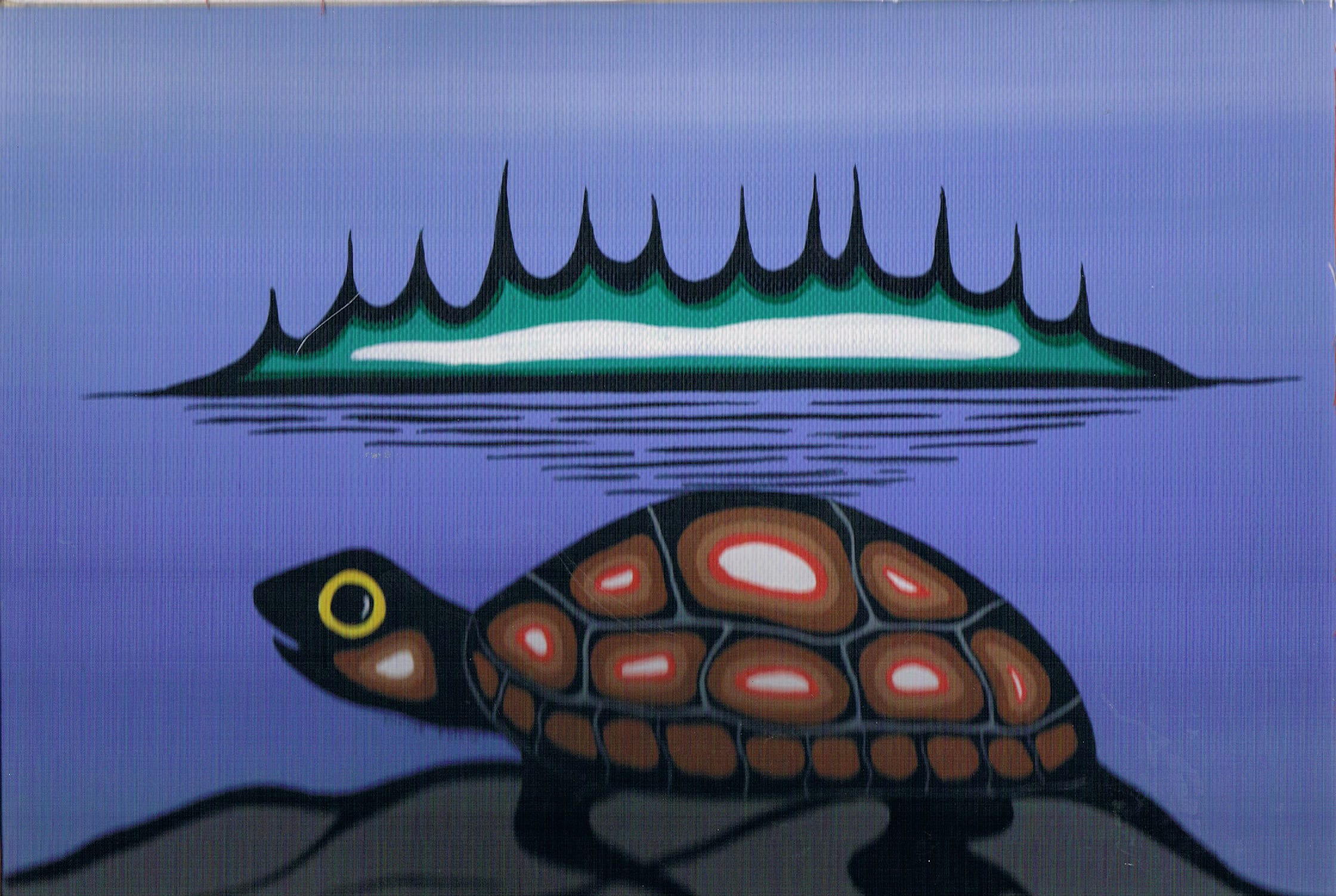
This is a painting that was done for me by a First Nation friend, Shawn Schibler, from Winnipeg in Canada.
Do you recognise the scene? If you are of the Ojibway tribes, you will, instantly. But, if you do not know First Nation traditions, you may need a hint. Here it is: Noah.
The painting depicts the Great Flood. Waynaboozhoo is a spirit of First Nation tradition, not vastly unlike the first world’s Holy Spirit. When the flood came, which we know of with Noah and his building of the Ark, Waynaboozhoo sought refuge on a log that floated in the floodwaters. Many creatures came and joined him on the log, but it was not large enough for them all. Those who could swim would swim next to the log and swap places with other creatures who had rested enough to re-enter the water. The same went for birds: some rested on the log, whilst others flew along with them high above.
One after the other, the creatures tried to reach the bottom of the water, to dredge up earth and use it to reconstruct the land above the water. Many tried, but failed. Finally, the muskrat wanted to try, and was mocked, since he was so small and weak. But he dived to the bottom and had just enough strength to gather some earth and come back to the surface. When he surfaced, he was so tired, he expired and died. The others found the earth in his paw and the turtle asked that the earth be placed on his back, so that a new earth could come from this flood:
“Use my back to bear the weight of this piece of earth. With the help of the Creator, we can make a new Earth.”
Waynaboozhoo put the piece of Earth on the turtle’s back. All of a sudden, the noo-di-noon’ (or winds) began to blow. The wind blew from each of the Four Directions. The tiny piece of Earth on the turtle’s back began to grow. Larger and larger it became, until it formed a mi-ni-si’ (or island) in the water. Still the Earth grew but still the turtle bore its weight on his back.
Waynaboozhoo began to sing a song. All the animals began to dance in a circle on the growing island. As he sang, they danced in an ever-wide…