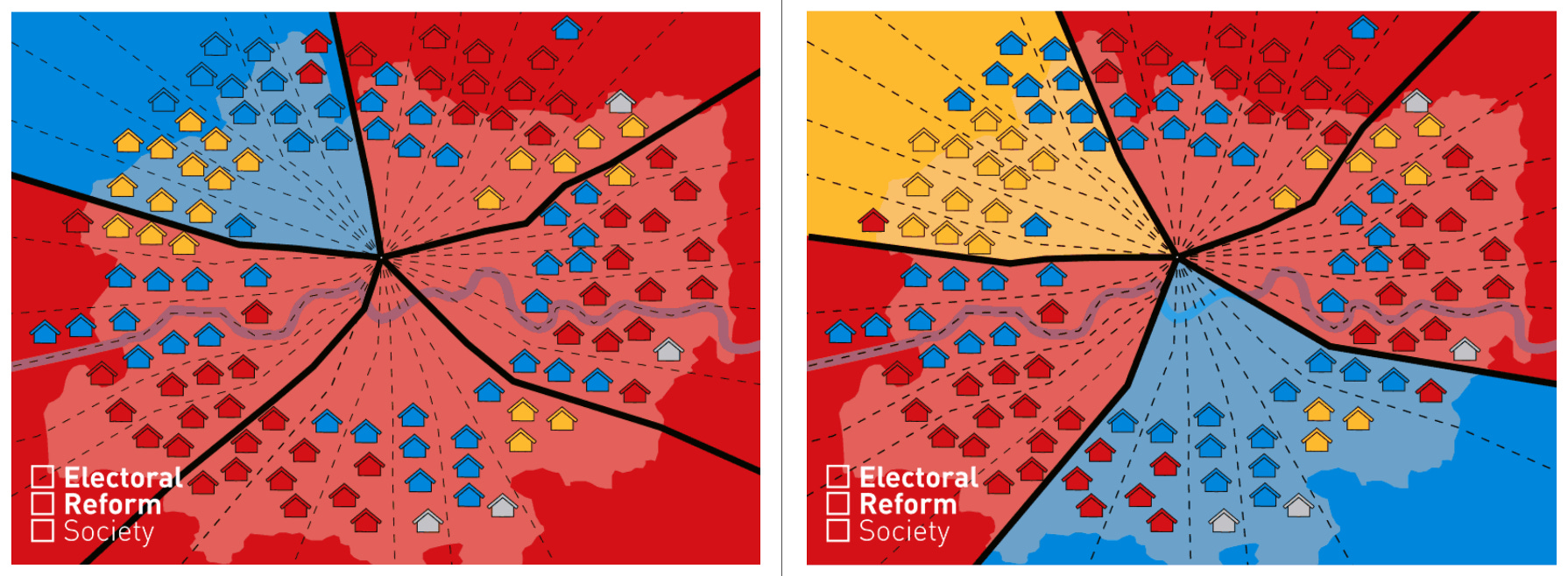
In his song L’Italia, Marco Masini sings, “È un paese, l’Italia, che governano loro”, which can be translated as Italy’s a land ruled by “them”. Masini sings of his homeland, but is it not something that we can say about every country?
Famously, the US Constitution begins with the words We, the people, so America is not ruled by them, it is ruled by us (by which I mean the Americans). Yet, the US Constitution was not signed by the entire population of the colonies. In fact, only 38 of the 70 members of the Constitutional Convention signed it (one of whom also signed as a proxy, making the total signatories 39 in number). Yet, I’ll warrant that, in most Americans’ breasts, there surges a sentiment of pride and honour at hearing those words, We, the people. So, here, in 2024, as America launches into its election season, who, exactly, are we, the people?
The answer to that question is as nebulous as the identification of who Masini meant when he spoke of loro—them. Who are Masini’s they? The government? Northern Italy’s industrialists? The communists? Ms Meloni’s far-right support? The Cosa Nostra? Or are loro in fact noi—us, whatever the government’s constellation might be? What do you think he means? And what do you think he ought to mean?
Italy and the US are both democracies. That ought to mean that it is indeed we, the people who are loro. But the nation state is a strange creature. In a state of anarchy, each individual is king of his own castle. Just like Englishmen are. Democracy is unrestricted freedom under the law, within the bounds of the law, exercisable by all and sundry, equally and without preference or denigration. We, the people, exercise utter and absolute freedom aside from what is proscribed by a law that applies to all of us equally. That is democracy. We ensure this by electing our own representatives in government, and abrogating to them the prerogatives that would remain our own were we to exist in that terra nullius state of anarchy. Politics can be seen as a complex structure but its complexities stem essentially from its existence as a career form. The career that politics offers makes it less than practical to step into and out of it like chairmanship of a theatrical society. It’s a full-time job, and the very election process demands fame, name-recognition, campaigning, money and promises—to those who pay the money, as to those who give their votes (which can sometimes lead to the elected parliamentarian being less than honest to one or the other). It demands keeping everyone, or as many of everyone as is possible, happy all the time. And, when the happiness factor ceases to add up (like when 70% of the British populace clamours for its elected representatives to demand a ceasefire in Gaza and government and opposition alike ignore them), that is when democracy starts to show its weaknesses. That is when it starts to show that the fairness, the universal consent on which it is predicated, no longer obtains. It is at that moment that America’s We, the people becomes Italy’s loro (at least as I believe Masini meant it).
Do the shops open on Sundays where you are? When I was in The Netherlands at the weekend, it occurred to me to do a little shopping for some Dutch specialities. I like their peanut sauce, special cheese, nasi goreng mix and atjar tjampoer for an Indonesian rice table, and other things you can’t get so easily here. But Albert Heijn was closed in the small village where I was, so I’ll need to pine for peanuts a little longer. “Ah, yes,” said my buddy, “but the shops in larger towns are open some part of a Sunday.” I think that’s right, but it got me curious. Who decides when a shop opens? (Clue: it’s not always the shopkeeper.)
In France in 2013, there was uproar about shop opening times. The legislation governing shops, les magasins, les commerces, was so multi-layered, it attracted the nickname millefeuille, a name normally reserved for a luxurious confection made of endless layers of wafer-thin pastry (French-speakers like to exaggerate: they thank you a thousand times, don’t just split hairs, but cut them into four, and use the expression “no, perhaps?” to mean “certainly!” (see note); millefeuille literally translates as a thousand leaves, but you needn’t ever count them).
Note: merci mille fois ! ; couper les cheveux en quatre ; non, peut-être ?
The millefeuille referred, of course, to the stack of rules, exceptions, special provisions, sectoral application, industry norms and so on that constituted a veritable labyrinth of legislation when all that’s really involved is (a) shops and (b) people who want to go to shops (or don’t, as the case may be).
It seemed that opponents of grands surfaces like Merlin Leroy enjoyed sauntering down high streets shuttered with roller blinds to avoid vagrant hooligans lobbing bricks through store display windows, and window-shopping at those that dared run the risk of errant vandalism, the odd car chugging past carrying its occupants to a dutiful afternoon of coffee and cream horns with Tante Béatrice, at which smartly besuited children would sit, hands exposed palm-down on their knees, being seen and not heard, as the grown-ups all remarked “Oh, comme ils ont grandi !”, andfelt that no one should be desecrating their or anyone else’s Sunday pleasures by actually contracting sales and purchases with those very devils, themselves: les commerçants.
British Sunday-opening laws are also a mish-mash. Because there are none. The rules in the United Kingdom differ among Northern Ireland, Scotland, and England & Wales (hence, not British). When London hosted the Olympic Games in 2012, the Sunday trading laws were suspended for eight weeks, and I can assure you that that alone would’ve had Eric Liddell reaching for his chariot of fire, if it’d have been Paris 1924.
Whatever had been the overpowering need to introduce them in the first place back in 1930 was no longer a burning issue in 2012 as long as hordes of affluent global travellers were in town just itching to be fleeced of their souvenir budgets; once the visitors had re-departed for their own corners of the globe, England’s shop-closure laws came back into force. Some say they’re there for religious reasons, but clearly one is allowed to be a sinner for the Olympic Games. Ain’t that a slug in the rubber parts: lift-and-lay legislative morality. (Lift-and-lay what?!!)
Scotland has no Sunday trading laws, and that’s a bit surprising, since they’re all protestant puritans up there. I know, I am one. When Scotland started building its railways (the first was 1722—Tranent & Cockenzie), there were no rules against Sunday running, and yet no railway company ran trains on a Sunday. By 1850, over 6,000 miles of railway had been laid in Great Britain, and much of it was running services on Sundays. Except in Scotland. The first attempts at Sunday running of trains met with furious opposition from the church and its parishioners. You might wonder why there were therefore no laws against Sunday trading up in North Britain. Well, there were also no laws against spending all day stood on your head. Put simply: the one was regarded as unlikely as the other, and so there were laws against neither.
Sunday trading laws are the kind of laws that get introduced when the assiduously followed way of doing things ceases to be assiduously followed, and are used by those who wish to continue assiduously following the way of doing things to make sure that no one else stops being assiduous. Perhaps they think, like some French, that children should be seen and not heard. In England a child’s hands should be kept under the table. In France, it is de rigueur to place your hands on the table. France and Britain may be fromage and cheese, chalk and craie, but they both know superfluous levels of conventionality. And, changing conventionality can be an upward struggle. Even if the ultimate aim of abandoning conventionality is in fact the very democracy that it…