“It’s a long and winding road for Epic. The firm lost the Apple case, which is on appeal, but got the Google case to a jury.” (Matt Stoller: BIG Newsletter, 12 December 2023.)
Matt Stoller is a respected blogger who discusses competition law matters, and this quote is from a recent blog post in which he describes a victory for a firm named Epic against another company, called Google. He, in part at least, ascribes Epic’s victory (thus far; the decision is to be appealed) to its having secured a judgment by a jury—once described as constituted by twelve men good and true.
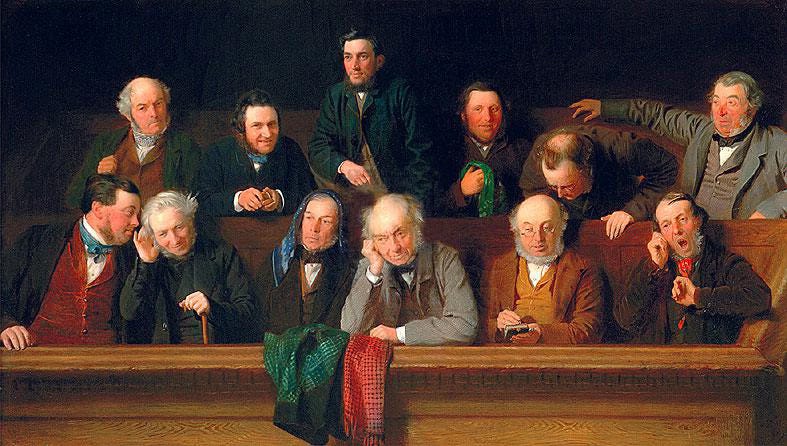
Not everybody gets to pop into a court of law to see a jury trial, so not everyone knows what a jury looks like. Here’s one:
Image: The Jury, by John Morgan (By John Morgan - The Jury by John Morgan.jpg in Wikipedia (English), Public Domain, https://commons.wikimedia.org/w/index.php?curid=4912282).
As you can see, although the clothing betrays the fact that these twelve men good and true date from 1861, one of them could otherwise be seen as holding a mobile device, which another member is offering advice on. The fellow next to him could perhaps be having a phone conversation. Luckily, these things are no longer allowed in modern courts of law.
The chap second left on the front row can’t hear the guy sitting next to him, let alone the witness. The chap first left, back row, however, can, and is most intrigued. Second left, back row, looks a little like a second-hand car dealer, except there were no cars in 1861. Whilst, in one of her films, actress Margaret Rutherford was pulled up as a jury member for knitting whilst attending to the court’s matters (it helped her concentrate, she said), there could perhaps be a view that this particular jury would aptly fit the description of a motley crew.
While jury trial can be dated back to, certainly, ancient Greece, with their dikastaí (up to 1,501 of them in a jury), followed by ancient Rome, with their comitias of but 100, the founding document on which the modern common-law jury is based is generally taken to be Magna Carta, and its article 39 (translated):
No free man shall be captured, and or imprisoned, or disseised of his freehold, and or of his liberties, or of his free customs, or be outlawed, or exiled, or in any way destroyed, nor will we proceed against him by force or proceed against him by arms, but by the lawful judgment of his peers, and or by the law of the land.
Since Greek and Roman times, the number of jury members had by 1215 reduced (from 1,501, or 100, to 12). Twelve is the figure in equivalent procedures in Islamic law; it was the number under the Rhenish provinces in the 18th century; under Æthelred the Unready in England in the 10th; and under Henry II of England in the 12th.
Comparing a jury to a motley crew is not a disparagement. In many ways, it is the precise point. Lawyers are generally forbidden from acting as jury members. They know too much about the law. There must be a certain naivety to a juror. But, that said (other than in grand juries), the role of the modern juror is not to judge the law, but to find the facts.
To a large degree, the jury is a nebulous fiction, and the philosophy underlying what a jury is, what it is composed of, what its task is, and its prevalence within the legal system has never truly been settled, and still isn’t, for jury members are very variable creatures across the breadth of this globe of ours. Judges, however, are not. Judges get appointed by the state, to execute the state’s justice, and, since it is the state that enacts the laws that its judges judge, and whilst some states instruct their judges to exercise more (or less) judgment in the judgments they hand down, there can ultimately be no disputing the fact that, however just or unjust justice is when imposed by the judiciary, provided the judge acts in accordance with the state’s prescript, then that is the state’s justice.
What makes juries a nebulous fiction is the fact that they are so central to many procedures in some countries and are utterly absent in others. On the whole, even in the common law countries, where they are commonest (albeit some have abandoned them as being susceptible to bias—e.g., Singapore, India, Pakistan, Malaysia), they tend to be restricted only to criminal trials, and not civil actions. The USA differs in this (for instance, to cite a notorious case of recent date, the Carroll I and II trials are instances of civil jury trials).
Out of this then arise some interesting questions to ponder:
Are juries indeed susceptible to bias?
If so, why do some countries use them?
If not, why are they not used for all trials, civil and criminal, in all instances?
Why “12” members? Why not 1,501, as in ancient Greece? Why not 15, as in Scotland?
Why were women excluded for serving on juries for so long? Because they cannot judge facts? Or because they could so easily be cowed? Not so much susceptible to bias as susceptible to duress?
If juries are indeed susceptible to bias, aren’t judges also susceptible to bias?
How can one justify a jury system under which the jurors (who may or may not be susceptible to bias or duress) determine the facts, and the judge passes sentence, but with his or her hands bound by the strictures of the statute? What, then is the role of the judge, except as a master of ceremonies?
This last question is a thorny one and concerns offences for which a judge has no discretion in sentencing, such as in cases of felony murder.
Felony murder is a crime, a serious crime, that, in some jurisdictions carries a penalty of death, and in many, life imprisonment. So, what is felony murder?
In Saudi Arabia, let’s say a western businessman arrives at Riyadh airport and hails a taxi in order to drive to his hotel in the town. On the road, the taxi is involved in an accident. Under Saudi law, the accident is the responsibility, not of either of the two drivers, but of the man sitting on the back seat of the taxi. Thus it was at least explained to me by somebody who lived in Riyadh. Under Saudi law, there is a causal connection between the accident and, not the mistake that one of the drivers may have made but the fact of the businessman landing at Riyadh airport and wanting to transfer to his hotel. That is the causal connection and that may seem tenuous to many, but it is not regarded as tenuous under the laws of the Kingdom.
Sorry, we were talking about felony murder, but the same sort of thinking, which may be dismissed, perchance, by western readers who fail to appreciate the finer points of Sharia law, actually prevails in respect of the taking of lives in western countries.
You can take the lives of others in a number of ways, some of which are classified as criminal acts and some of which are not. If we start at the top and work our way to the bottom, we find a ladder with many rungs, but the essential ones are as follows.
First-degree murder or murder with malice aforethought: the terminologies change from one jurisdiction to another, but this is the intentional killing of somebody, who need not be identified to the culprit, but done by targeting the victim or by acting so wantonly as to be insouciant as to the result of the act. The act will generally be one of extreme violence, such as discharging a firearm or wielding a knife. 9/11 was an instance of first-degree murder, as was the Uvalde shooting at Robb Elementary School, as were the crimes of Jack the Ripper, and the Moors Murderers, and Marc Dutroux. These were all cases of first-degree murder.
Manslaughter or culpable homicide: again, the terms vary but this is a lesser charge. The culprit causes death through an act that is not intended to cause death. Note that phrase: not intended. Manslaughter can entail a punishment equally as great as murder (e.g., life imprisonment), but the culpability—blameworthiness—attributed to the culprit is less. If murder is committed with malice aforethought, then the fact that manslaughter might be committed with mal…