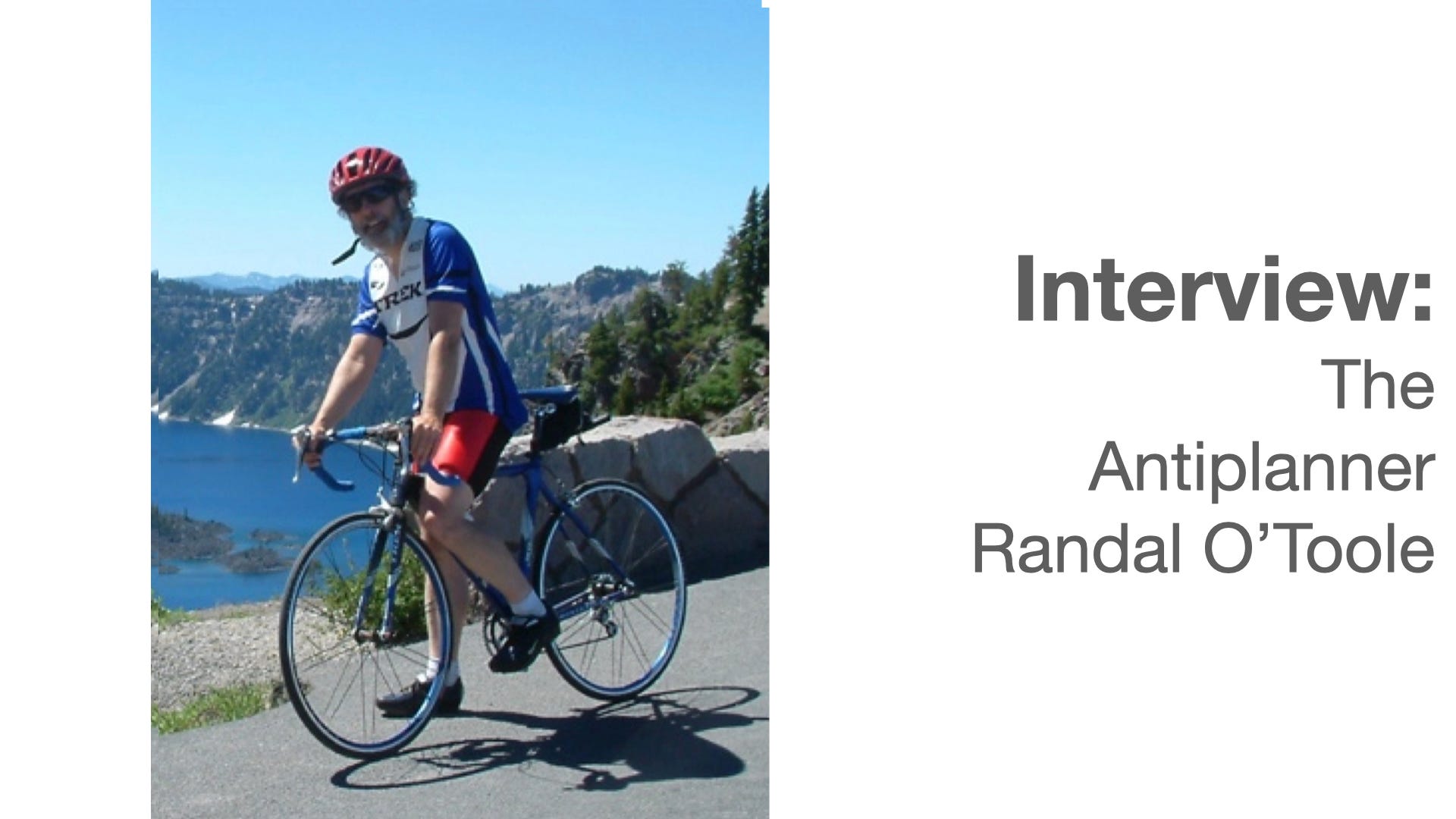
Randal O'Toole, an American policy analyst, discusses his maverick career, non consensus views on urban planning, transportation, and housing in this interview.
O'Toole runs the Thoreau Institute as well as the popular policy blog, The Antiplanner. He has written several books and hundreds of policy papers from a free market perspective on urban planning, government policy, housing, rail and other related land use topics. We explore his belief that urban planners often impose their preferences on the public, such as imposing restrictive land use planning codes to “force” people to live in apartments and use public transit, even though most people prefer single-family homes and driving. O'Toole also shares the impact of the pandemic on urban planning, reinforcing existing trends such as people moving to the suburbs and working from home. We discuss the potential of autonomous vehicles in replacing public transit in the future as well as his views on cycling.
In this interview, O’Toole critiques the idea of planning itself and promotes the repeal of federal and state planning laws and the closure of state and local planning departments. He explores in detail why planning fails, through documentation of planning disasters, while giving context of his perspective on land use issues in Hawaii such as cycling, light rail, affording housing, and agricultural lands as well as providing solutions for environmental protection and stewardship.
Topics / Time Stamps
* (2:08) On Biking in Oahu
* (12:33) Educational Background and Current Work
* (16:05) Economics vs Planning
* (20:31) The Iconoclastic Mindset
* (24:25) Buses vs Light Rail
* (26:55) Criticism of the Honolulu Light Rail System
* (33:47) On New Urbanism
* (43:45) Urban Planning and the Pandemic
* (46:16) Solutions to non utilized urban cores / skyscrapers
* (49:06) The Iron Triangle
* (51:30) Autonomous vehicles as an alternative
* (54:07) Houston as Model
* (59:18) Incentive-based conservation
* (1:04) The Grassroot Institute
* (1:06) Hawaii Land Use Reforms Recommendations
* (1:12) Vacancy Taxes as Symptom
* (1:15) On Optimism
* (1:17) Policy Briefs
The Antiplanner: https://ti.org/antiplanner/
Policy Briefs: https://ti.org/antiplanner/?page_id=16274
The Education of an Iconoclast: https://ti.org/antiplanner/?page_id=16272
Leafbox:
Today I had the pleasure of speaking and learning from Randal O'Toole. He's an American policy analyst. He's written several books, hundreds of policy papers, and he provides solutions from a free market perspective to various problems. He runs a popular blog called The Antiplanner, and he's featured in several debates on urbanism, environmentalism, government policy. But today I was curious about exploring his biography and discussing his memoir, the Education of an Iconoclast. We discussed his shift from forestry to economics, his 50 year career, his thoughts on light rail and other transportation, housing solutions, bus, Hawaii, top down urban planning, Houston as a model for development and other topics. I hope you enjoy. Thanks for listening.
Leafbox:
Hi, good afternoon, Randal.
Randal O'Toole:
Can you hear me?
Leafbox:
Now I can. Perfect. Thank you for your punctuality and for rearranging the meeting. I know you're a busy man.
Randal O'Toole:
Great.
Leafbox:
Well, Randal, I just thank you so much for your time. I've been reading your blog on and off for years and this morning I was biking. I live in Oahu, so I think that's important visual wise.
Randal O'Toole:
Oh, I hate biking in Oahu. It is so awful.
Leafbox:
I bike every day about 10, 12 miles to drop off my daughter back and forth. I was listening to some of your debates you've had with people, mainly James Kunstler and obviously I love biking. I wanted to start with biking. There are many debates you have online about the pros and cons of government planning and light rail, but I really wanted to start with your relationship with cycling and how that influenced your political evolution because I read most of your excellent biography and memoirs and I just wanted to understand how that cycling framework has influenced your analysis of cities and urban planning and design and everything.
Randal O'Toole:
Well, it's funny. One of the very first transportation issues I got involved in, it wasn't the first, but it was early. It was about 1975. I was invited to attend meetings of the bicycle advisory committee for the city of Portland. And I was an ardent cyclist. I didn't even have a driver's license at the time and I worked in downtown Portland and I lived in the east side, which if you know Portland means you have to cross the river. And Portland has, I think 11 bridges now. Only nine of them are open to vehicles and only seven of them are open to bicycles. And the lanes tended to be pretty narrow and there was a lot of on and off ramps on some of those bridges. So I went to the advisory committee and I said, you need to put some curb cuts to make it easy for bicycles to use the sidewalks so that they aren't blocking your narrow lanes.
A couple of the bridges, the lanes were only like 12 feet wide and there was no ability to pass because there were structures on both sides of the lanes. And so if you were bicycling, it was kind of scary to have cars pass you in this narrow lane if you were in the lane. Now there was a sidewalk, but you couldn't get up to the sidewalk without stopping and getting off your bike and lifting the bike onto the sidewalk and so on. So I said, put in curb cuts. And the city said, oh, we can't do that. It would be too dangerous when the bicycles come off, the cars wouldn't expect it. And they'd hit the bicyclists and two years later they put in all the curb cuts and all the places I recommended. So I stopped going to those advisory committee meetings, but they ended up doing what I recommended.
Now it wasn't because I had recommended it, it was because that was the logical place to put it. Since then, I occasionally participated in bicycle proposals, but today what I'm seeing is that the bicycle community has been captured by the anti automobile community. Even though at the time I didn't have a driver's license, I wasn't anti automobile, I was a follower of John Forrester. John Forrester wrote a book called, what was it called? Anyway, he argued that bicycles were vehicles by law, they were treated as vehicles and so they should act like vehicles. They should assert themselves when they were in very narrow lanes and make sure that cars knew they were there, occupy the whole lane if necessary, but usually they should try to be a part of the flow of traffic and not expect any special lanes or anything like that. In fact, he argued that bicycle lanes actually made traffic more dangerous.
What's happened since then is that we've had movements, pro bicycle movements that have made bicycle list feel like they are superior to other vehicles in traffic. There was a movement called critical mass where hundreds or thousands of bicyclists would go at rush hour one day a week and occupy some entire streets that were vital streets for people getting home and disrupt traffic as much as possible. And the bicyclists who were attending these critical mass events were told You were superior, cars are inferior, you should have the right of way over cars at all times. And what we saw happen was bicyclists then would go away from these critical mass meetings and be convinced that they were superior and they would insist on occupying right away and asserting right away when they didn't actually have it and they would get hit more frequently. And we've seen an increase in bicycle fatalities in recent years.
And I think that's partly because critical mass has warped the perspective of bicyclists. And so we've had cities adopt plans that they claim are to make streets safer. They call them vision zero plan. And these vision zero plans often call for taking a four lane street, in other words, a major collector street that's moving a lot of traffic and take away one of the lanes from the…