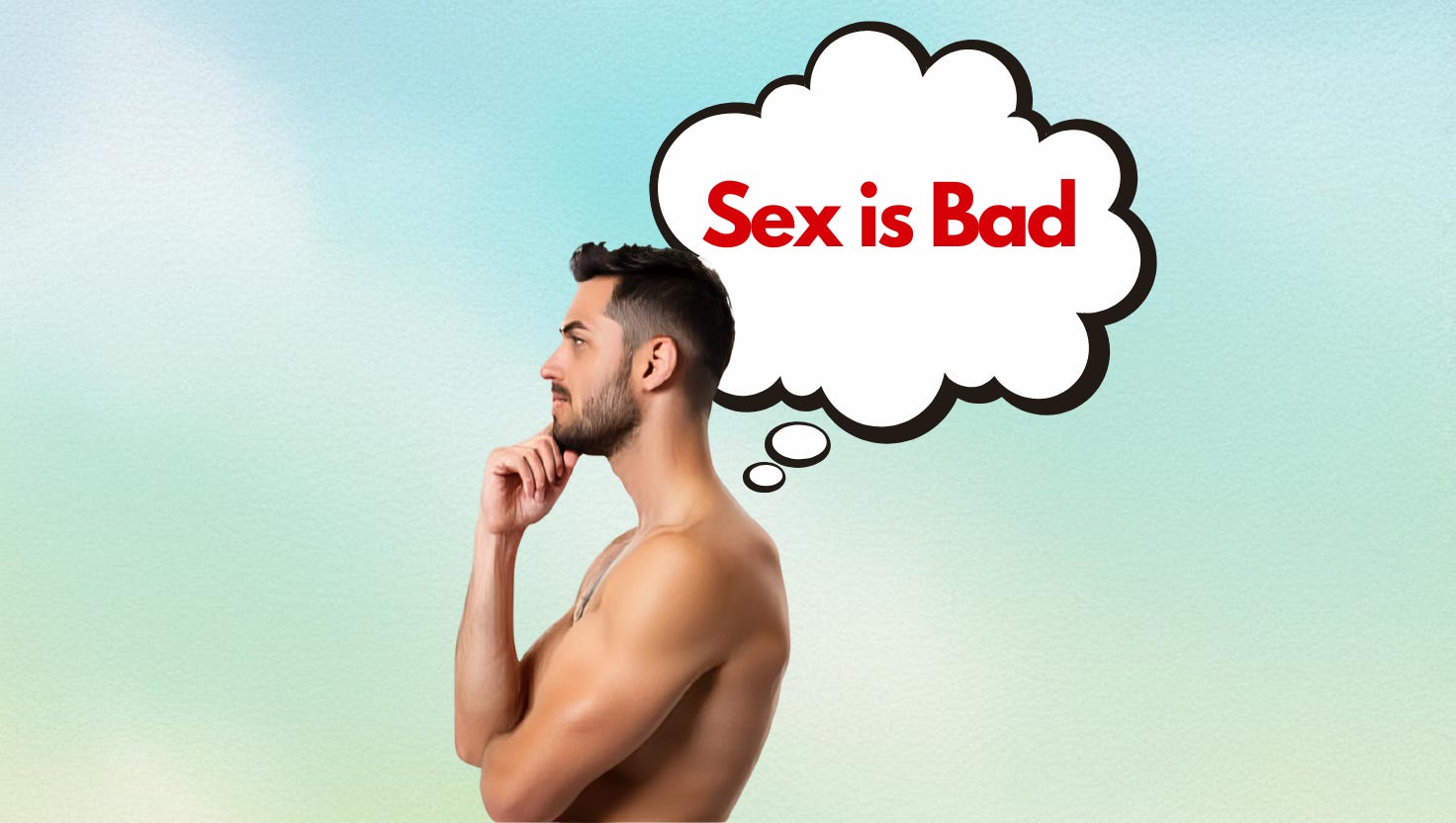
I keep wondering how “sex-positive” became a buzzword at the exact same time everybody started having less sex. When we live in a reality where medication protocols like PrEP and DoxyPEP can prevent a person from acquiring or shedding HIV and STIs, when U=U, why are we having less sex now than when sex was literally deadly?
Race Bannon, who writes the Substack Love At The Edges, shared a story in his post, From Passion to Performance, that may explain some of it.
“I was attending a large gay men’s kink play weekend. One of my friends there said he had talked to a guy who my friend had noticed was not interacting sexually or erotically with anyone, running counter to the weekend’s intent. My friend said the guy told him “he was afraid to do anything because he might make a mistake.”
In the United States, the sexual revolution of the ‘60s and ‘70s made it seem like we were finally abandoning our sexual hangups. Then, pandemics, socializing on screens, and educational efforts, in both academic settings and niche sexual enclaves like the one Race shared, make us all feel more like we’re taking a final exam than experiencing sexual liberation.
If the idea of sex fills you with trepidation, like you might make a huge mistake engaging in it, that makes perfect sense. You have been told sex is physically, socially, and intellectually scary for decades.
But, with isolation and loneliness now killing men at an alarming rate, with gay men being impacted even higher than non-gay men, it’s foolish to ignore the positive physical, mental, social & romantic, and spiritual benefits of skin-to-skin orgasm.
There are many reasons why people think sex is bad, and once we admit to having that feeling, we might be able to ask why we feel that way and be able to move past it.
Let’s go way back.
The authors of Sex at Dawn, an anthropological study of human sexual behavior, argue that humans didn’t care about who was fucking whom until we started owning things. Before that, when we were nomadic hunter-gatherers, the sperm donor was not all that important. Caring for the tribe’s offspring was.
When we became farmers, land and property ownership became tied to paternity: Who’s your daddy?” became a critical question, and sex started getting weird. It was no longer just about fucking; it was about property and power. Kings and peasants. Law and order.
In 1620, Puritans and Pilgrims settled in North America, bringing their hyper-paternal ideology with them that we still feel today: monogamous, baby-making sex is the only holy sex: end of message.
American politics illustrates our country’s ongoing devotion to scandalizing sex. Here’s a lengthy list. Sexual scandal is an old political fetish that never goes out of style.
The Sexual Revolution
In 1960, birth control pills were invented, paving the way for straight people to experience sexual liberation.
With sexual liberation in the air, gays flocked to San Francisco and other major cities where they harnessed their sexuality as a form of power. Sex was a unifying rite of passage. Alluding to and consummating dude-on-dude shenanigans was a political act of solidarity and liberation.
Then, AIDS
I was lucky enough to sample gay sex before AIDS, before I saw it mercilessly kill my best friend, Alvin, my boyfriend, Tony, and my mentor, Gustav, and a quarter million other gay American men over 12 years.
That kind of trauma does not occur without leaving a mark on the soul of a community anchored in sexuality. It was truly traumatizing and has left a permanent mark on the psyche of gay men.
Guys now in their early 40s learned sex education from the Grim Reaper himself. “BANG YOU’RE DEAD!” “No ifs, ands, or cures.”
Sex will kill you.
Bathhouses and sex clubs were closed, regulated out of existence, or left limping along in a legally dubious state, making them unattractive to investors. We see the rotting corpses of those establishments still languishing in Los Angeles: FLEX, Slamer, and North Hollywood Spa.
The appalling facilities and our inability to make them legal again manifest our collective attitude toward gay sex, and the Google reviews illustrate what we think we deserve.
“The whole place smelled of urine, and it is not maintained. It’s filthy, neglected, and has seen better days.”
The fallout of AIDS is still with us.
Gay sex was against the law in 13 states until 2003.
Until the 2003 Supreme Court Of The United States (SCOTUS) decision, Lawrence v. Texas, butt sex was still forbidden in 13 states (including Nebraska, Wyoming, and Idaho, where I grew up). Before that, even if you were doing it in your own home, behind closed doors with another consenting adult, you were breaking the law.
That kind of institutional threat is hard to shake off.
Pre-Exposure Porphylaxis (PrEP)
With the introduction of pre-exposure prophylaxis (PrEP) medication in the summer of 2012, we finally had a tool to thwart the horrific menace of AIDS.
This should have been a good thing, like something we would have thrown a parade to celebrate.
Instead, in a bizarrely ironic flame-out, the President of AIDS Healthcare Foundation (AHF), Michael Weinstein, hated the new treatment, calling it a “party drug” and “a public health disaster in the making.” Weinstein is one of the most significant forces behind the “sex is bad” narrative, spending tons of time and money to keep sex dangerous and scary.
Many guys went on PrEP anyway, but very discreetly, because the largest AIDS care institution in the world said it was bad.
Quietly, we went from seeing pages and pages of obituaries, the names and faces of dead gays in every issue of Frontiers Magazine, every two weeks, to seeing practically none.
For those with access to healthcare, HIV transmission rates plummeted.
“But PrEP doesn’t protect you from other sexually transmitted infections!” the naysayers pointed out.
Sex is still bad!
So, the gays wanting to be perceived as good people (that’s most gays) stayed quiet.
Marriage Equality
How could this be a bad thing? Stay with me.
In 2015, the SCOTUS decision, Obergefell v. Hodges, gave same-sex couples the right to marry. Gays could now legally participate in one of the most overtly shared rituals in civilized society. Along with the dignity of equality came the lure to join heterosexuals in the social climbing games of polite society.
No longer marginalized by the law, gays could join straight people in competition for social prestige, where married, monogamous, and parented citizens reign supreme.
Open, shame-free sexual liberation was not (and is not) an asset for those wishing to pursue the adulation of general society. With marriage equality, gays went from being society’s archetypal holders of sexual liberation to becoming general society members afraid of being put on the sex scandal list with everyone else.
#MeToo unveiled lots of bad sex.
The #MeToo movement went viral in 2017, and women finally started to have their voices acknowledged regarding sexual violence. We learned horror stories outlining truly bad sex: non-consensual sex, rape, power manipulation, and coercion.
#MeToo was necessary and good, but it had a chilling effect on the discussion and practice of sex. With so many horror stories in the air, it was hard to find reasons to celebrate sex.
COVID-19 made human contact deadly again.
COVID hit in 2020, and we learned to be afraid of everybody: death tolls and injections on every news cast. Social media algorithms pushed fear to the top of our feeds. We logged more screen time than ever in human history.
We began to fear other human bodies and have less sex.
Then, we had to relearn how to share the same side of the sidewalk, share the same air with other humans, and touch other human beings again.
We’re still recovering from that trauma.
“Safe, Sane & Consentual”, “Risk Aware Consensual Kink”, “Stranger Danger”, “Enthusiastic Consent.”
Rather than frame sex as a powerful experience capable of enhancing emotional, physical, and relational growth, sex was framed as a seductive monster; sexy and alluring, but ultimately dangerous and damaging.
As Race mentioned in his article, many of our efforts to make sex, especially exotic sex, accessible, focused on danger while we forget the liberating parts. Most “sex education” is focused on the horror stories of sex gone bad.
It’s no wonder a young person today would rather abstain than face the beast.
People’s brains are full of so many sex-related horror stories, from disease to rape; it’s just too much. Add to that a new commitment to screen-based socializing, which strips humans of the ability to interact in person, and we have a recipe for isolation, loneliness, and less sex.
DoxyPEP
In 2022, San Francisco issued guidelines for DoxyPEP, enabling people to avoid most sexually transmitted infections (STIs). In 2024, the National Institutes of Health (NIH) did the same.
The naysayers’ last bit of science proving sex is medically bad for you has evaporated.
Quietly, again, very quiet because sex without medical consequences is apparently nothing to celebrate in the press, sex is medically safer than ever before.
But we’re not celebrating it. We’re role-playing 1950s America instead.
We currently hide gay sex in the shadows like it’s the 1950s.
Instead of looking for shoes tapping under a public bathroom stall wall, we launch our sex apps, tap a two-dimensional screen, and have hookups that often feel two-dimensional as well.
Guys are fucking in warehouses, condos, cars, bushes, gyms, cars, bathrooms, and anywhere there’s eager eyes and a bit of cover. Guys sucking cock are getting kicked out of gyms and dance parties. Warehouse parties are being raided and shut down.
Remember when gays had their clubs raided and shut down? Like, three months ago. Way back in the summer of 2025. Looking at you, Los Angeles. Sorry DenLA.
WTF?
We deserve better!
Our dignity requires that we fully embrace ourselves and the same-sex attraction that makes us a community in the first place.
To do that, we need to believe that sex is good.
Medical science has weighed in: Sex is good.
As I said at the top of this piece, sex improves our lives physically, mentally, socially & romantically, and spiritually.
Here’s the breakdown.
Physically, it’s a workout. Physical activity is good for us. If you’ve ever been in a darkroom crammed with guys engaged in sex, you’ve felt the literal heat generated from engaged muscles, elevated heart rates, and calories burned. That’s good for your heart health, lowering your blood pressure, and reducing the risk of stroke and hypertension. It’s good for your prostate. It increases your libido, which creates a positive feedback loop. More sex, more sex benefits. Repeat.
Mentally, we are treated to doses of dopamine, endorphins, and oxytocin — brain chemicals that increase motivation, focus, and compassion while lowering pain and stress. This explains the big dick energy swagger we often feel after a satisfying encounter: we feel strong, capable, and open to other people’s feelings.
Socially & romantically, sex generates affection, cuddles, and trust. We become attached to the person or people we share the experience with. Pillow talk is a result of this affection and trust. We open up. We connect. We communicate and seek to understand each other.
This is particularly useful for a group whose primary commonality is sexual in nature. (Gay men) When we do our best to help our fellow gays have good sex, we are building community. A real-life community you can see, touch, and feel on many levels.
Post sex conversations in bars, bathhouses, and sex venues (where they have created places to talk) have been some of the most honest, heart-opening discussions of my life.
Spiritually, sex brings us into the present moment and can make us feel connected to something greater than ourselves; to something spiritual.
~Ram Dass was a Harvard professor and psychologist who became a Yoga guru after a life-changing trip to India.
So, if you still feel like sex is socially intimidating, unsafe, and cringeworthy, it makes perfect sense. But that second thing is almost never true. It’s medically safe.
The psychological and social parts of this attitude shift are ours (as a community of men who have sex with men) to address. If we don’t, we are ignoring a powerful tool capable of mitigating the life-threatening effects of isolation and loneliness.
Love yourself, love your boner, and make friends.
Until we meet again, please be good to yourself,Mike