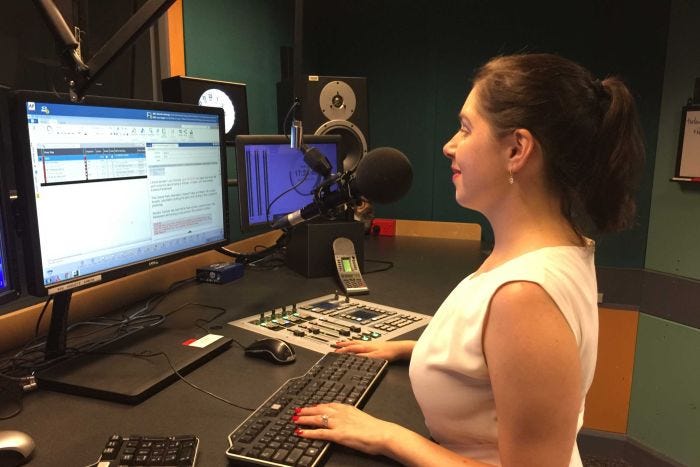
In this latest Streets of Your Town—The Journo Project podcast, journo extraordinaire and Triple J newsreader Nas Campanella.
Just click on the play button above for your listening pleasure!
This week’s Journo Project features Nas Campanella, who is thought to be the only blind newsreader in the world.
Nas is a journalist and radio newsreader on the ABC’s national network, Triple J, and a proud journo who has wanted to do this job since her teens.
She secured a highly sought after ABC Cadetship in 2011, spending her first year newsgathering in Sydney before moving to Bega where she began newsreading.
Nas lost her sight when she was six months old and uses an audio speech program to help her read the radio news bulletin. She doesn’t read braille.
“I’m very, very fortunate that I was born in a time and grew up in a time where all this amazing technology has been developed and enabled me to thrive and given me opportunities that other people who were blind decades ago would never have been able to do, which is amazing,” Nas says.
“For too long, stories about people with disabilities, they haven’t been told by people with disabilities so I really am quite keen to change that and to show the community that people come in all shapes and sizes and even though a person might not communicate in the way that you or I do, they still have a voice, they still have a story to tell and it’s a damn important one and they deserve the time in the public to share that story if that’s what they choose to do.
“I think having a public profile on Triple J and now on television has meant that I’ve somewhat normalised the fact that people with a disability, not only can they work, but they can work really hard and in high profile roles and that it’s possible because the ABC’s made it possible and shown people that it can work really well and that it doesn’t take huge amounts of money or huge amounts of support.
“I don’t need a person to come and hold my hand to do it. I’m fine on my own.”
In 2013, Nas joined Triple J, where she produces, writes, and reads the news several times a day.
You can hear what Nas hears while reading the news in this story:
Her typical day at work would make many people’s heads spin.
“You’ll know the local, national and international stories of the day, even before you step foot in the office. I would’ve been listening to probably three different radio stations across the morning, just flicking, have a look at some of the headlines in the papers and online and things like that so you come in and so we’ll go through the stories that pop in on the ABC wire,” Nas says.
“We might rewrite the stories, cut our own audio, we do our own interviews and write our own stories as well, and so you’ll put those stories into a bulletin of three minutes exactly and then pop into the studio and read it and then you’re obviously repeating that for several hours.
“After you come off the air, you’re writing stories again, even though you’re writing in between the bulletins.
“Then I often do a story for Hack or a story for one of our flagship current affairs programs like AM. Last Friday, between my bulletins, I was doing interviews, cutting audio, writing a script for Saturday AM, I had a story about how coronavirus is impacting the disability community.”
After her ABC cadetship, Nas was determined to have a regional posting, with the experience still informing her work as a reporter and newsreader today.
“After my cadetship, which was a steep learning curve, most cadets go off and do a regional placement and at the time, I was offered a full time ongoing position in Sydney, it was going to be really cushy and great and no one had ever been offered that before, but I was pretty devastated because I wanted to be given that same opportunity to go and professionally and personally have that regional experience,” she says.
“I just wanted to be treated like everyone else. That’s all I’ve ever wanted, that’s all anybody wants, and I thought if everyone else is going off for this new challenge, this new chapter, then I need to do the same thing.
“I was really lucky that the ABC made that happen and I went off to Bega, in the New South Wales far south Coast, and I was there for 12 months and that was where I really learnt to be a journalist.
“No one was feeding me stories, there was rarely press releases that came in, it was all about making good contacts and keeping those contacts and keeping your ear to the ground and listening to what was going on and coming up with the news agenda of the day for a huge region.
“For me, when I went down there, it seems really trivial but I have this thing that I wanted to milk a cow, shear a sheep, and go fishing and I did all of them and it was on these amazing farms with these amazing people and I came back with stories and beautiful life experiences that I’ll cherish forever.”
Above: Paul Kennedy, Lisa Millar and Nas Campanella presenting on ABC News Breakfast
Not one to stop there, Nas is now also an accomplished television reporter, sending reports around the country from the Disability Royal Commission and also filing from overseas.
As Nas explains on this episode of The Journo Project podcast, she hopes that her example gives Australians a glimpse of how much people with a disability are capable of.
“When I first started in journalism way back at uni and people were often saying, ‘Oh, you’ll never be able to do television. It’s not going to work’,” she recalls.
“I had multiple reasons why thrown at me but I think it’s been really gratifying to now do it, and to show others than I can actually work when you put the right supports in place and I’m really lucky to have an organisation and a team behind me that are willing to make it work and that’s all you need.”
She says her reporting from the Disability Royal Commission has been incredibly challenging, but rewarding.
“It’s been emotionally draining and physically challenging as well in terms of so many commitments in terms of TV, radio, online, live crosses and all those types of things but I’ve really loved it,” she says.
“I’ve loved being there to talk to witnesses after they’ve come out of giving really personal intimate, sometimes very tragic, stories and evidence and I feel a huge responsibility because we don’t have many journalists who at least publicly identify as having a disability.
“It’s really great for me to feel like I can be a person who people can feel comfortable to talk to and that I have a level of understanding and knowledge of the sector that perhaps other journalists don’t, and I can bring a level of analysis to the story that others might not be able to.
“What I’ve loved is that my managers have expected of me what they expect of every other journalist and that is to file accurate, fair, balanced stories to the deadline that’s expected.”
Nas is also changing the way the ABC operates too. Before the start of the Disability Royal Commission, she developed ABC’s first disability editorial guidance note, that is a guideline for journalists anywhere on best practice when reporting disability issues.
“It’s publicly available and it’s just really quite frankly simple common sense tips and tricks,” she says.
“Don’t ask someone about their disability if it’s not relevant to the story, don’t patronise.
“If you are there with a person who is deaf or hard of hearing, address them, don’t address your questions about them to their interpreter.
“You can still put people who are deaf or hard of hearing on radio, you just need to find an interpreter to facilitate that.
“I think as long as you come from that perspective of wanting to empower rather than patronise or just to remember that you’re supporting people to tell their story is a good place to start.”
Behind the Scenes
It’s incredible looking back on this interview with Nas and that we managed to just get it in before th…