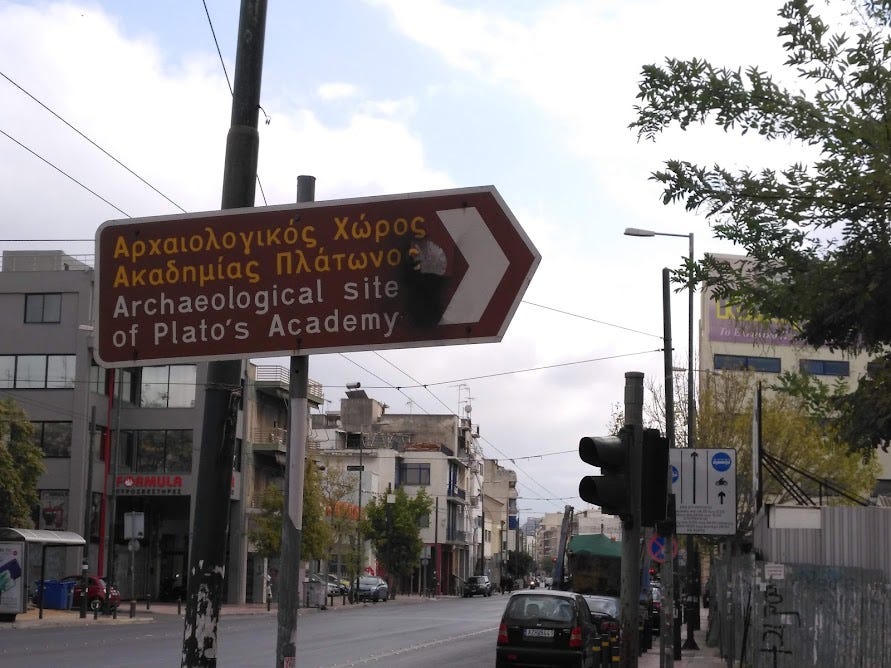
This is a talk given by Donald at the original location of Plato’s Academy, in what is now Plato’s Academy Park, near the centre of Athens. He discusses the history of the park from Socrates, through Plato, to the Stoics, and what the future may hold, describing the plans of the Plato’s Academy Centre to create a conference centre near the original location of Plato’s school.
Transcript
This is a talk that I delivered in the grounds of Plato’s Academy Park in Athens, in September 2022, as part of a four-day event organized by the Aurelius Foundation and YPO or Young Presidents Organization. The mayor of Athens also spoke that day about the importance of celebrating this historic location, near the city centre. Our nonprofit startup, The Plato’s Academy Centre was created in Greece in order to raise awareness of the area, and we hope, ultimately, to help create a new conference centre there so people can come from all over the world to do philosophy and benefit from ancient wisdom, at the original location of Plato’s Academy.
Philosophy at Plato’s Academy Park
Behold
Where on the Aegean shore a city stands,
Built nobly; pure the air, and light the soil;
Athens, the eye of Greece, mother of the arts
And eloquence, native to famous wits,
Or hospitable, in her sweet recess,
City, or suburban, studious walks and shades:
See there the olive grove of Academe,
Plato’s retirement, where the Attic bird
Trills her thick-warbled notes the summer long…
That’s how the English poet, John Milton, envisages this place in his epic Paradise Regained.
According to legend this area, known as Akadimia, originally belonged to, and was therefore named after, the Greek hero Akademos. He reputedly saved Athens from being sacked by the Spartans, when Helen of Troy was still a child, according to legend. So the land became sacred to his memory. Over the years it was cultivated into a public area of pleasant olive groves, and gardens, with streams, running-tracks and popular walks shaded under the trees. Over time, a palaestra or wrestling school was built here, the ruined foundations of which can still be seen in the grounds of the park. It could perhaps be described as an ancient Athenian recreational ground, although in addition to sports facilities, there would have been shrines and libraries here. Young men exercised here in the nude, and older men walked among the groves, discussing politics and philosophy.
The Academy was destined, as you know, to become synonymous with philosophy, and more famous than Coca Cola because, ever since, down to the present day, every other academy in the world bears its name. Every single one of you has heard of this place. And every thinker, every politician, every psychologist, that you admire, thinks and speaks as they do, at least in some small part, because a few hundred of their ancient predecessors were schooled where you’re now standing.
Socrates
The Academy is justifiably famous for being the home of Plato’s school, the first institute of higher learning in European history. However, as we walk here, we’re following in the footsteps of many other great philosophers, not just Plato. Perhaps most importantly of all, from time to time, Socrates himself walked here, long before Plato, his most famous student, was even born, posing questions about the nature of wisdom and what it means to live well. Plato’s dialogue named Lysis opens with Socrates walking from the Academy to the Lyceum, and we’re told he often discoursed on philosophy in the gymnasia of Athens as well as in the Agora, and in the homes of his friends. We’re bound to imagine Socrates strolling under the trees here, casually discussing philosophy with his acquaintances.
Plato
Plato was a young man about twenty years old when he first encountered Socrates. He became his devoted student and remained so for eight years, until Socrates was executed, forced to drink hemlock, in 399 BC. Plato must have felt utterly disillusioned by Athenian politics and the way his mentor had been treated. He left Athens, travelling to other regions where he studied with other philosophers. On his return to Athens, about twelve years later, his friend and patron, Dion of Syracuse, it is said, “bought for Plato the little garden which is in the Academy”, where he made his home, and based his school, consecrated with a shrine to the nine Muses. We’re therefore told that Plato “lived in the Academy, which is a gymnasium outside the walls, in a grove named after a certain hero, [Akademos]” (Diogenes Laertius).
Plato spent the next four decades teaching philosophy here. He had many students. The most famous was, of course, Aristotle, who came here aged seventeen, and studied at Plato’s Academy for twenty years, although he would later set up his rival school in a gymnasium at the other side of the city, called the Lyceum, part of which is now a pleasant garden, open to visitors. Can you imagine Plato and Aristotle, the two most brilliant minds of antiquity, walking among these trees, talking most intensely with one another, about the nature of wisdom, for two whole decades?
When Plato died we’re told he was buried in the Academy, and a huge procession of his students turned out for the funeral ceremony. A statue of him was erected here by his friends, and a tomb, which bore the following epitaph:
Earth hides Plato’s body in her bosom,
But his soul has an immortal station with the blessed.
Ariston’s son, whom every good man, though living far off,
Honors for glimpsing the divine life.
Later another epitaph was composed for him, which reads as follows…
Eagle, why do you swoop over this tomb? Tell me,
Do you gaze at the starry house of one of the gods?
The eagle replying, says,
I am an image of the soul of Plato, which has flown to Olympus,
While his earth-born body lies in Attic soil.
This is the resting place, in other words, of the most celebrated philosopher in history. His remains may still be beneath our very feet.
Zeno
For centuries, the Academy remained a centre for the study of philosophy, and, indeed, a beacon of civilization in the ancient world. It had quite a colourful history. For instance, a generation or so after Plato’s death, so the story goes, there was a wayward youth called Polemon who would hide bags of money in the grounds of the Academy “to procure”, we’re told, “the immediate gratification of his desires”.
Polemon was a drunkard, perhaps an alcoholic. One day he burst into a lecture on philosophy, intoxicated and reeking of wine, with a garland on his head. The lecture on temperance, being delivered by one of Plato’s successors, was so persuasive, though, that young Polemon abandoned his hedonistic lifestyle and adopted the ways of a model student. After years of industrious study, he actually became himself the head of the Academy. His self-control became so legendary that it was said he remained unmoved even when bitten on the thigh by a rabid dog, though his friends were panicked on his behalf.
Polemon’s story is that of an intemperate young man who managed to turn his life around and ended up becoming renowned as a philosopher and a role model to others. We’re told that he chose to withdraw from society and, it is said, to “confine himself to the Garden of the Academy, while close by his scholars made themselves little huts and lived not far from the shrine of the Muses and the lecture-hall.”
The Academy’s name is synonymous with the philosophy of Plato but it also plays an important part in the history of the Stoic philosophy, which you came here to learn about. Around the same time that Polemon staggered drunk into the Platonic Academy, a Phoenician merchant, called Zeno of Citium, was shipwrecked at the nearby port of Pireaeus. Having reputedly lost his entire fortune at sea, Zeno turned to the study of philosophy. He began as a Cynic ph…