This is the second part of an essay about Zadie Smith. You can read the first part here. As an experiment, I have recorded this essay so you can listen rather than read. Let know what you think…
Both essays are partly paywalled. But, good news, there’s a summer sale—20% off a subscription if you sign up before September 13th.
Don’t forget, the next bookclub is this Sunday 10th September, 19.00 UK time. We are discussingThe Annotated Alice.
My next salon, in October, is about sonnets.
Zadie time
The only poem Zadie Smith knows by heart, apart from some Shakespeare, is ‘Animals’ by Frank O’Hara. (“In the brain space where memorised poems should be,” she once said, “I have a large collection of rap couplets.”) ‘Animals’ is about looking back from middle-age to youth. “It’s no use worrying about Time,” O’Hara writes, straight after remembering a time when “the day came fat with an apple in its mouth.”
The obvious image that brings up is a pig, ready for feasting—a symbol of fleeting youth, inevitable death, and all that jazz. One day you’re a pig in the field, the next you’re roasted It might be no use worrying about time, but that’s because it’s inevitable.
‘Animals’ is about looking back to a time when “the whole pasture looked like our meal”. Not youth itself, but the changed perspective that comes with middle-age. This sense of time changing our perspective of the world might be the central theme of Smith’s work.Talking about how she gets started on a book, she said:
the writing process... for me, is usually “I started at page one and kept going” or “I was struck by some tedious trauma from my childhood and had to make it into a novel to be free of it.”
Struck by some tedious trauma is a nice Larkinian phrase and it sums up the way that Smith makes her bigger arguments—about the importance of equal access to beauty, or the loss of the post-war social order—through stories of ordinary life and her changed perception of the past. So many of her novels are driven by one generation not knowing how the other understands the world. As she told BU Today:
It’s so hard to understand when you’re 19 or 20 why middle-aged people are like they are or why marriages continue. You don’t understand any of it, you just wonder, what’s wrong with you people? And then, of course, you become middle-aged and go, ah, OK, I get it now.
Smith has talked about the importance of time in historical perspective, too. The essence of Swing Time is the interruption of history, the forced changing of a people’s times.
…what was done to black people, historically, was to take them out of the time of their life… who knows what would have happened — nobody knows. But it would’ve gone a certain way, and we were removed from that timeline, placed somewhere entirely different, and radically disrupted.
That sense of being dislocated in time is, of course, the basis of Howards End, which opens with an engagement between two people from different social classes. A tremendous fuss is caused—but by the time Helen arrives to sort it all out, the engagement is over. The characters are removed from one timeline and put into another one. It was a minor affair, barely that, but it changes the course of all their lives. You might call it some tedious trauma.
Howards End was the model and inspiration for On Beauty. (See part one for more details.) Both are novels about the contrast of aesthetics and pragmatism. But On Beauty is essentially about arguments of literary criticism and aesthetic philosophy.
Forster might be the least intellectual of the Bloomsbury writers. Why take him as a model? To understand that, we first need to go back to Smith’s other source—Elaine Scarry’s 1999 lectures On Beauty and Being Just
On Beauty and Being Just.
On Beauty contrasts the unaesthetic ideas of Catherine Belsey (the critic who believed Shakespeare’s plays are not works of art but “a location of cultural history”—curses upon her) with the revival of beauty espoused by Elaine Scarry. Howard represents Belsey (which is why he shares her surname) and through his own misdeeds and midlife crisis—and a good dose of comeuppance—comes to realise the truth of beauty. As Adam Kirsch says, in a perceptive essay, “Howard’s downfall… is the revenge of beauty.”
Scarry’s lectures are full of common sense, occasionally couched in the cant jargon of modern literary criticism. Here for example is the opening paragraph, which finally comes alive in the final sentence.
What is the felt experience of cognition at the moment one stands in the presence of a beautiful boy or flower or bird? It seems to invite, even to require, the art of replication. Wittgenstein says that when the eye sees something beautiful, the hand wants to draw it.
Scarry talks about the way we make errors about beauty—we can see beauty in new places where we don’t expect to find it. We also know that beauty fades. Beauty makes us accept transience.
The first idea is used in Howard’s work as an art historian—like Catherine Belsey, he denies that art can be beautiful, but then he is moved to tears by Mozart. And the delusion of infinite beauty is what drives him to commit adultery with two women who both look somewhat how his wife used to look. He finds beauty in an unexpected place and is confronted with transience. To make sure you don’t miss this point, the Mozart is played at a funeral.
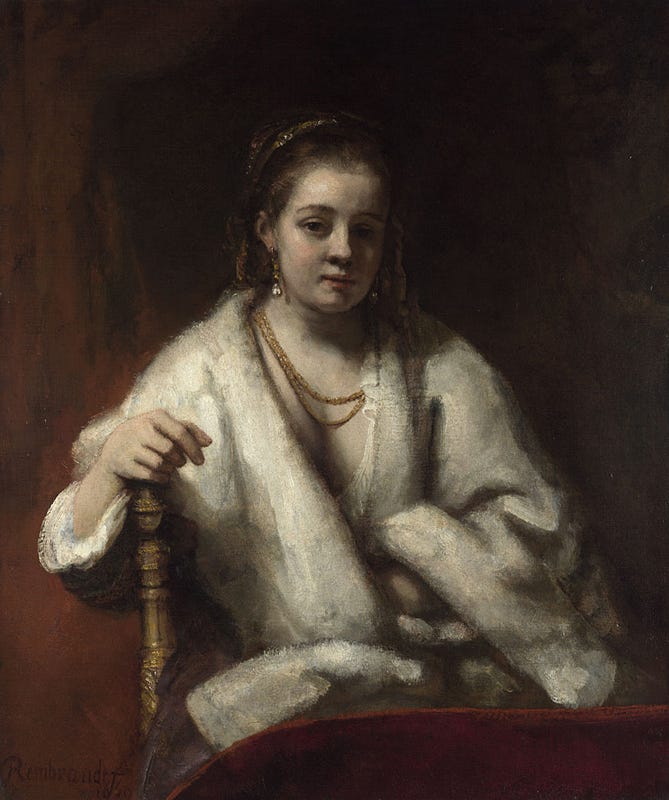
Smith makes nice irony out of Howard’s problems. In the classroom he makes Scarry’s first mistake: he cannot see the beauty in Rembrandt. Out of class, this leads to the second mistake: he hasn’t remembered that because beauty is real, beauty fades. Howard tries to swing through time, back to youth, to a place where beauty was felt, not a mode of discourse or a method of radical decentering or any of the other theoretical phrases he might use.
Howard cannot start to see life clearly while he is clouded with the ideas of his theories. He had become dogmatic and middle-aged. Beauty shakes him out of his dogmatic slumbers.
“greatness appears suddenly; like a thunderbolt it carries all before it”
You might wonder if Scarry’s book amounts to a sort-of admission that Harold Bloom was partially right, that literary criticism ought to owe as much to Longinius as it does to Aristotle. Aristotle gives us genre, structure, character, mimesis, and so on. Longinius gives us the sublime. Aristotle analyses literature: Longinius feels it.
Great writing does not persuade; it takes the reader out of himself. The startling and amazing is more powerful than the charming and persuasive, ... [and] greatness appears suddenly; like a thunderbolt it carries all before it and reveals the writer’s full power in a flash.
That was what happened to Howard with the Mozart. It’s what Scarry means about beauty surprising us into aspiring to the truth. Without the thunderbolt, art cannot function. The thunderbolt flashes and shows us the world—there are eternal truths, beauty is real.
And of course, when the thunderbolt hits, you are taken out of your time. Great literature—great beauty—can make us see our lives again in different terms, as Howard and Kiki do at the end.
The brilliant and the banal
What, then, does this have to do with Forster? The fact that Forster’s novel relates to Smith’s notions of time doesn’t quite explain why Smith used it as her model. He’s hardly an intellectual novelist. For all his talk of Schlegel, and his descriptions of Beethoven, he wasn’t using his fiction to resolve academic disputes about aesthetics.
The answer, I think, is Zora Neale Hurston. Smith was given Hurston to read aged fourteen, by her mother. First, she resisted. But something about Hurston’s writing compelled her to think differently. A thunderbolt struck.
My resistance to dialogue (encouraged by Nabakov, whom I idolised) struggled and then tumbled before Hurston’s ear for black colloquial speech…
Smith wanted to “an objective aesthete, not a sentimental fool”. Hurston showed her you could be both. You can balance objective, high-minded aestheticism and sentimentality. That’s what Howards End is about. In Smith’s words, “to love Forster is to reconcile oneself to the admixture of banality and brilliance that was his.”
The serious sentimental
Writing about Middlemarch, Smith says we change our view of the characters as we age because “it is about the effects of experience that changes with experience.” Fourteen year olds cannot understand Rosamund and Lydgate’s marriage, she says, in the way that they can understand Jane Eyre. Ageing shows us too that Dorothea’s angst is far more serious than Fred’s problems. “With time, we’re less tempted to find serious only those matters clothed in Seriousness.” The young George Eliot was a puritan who went on that journey herself.
And that’s the theme of On Beauty. As we age, we are taken out of our time. Not with the violence that was committed to Africans. But still with a sense of disruption. Things that once made little sense, now do. And vice versa. Smith as a young novelist was writing in the shadow of Gravity’s Rainbow, full of something like the young George Eliot’s puritanism. With time, she was less tempted to find serious only those matters clothed in Seriousness.
Howard learns this, too. He learns not just that beauty exists, but that ideas about beauty are an admixture of banality and brilliance. This is the thunderbolt of art taking its revenge.
Without Forster as her model, On Beauty would have been like her first two books. Over-active piles of intellectual clutter. For all his banality, Forster gave Smith elegance, the sort of prose that makes you pause. It is thanks to Forster’s example, more than Scarry’s theory, that in On Beauty Smith stopped thinking like a critic, a theorist, a post-modernist, and wrote an aesthetic novel. As it did with Howard, Smith let beauty take its revenge on her.
Beauty shocks us into realising how our perspective has changed. The flash of great art illuminates things you understand now that you didn’t before.
The lesson of On Beauty is that the sentimental can be serious.