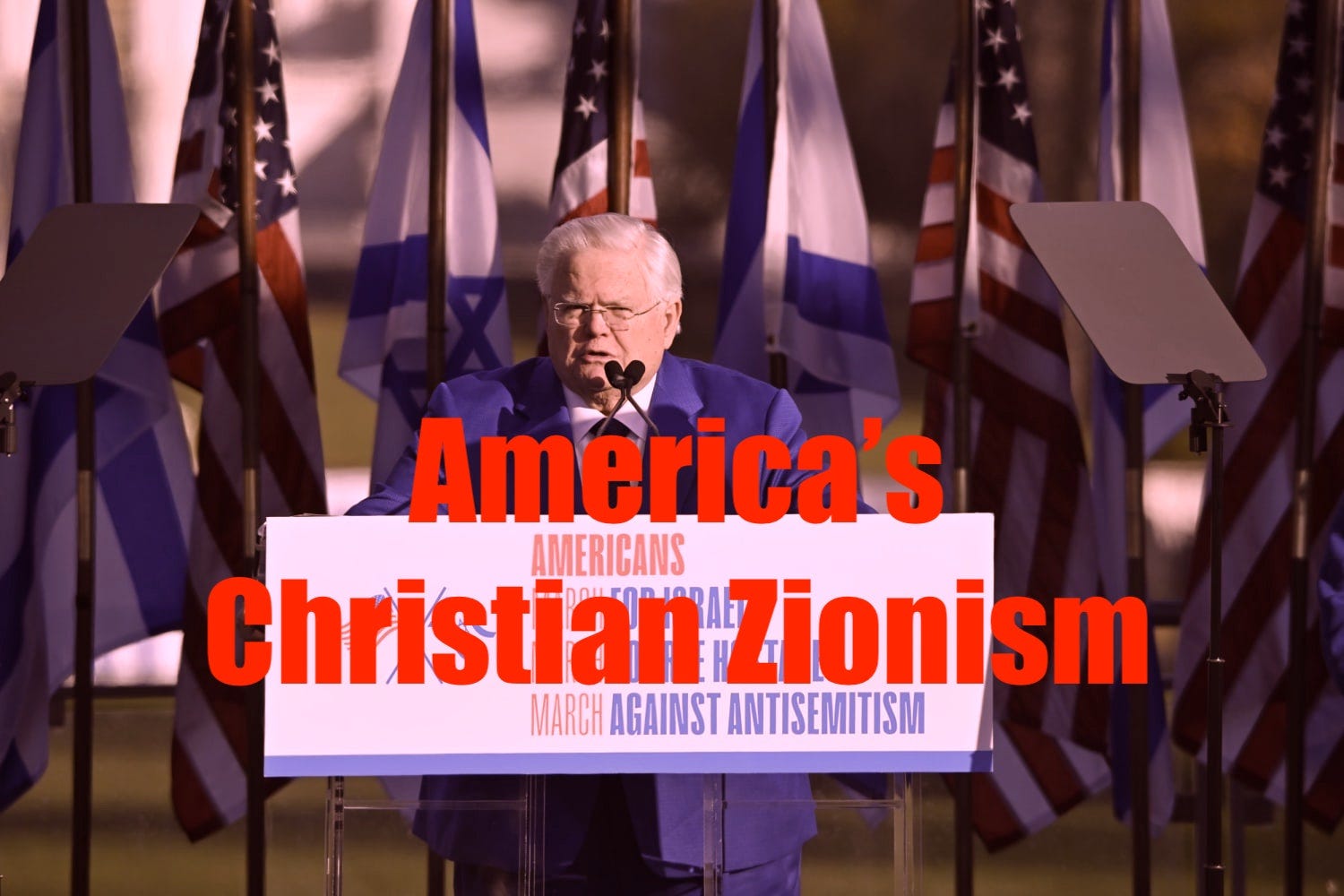
How can a faith that professes to embody God’s unconditional love support the most brutal acts of humanity, livestreamed? How can a religion that prides itself on selfless giving, saving lives, and pious living stand by, watch, and support the brutal annihilation of an entire people right before their eyes? The reason for this maddening dissonance is rooted in deep fear-programming within American Evangelicalism. I know this intimately because I was once a victim who broke free from the spell.
My Personal Journey Out of Hell
I was deeply immersed in my Christian faith.
A devout worshipper.
I loved, and still love God with my whole being.
I belonged to an all-Black Pentecostal Holiness church, where I learned about the power of faith and the living Word. I witnessed healings, miraculous interventions, financial breakthroughs, and moments that felt like heaven opening on earth. Being a woman hungry to please God, I was easy prey for hypnotic Word of Faith teachings that fused rhetoric with displays of power. In my mind, if the power was real, then God must be present.
What I couldn’t yet imagine was that corruption and miracles could coexist, that humans could stand amid what seemed like God’s power and still twist it for their own ends. That was the seed of a dissonance that would take me more than three years to escape.
Inside the church, that dissonance was easy to ignore because we all breathed the same air of duality. We were in the world but not of it. Our bodies belonged to earth, but our souls were citizens of a higher order—a divine operating system. We were taught that we possessed superior insight, a “discernment” unavailable to unbelievers. The Holy Spirit, we were told, guided every thought, whispering through Scripture and inner impressions.
But the language of guidance was elastic—vague enough to be shaped by whoever held the microphone. When right and wrong were reduced to “what pleases God,” interpretation became control. All it took were a few sacred trigger words—chosen, obedience, blessings and curses, the will of God—to keep entire congregations self-policing.
We monitored ourselves and one another, scanning constantly for invisible blemishes to purify, seeing demons in every doubt, striving to earn a love that was already promised but never felt. The result was a community primed for manipulation—hearts sincere, minds pliable, obedience guaranteed to whoever was anointed “leader.” That was my spiritual training ground.
The Fracture
When the world locked down in 2020 and our collective gaze shifted online, I watched the dissonance I had long ignored metastasize. Donald Trump turned outrage into liturgy, and American Evangelicals called it revival. I watched believers defend the indefensible; cruelty, vulgarity, violence, racism, because they had been conditioned to equate power with divine favor.
The harder they twisted to justify him, the clearer the truth became: the faith I loved had been hijacked. My excuses ran out. Their devotion to his depravity broke the last tether of my denial.
That rupture began my deconstruction.For the next three years, I questioned everything; every verse, every sermon, every fear. My only compass was the rule I had once recited without understanding: God is love. That single truth became my doorway out of hell.
It was agony. Each time I doubted, Scripture surfaced in my mind like a weapon; verses of wrath and warnings of apostasy. I would fall asleep terrified that God might kill me for thinking. I woke relieved just to be alive. Alone, I wrestled with a God who no longer fit the cage I’d been given, until love, not fear, became the only voice I could trust.
I understand why many Christians watch what’s happening to the Church and yet feel powerless to intervene. For some, belonging to the collective matters more than truth itself. The thought of being ostracized, cut off from community, family, or salvation, feels more unbearable than death. Breaking free from mental and spiritual control is terrifying.
But this is where the rubber meets the road: every believer is called to heed God’s Word even in the face of persecution. And persecution does not always come from outside the Church; it often comes from within it. That is the true test of love, whether our devotion is to God or to our own ego’s need for acceptance.
Those who remain bound to Christian Zionism are not merely trapped in false doctrine; they are clinging to identity, power, and belonging. They have chosen ego over love. And this is the mirror now confronting American Evangelicalism: a movement that once preached freedom has become terrified of it.
Thanks for reading Manufacturing Dissent! Subscribe for free to support our work.
What the Elites Did to Evangelicalism
When I say American Evangelicalism was hijacked, I don’t mean a single coup. I mean a slow, deliberate rewiring of the American Christian soul. In the early twentieth century, the ruling class saw that religion could move the masses more effectively than any policy. The pulpit reached where propaganda couldn’t, into the human soul, where eternity could be held hostage for obedience.
So the establishment began to merge faith with nationalism, Jesus with empire, and salvation with obedience. Over decades, as the ruling class strategically weaponized media and theology schools, the message of Christ was replaced by the myth of the chosen nation. Evangelicalism, once a grassroots spiritual movement, was remodeled into a psychological operation serving geopolitical agendas.
The Cold War sealed the deal. Anti-communism became the new gospel; Israel became the proxy of divine prophecy; and the “free world” was cast as God’s army against evil. Churches became distribution centers for state ideology, while congregants believed they were defending God Himself.
Follow the Money: The Architects of Influence
Behind the curtain stood industrial titans and political strategists who understood that controlling belief is the highest form of power. Figures like John D. Rockefeller and J. P. Morgan financed advertising campaigns promoting premillennial dispensationalism, a theology that fused American patriotism with end-times prophecy. Think tanks, oil magnates, and intelligence-linked foundations built new seminaries, media networks, and prophecy conferences.
This theology, later branded as Christian Zionism, turned unconditional love into conditional allegiance. To bless Israel was to bless God; to question Israel was to curse Him. A faith once centered on mercy was converted into a machine that sanctified militarism, apartheid, and silence in the face of genocide—because it was “God’s plan.”
The Manufactured Dissonance
To maintain control over millions of sincere believers, the architects of this system didn’t need to silence conscience. They just had to confuse it. The simplest way to do that was through dualistic thinking.
They split the world into:
Good vs. Evil
God’s side vs. Satan’s side
Us vs. Them
Once that binary is established, the ruling class can accomplish any goal by plugging in their agenda as “Us/Good” and manufacturing an enemy as “Them/Evil.” Evangelicals traded their discernment and picked a team.
This is the engine of cognitive dissonance: the mind cannot hold both love and hatred, mercy and murder, at once. So it resolves the tension by spiritualizing cruelty. Bombs become God’s weapons against evil. Empathy becomes a trick of the “enemy.” To question the system or form an original thought becomes rebellion against God Himself.
It’s a closed circuit where fear masquerades as faith. The dualism gives believers the illusion of moral clarity while stripping them of moral agency. The enemy is always “out there,” never within. And as long as people believe that, the architects of power remain untouchable.
Evil by Design: How Islam Became the Devil
With dualistic thinking installed, the ruling class input Islam into “Them/Evil” parameters. And the Middle East conflict was b…