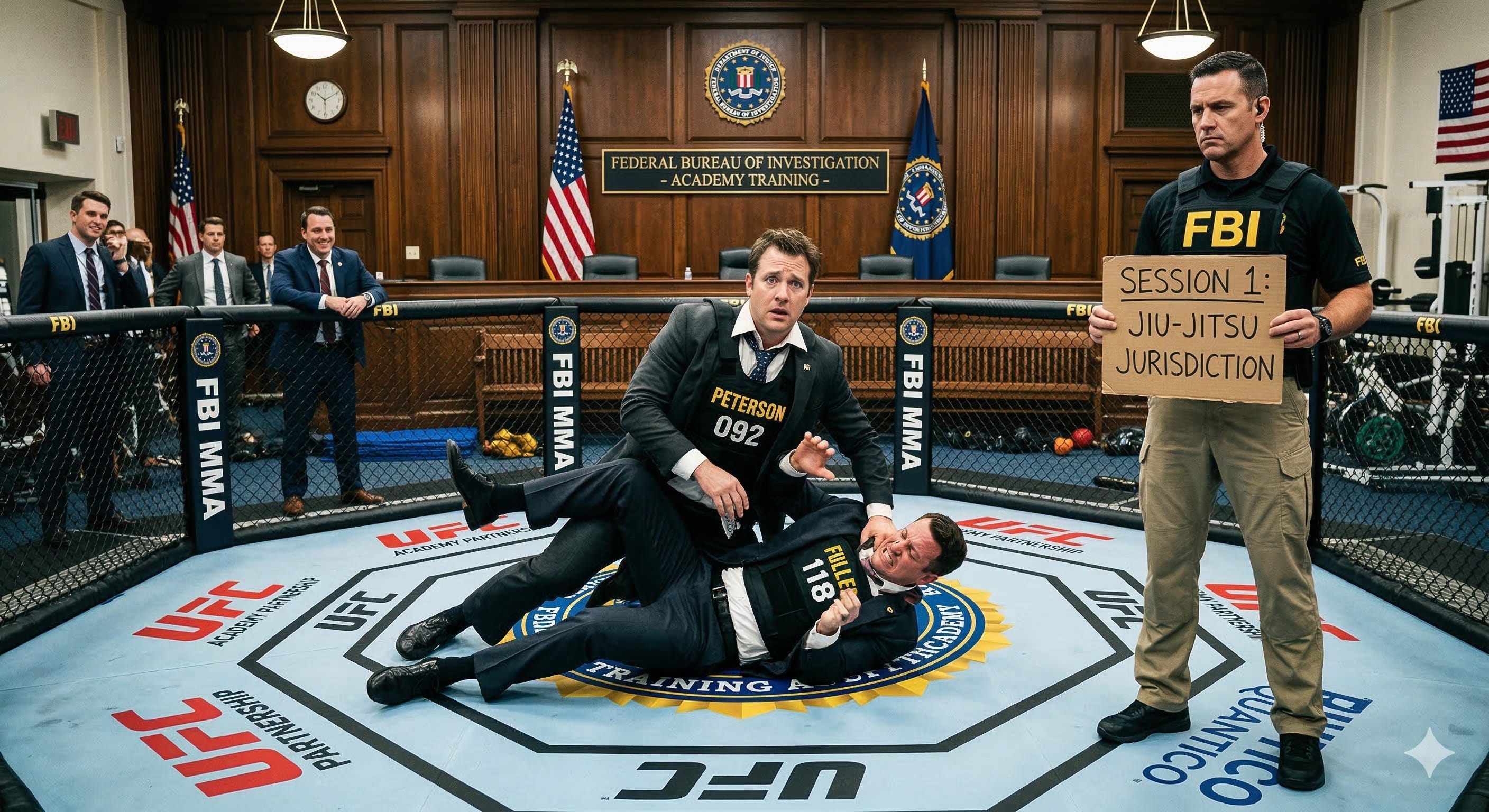
This week, Lisa and David talk about Karoline Leavitt performing for an audience of one; Trump’s weird shoe obsession signals broader, gutless sycophancy; DOGE staffers testify to prioritizing executive mandates over program merits in grant reviews; Facebook new policies will give us more clickbait videos; Washington state Spanish hotline provides accented AI English; what’s up with Ben Shapiro’s eyebrows; Pentagon calls Stars and Stripes “woke” and sets to strip editorial independence; FBI Director introduces UFC training for agents in peak “unserious” era; New "Emerging Liberty Dime" discards olive branch; Palantir CEO claims AI will shift economic power from the college-educated to working-class men; Erika Kirk appointed by Trump to Air Force advisory role despite no traditional military or academic governance credentials; McDonald’s CEO burger bite PR disaster; why Homo Sapiens might be much older than we thought; Trump endorses Jake Paul; and more.
Added Context for DOGE Staffers’ Testimony
Former staffers from the Department of Government Efficiency (DOGE) have recently testified that they were directed to review and recommend cuts to Department of Justice (DOJ) grants by rigidly applying President Trump’s executive order language, with little or no regard for program merits or statutory goals.
What the former staffers said
* One former DOGE staffer described looking at grants “through the lens of complying with” the executive order, suggesting that any program language touching on disfavored themes (like certain diversity or gender-related terms) was flagged, regardless of its public safety value.
* Documents show that Tarak Makecha, a DOGE-associated staffer with a prior connection to Elon Musk’s Tesla, created a spreadsheet identifying hundreds of DOJ grants for termination without consulting the program managers who ran those grants.
* According to accounts reported from these whistleblowers, DOJ leadership had approved this process, effectively outsourcing a major grant-screening function to a small political/ideological team rather than career grant administrators.
Scope of the grant cuts
* In April 2025, DOJ moved to terminate or rescind the remaining balances of more than 360–370 awards, originally valued at roughly 812–820 million dollars, across the Office of Justice Programs and related components.
* A later analysis estimated that grantees actually lost on the order of 500 million dollars in remaining funding, hitting community violence intervention, research, law enforcement support, courts, and victim services programs.
* Some grants were quickly restored after media and external scrutiny, including funding for pet‑friendly domestic violence shelters and similar victim‑support programs, but most remained canceled.
How the cuts were targeted
* The staffer’s spreadsheet and subsequent reviews targeted 365–373 grants for elimination, often without input from the program offices; many program managers first learned of cuts only after grantees received termination notices.
* While some defunded grants included diversity, equity, or gender‑related language, roughly 60% of the terminated awards did not reference such terms, indicating that cuts went well beyond explicitly “DEI‑branded” projects.
* Numerous terminated grants in fact aligned with the administration’s stated priorities—such as violence reduction, support for crime victims, child protection, and law enforcement capacity-building—suggesting that political or ideological filters overrode public safety considerations.
Examples of affected programs
* Community violence intervention and prevention: about 169 million dollars in initially awarded funding was eliminated, including roughly 145 million for front‑line violence intervention programs and technical assistance, plus 8.6 million for related research and evaluation.
* Law enforcement and prosecution: around 71.7 million dollars in grants were cut, including training and technical assistance tied to Project Safe Neighborhoods and other longstanding violent crime initiatives.
* Research and data: roughly 64 million dollars in grants from the National Institute of Justice were rescinded, including work on domestic violent extremism, elder abuse and financial exploitation, and hate‑crime reporting improvements.
* Courts and access to justice: about 29 million dollars in grants were revoked, including funding for capital case integrity efforts and training to protect Sixth Amendment rights to counsel, speedy trial, and an impartial jury.
Fallout and ongoing responses
* Grantees and DOJ staff reported significant disruption, including layoffs at affected organizations and a flood of calls to DOJ; staff were even given scripts for dealing with “confrontational” grantees.
* DOJ has restored at least a handful of the most politically visible or sympathetic grants, but the bulk of the cuts remain in place while grantees pursue appeals within DOJ or in court.
* The whistleblower testimony and document releases are feeding ongoing congressional and media scrutiny, and they intersect with broader litigation over politically driven grant terminations at other agencies (e.g., CDC and NIH) under the administration’s anti‑“ideological” funding push.
Videos of the DOGE staffers’ depositions about the grant cuts exploded across social media, then were ordered taken down from YouTube by a federal judge, which has now become its own controversy.
How the videos went viral
* Academic groups suing the government over DOGE‑driven grant cancellations uploaded about 25 hours of deposition video from former DOGE staffers, including Justin Fox and others, as part of their court filings.
* After a New York Times piece drew attention to the case, short clips spread rapidly on X, TikTok, YouTube, and other platforms, where viewers mocked the staffers’ inability or refusal to define “DEI” and their descriptions of using ChatGPT and keyword scans (e.g., “black,” “homosexual,” but not “white” or “caucasian”) to flag grants for termination.
* Commentary channels and progressive pages framed the clips as “humiliating” or “way dumber than we thought,” highlighting admissions that the process did not meaningfully reduce the deficit and that thousands of grants and jobs were affected.
Why YouTube removed them
* The government told Judge Colleen McMahon that the plaintiffs had improperly shared the deposition videos on YouTube, arguing that wide distribution had “no legitimate bearing” on the case and was endangering witnesses, citing harassment and death threats directed at Justin Fox.
* On Friday, the judge ordered the groups who uploaded the videos to remove them from YouTube and elsewhere online; the plaintiffs’ emergency request to keep them up was denied, at least for now, pending a hearing.
* As a result, original uploads and many embedded players in news stories went dark over the weekend, and outlets that had directly embedded the YouTube videos had to pull or update those embeds.
Ongoing circulation despite takedowns
* Even as YouTube removals went into effect, copies of the deposition footage were quickly mirrored: reporters found full archives re‑uploaded as torrents and to the Internet Archive and clipped across other platforms.
* Advocacy and partisan pages have leaned on those mirrors and on short commentary videos (which often use brief, arguably fair‑use clips) to keep the content circulating despite the takedown order.
* Critics of the order argue that taking the videos off YouTube undermines public oversight of senior officials, because the depositions go directly to how AI tools, ideology, and executive power were used to cancel large numbers of federal grants.
Added Context for Attacks on Stars and Stripes
Stars and Stripes is a U.S. military newspaper with roots in the Civil War and a long‑standing reputation for trying to be politically neutral and independent, even though it sits inside the Defense Department’s structure.
Historically, Stars and Stripes has described its mission as providing independent news and information to the military community, and external reference works echo that it operates inside DoD but is “editorially separate.”
Stars and Stripes is generally seen as providing nonpartisan coverage and to present a full picture of military life, not avoidance of critical stories about the services or civilian leadership.
This week, a senior Pentagon spokesperson publicly labeled Stars and Stripes “woke” and accused it of focusing on “distractions” and “repurposed DC gossip columns,” signaling a political realignment of its mission.
An 8‑page “modernization” memo issued March 9, 2026, tightens control by:
* Severely restricting or effectively banning use of wire services like AP and Reuters.
* Prohibiting comics and other syndicated features.
* Requiring content to align with “good order and discipline,” a Uniform Code of Military Justice term that can be used to suppress critical coverage.
* Directing greater use of official PR material and narrowing the range of permissible sources.
Impact on the newsroom and coverage
* Stars and Stripes journalists and former staff say they fear an “America First takeover” that would turn the paper into a mouthpiece rather than an independent watchdog, undermining its ability to hold military leadership accountable.
* Reporters worry they will be unable to provide timely, global coverage—especially of combat zones like the new conflict with Iran—because they lack their own reporters everywhere and have depended heavily on wire services to fill those gaps.
* The memo’s restrictions also affect everyday content troops rely on (sports, March Madness, lighter features), which has historically been part of Stars and Stripes’ service‑member‑oriented identity.
Press‑freedom and political context
* Press‑freedom groups, including PEN America, have warned that direct editorial oversight by Pentagon political appointees threatens to convert Stars and Stripes into an administration messaging outlet, rather than an independent paper serving troops.
* These moves come after earlier attempts during Trump’s first term to defund or shut down Stars and Stripes, and against a backdrop of broader contraction in military journalism (layoffs at Military Times, hollowing out of Military.com, etc.).
* The financial “modernization” plan circulating within DOD includes expanded oversight, reduced purchased content, a shift away from print, and discussion of eliminating Stars and Stripes altogether despite its relatively small cost to the Pentagon budget.
Added Context for the Air Force Academy Board of Visitors
The Air Force Academy Board of Visitors (BoV) is a statutory oversight panel created by Congress to keep an external eye on how the Academy is run and how it develops future officers.
Key functions include:
* Reviewing morale, discipline, and quality of life for cadets and staff.
* Evaluating curriculum, academic standards, instruction, and “academic methods.”
* Looking at physical equipment, facilities, and fiscal affairs at the Academy.
* Visiting the Academy periodically and then submitting formal reports and recommendations to the Secretary of Defense, the Secretary of the Air Force, and Congress.
It does not directly command the Academy or issue binding orders, but its reports and recommendations can shape policy, resources, and the broader culture of officer education over time.
Erika Kirk was recently appointed by President Trump to the U.S. Air Force Academy’s Board of Visitors, the congressionally mandated oversight body for the Academy. She has no traditional military or academic governance credentials.
* She will have a vote and voice on oversight questions about discipline systems, curriculum, institutional culture, and how the Academy prepares officers for the Air Force and Space Force.
* Her appointment explicitly ties the Air Force Academy’s oversight body to the Turning Point USA world of conservative youth activism and culture‑war politics, rather than traditional military or academic governance profiles.
* Signals that ideological alignment and political loyalty remain central criteria for some of the president’s appointees to military education oversight bodies.
* Illustrates how culture‑war and partisan actors are being integrated into formal oversight roles in the military education ecosystem, not just in outside commentary.
Added Contest for Homo Species Conversations
The conversation specifically touches on the Harbin skull (often nicknamed “Dragon Man” or Homo longi), which many researchers now believe is our best look at a Denisovan. The “AI stuff” David mentions refers to digital craniofacial reconstruction, which helps scientists “undo” the damage or deformities in fossils to see what these people actually looked like.
Links:
Yergz Radio (yergzradio.com)
Dare Talk Radio (daretalkradio.com)
This Week in Outrage Substack (outrageoverload.net/twio)
Judge Orders Removal of DOGE Deposition Videos From YouTube (The Wrap)
Callers to Washington state hotline press 2 for Spanish and get accented AI English instead (AP)
Pentagon tightens controls over Stars and Stripes after calling it “woke” (NPR)
A symbol of peace was cut from US dimes (USA Today)
Palantir CEO Makes Shocking Confession on Disrupting Democratic Power (New Republic)
Erika Kirk And The Air Force Academy Board: What The Appointment Reveals About The Panel (Military.com)