Welcome to a new episode of Spark of Awareness.
I’ve been away for a few weeks, integrating everything that happened over the past months. Many positive changes took place, but integration takes time. Sometimes, making priorities means letting go and accepting that we do not always have control — a theme I’ll explore throughout this series.
In this series, I’m diving into the six human needs and their shadow expressions in leadership.
The framework of the six human needs appears across several psychology and coaching work. You may know it through Tony Robbins’ work, but there are many models exploring human motivation and behavior: self-determination theory, Maslow’s hierarchy of needs, and others.
I’m always interested in examining how humans function through different lenses. What I find valuable about the six human needs model is its ability to reveal our patterns and shadows.
The purpose of this reflection is cultivating self-awareness. Self-awareness allows us to become more conscious of what we do, how we think, and ultimately, how we act.
The six human needs are:
* Certainty
* Variety / Uncertainty
* Significance
* Love and Connection
* Growth
* Contribution
Each episode in this series explores one of these needs through the lens of leadership and self-awareness. Today, I’m focusing on the first: the need for certainty.
The Need for Certainty as the Need for Control
The need for certainty is highly present in business and leadership.
If I had to translate certainty into practical leadership behavior, I would call it the need for control.
When the need for certainty becomes dominant, it often turns into an excessive focus on control. In organizations, this pattern appears frequently.
We try to control outcomes. We seek certainty around success. We want guarantees that we will meet our targets, grow, survive, or secure the future.
This creates pressure — pressure from leadership to control markets, despite the reality that markets cannot be controlled.
It shows up as controlling employees, peers, or outcomes. It can manifest as manipulation, increased dependency on systems or people, and a loss of sovereignty.
The need for certainty itself is not wrong. All human needs are valid.
The problem emerges when a need becomes unexamined and overextended. At that point, it turns into a shadow — a blocker to growth, personal development, and consciousness.
The Shadow Side of Certainty
The shadow of certainty is an excessive attachment to control, safety, and predictability.
We want every action we take today to guarantee future success. We want certainty that effort will produce the desired outcome.
Unfortunately, reality does not work that way.
Effort increases probability, but it does not guarantee results — especially in business.
Startup success rates alone remind us of this reality.
This overinvestment in certainty often extends to teams and relationships. Leaders may try to control employees to ensure they stay forever. Similar patterns appear in personal relationships: controlling someone to prevent them from leaving, or to obtain something from them.
But controlling the market, outcomes, or other people is ultimately an illusion.
People do what they want to do. They often act according to their own motivations, not according to our expectations.
Recognizing this is an important reminder: much of what we try to control is beyond our control.
The Reinforcing Cycle of Control
The need for certainty easily becomes a reinforcing loop.
When control fails, we often respond by trying to create stronger mechanisms of control: more contracts, more legal protections, more planning, tighter agreements, reduced freedom.
The question becomes:
Do you notice yourself forcing guarantees in order to feel in control?
The path forward is not stronger control.
It is learning to release control.
It is surrender.
Learning to Surrender
I speak from personal experience here.
The need for certainty was deeply present in my earlier life. Certainty represented safety. I wanted assurance that no one would harm me, that there would be financial runway, that my salary would keep me safe.
Working in the games industry taught me otherwise.
It has been an incredible journey, but also one filled with uncertainty.
Teams closed. People left. Expected numbers did not materialize. I left companies I had not planned to leave.
Over time, I learned — often the hard way — that there is very little I truly control.
Practicing Not Knowing
If you recognize yourself clinging to certainty, especially when it prevents growth, the practice is simple, though not easy:
Practice not knowing.
What does it feel like, in your body, to let go of control little by little?
For me, releasing control created anxiety and stress. It became a gradual practice: letting go a little more, then a little more again.
What can you release and discover that nothing catastrophic happens when you stop controlling?
At minimum, your body often feels different — less contracted, less tense, less exhausted.
Because certainty and control create physical contraction. They create tension, fatigue, and when sustained long enough, chronic symptoms.
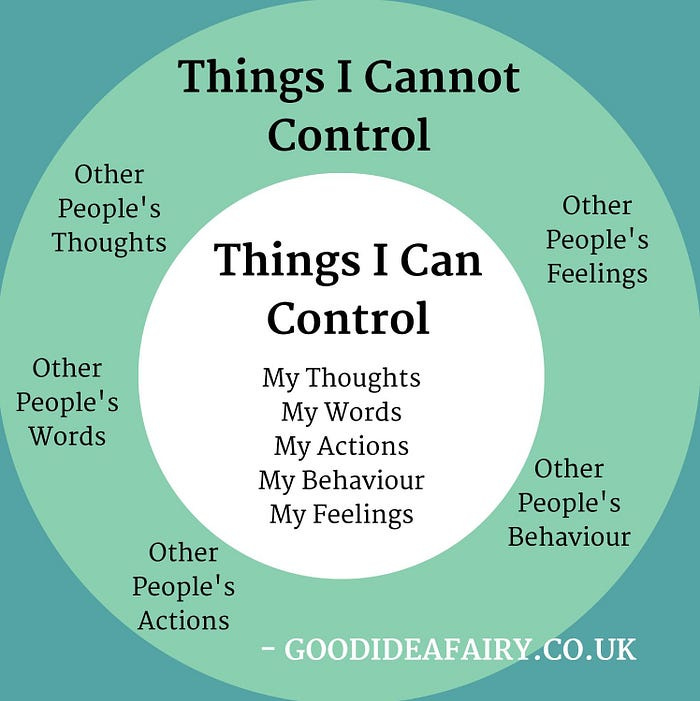
What Can You Actually Control?
This brings me back to stoicism.
Stoic practice reminds us that we control very little outside ourselves.
What we can influence are our thoughts, our perceptions, and the actions that arise from them.
How do you interpret events?
How do you speak to yourself?
Negative self-talk tends to generate actions that reinforce negative beliefs. A different interpretation creates different possibilities for action.
Your perception of a situation is something you can work with.
Acceptance as a Leadership Practice
Another practice for those heavily attached to control is acceptance.
Acceptance of what is.
When someone does not do what you want, when reality unfolds differently than expected — can you sit with it?
Can you be with your frustration?
This has been an important practice in my own life.
Because my pattern was certainty, much of my work involved becoming familiar with anxiety, uncertainty, and not knowing.
Learning that it is safe not to know.
Because trying to know everything is largely an illusion.
It rarely changes the outcome.
What changes is your internal state: you feel clearer, calmer, and more grounded in your body.
Closing Reflection
To summarize:
Everyone has a need for certainty.
In its shadow form, certainty becomes an excessive need for control and predictability.
The invitation is to practice not knowing. To move forward without guaranteed outcomes. To discover what happens when you continue walking your path without certainty.
A few years ago, I did not know I would become a coach.
I did not try to force the answer.
I focused on learning, improving my craft, listening to the market, understanding what people needed, and following the current of life.
Today, I’m in the right place.
But arriving here required surrender.
So the question I leave with you is:
How can you surrender a little more to not having control?
Thanks for reading Rise and Play! Subscribe for free to receive new posts and support my work.
🌿 Next ORIN Women’s Retreat on Sept 11-16 (Portugal) 🌿