You’ve agreed to put on mental handcuffs and won’t be thinking straight.
That’s what you should conclude, first and foremost, if you choose to grapple with philosophy’s famous “Trolley Problem.”
If you’re unfamiliar, it goes like this:
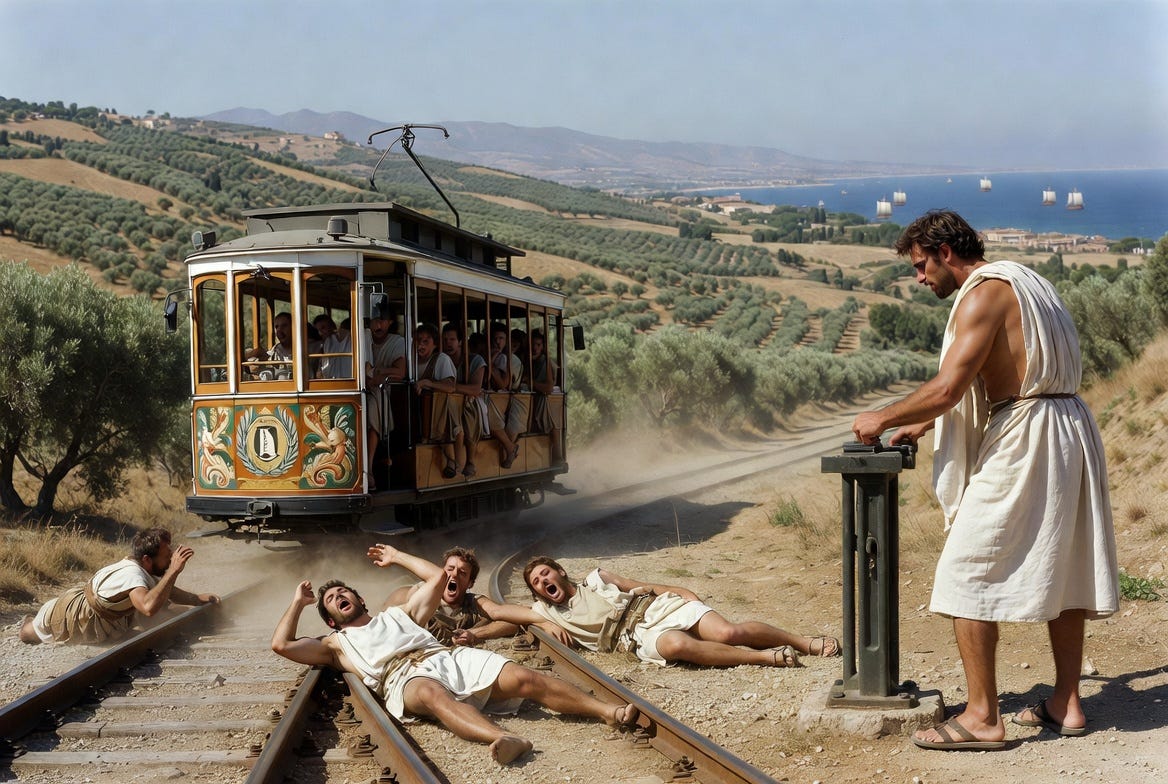
The Setup: A runaway trolley is about to kill five people lying on its track. You can pull a lever to divert it onto another track, where one person will be killed instead.
The Question: Is it better to take an action that will kill one person in order to save five, or to not act, even though more people will die?
Since I try to act with virtue, a subscriber recently asked me how I’d respond to this moral problem during a chat. Here’s what I told him.
A Delusion of Fixed Outcomes
Our intentions imperfectly correlate with outcomes. Every functional adult realizes this, but we choose to ignore it in thought experiments like this.
In Physics: It’s called the “three-body problem.” It’s hard enough to account for all the variables of two simple constants interacting in a vacuum. Add in another and it becomes nearly impossible. Any realistically complex system dissolves into a morass that’s analytically intractable and resistant to computation.
In Neoclassical Economics: It’s called “rational choice theory.”Humans are assumed to be rational actors maximizing their utility — happiness, wealth accumulation, or other preferences. Modern economics textbooks tell students this. Yet a vast field of “behavioral economics” research documents humans deviating from rationality due to biases, emotions, and flawed heuristics. Predictive modeling is frequently way off. Economists are wrong all the time.
And knowing this, someone demands you accept that an intention to pull or not pull a lever will lead to the fixed outcomes they’ve dictated? This is the first reason why we should push back on this thought experiment. It wants to set us up as gods. We are, in fact, a single actor in an overwhelming tsunami of causality that’s bearing down on us and the rest of our world. We cannot make decisions assuming certain outcomes will result.
Decide what you will, but any of this may happen:
* Unseen bystanders rush in and rescue one or more people.
* The lever may be broken, or we don’t know how to disable the safety lock.
* The trolley conductor had fainted, but suddenly wakes and throws the emergency brake.
And many, many other possibilities.
So it’s not in uncontrollable outcomes, but in intention, where morality lies.
What’s Your Role?
No one wakes up at a switch like a blank slate. Real humans have backgrounds and roles, some chosen, others provided by fate. Parents, politicians, and safety inspectors should choose differently because there is no absolute moral choice. “Good human,” is one role we balance alongside others.
Does it not strike you as bizarre that you — a blank-slate human — is at this switch, presumably in some rail yard or control tower?
Are you a trespassing vandal or thief? Do you work for the public transit service? Are you a police detective coming to investigate whatever dastardly chain of events led to six humans lying on trolley tracks?
The police inspector may prioritize stopping an escaping criminal mastermind before he can set up an even greater slaughter. A public transit engineer may know the ins and outs of the system and act with an unknowable perspective. Are you in the Secret Service and know the president is tied to one of the tracks?
These are incredibly important roles dictating priorities the Trolley Problem doesn’t want us to consider. Because when we do, we start to see that its handcuffs are designed to limit us to a blind binary choice aligning not with reality or morality, but narrow ivory-tower philosophical debates.
They’re trying to railroad us into their perspective by literally using a railroad.
Throwing The Switch Toward Virtue:
Virtue appears at the confluence of wisdom, justice, courage, and moderation.
I assume you’re not an all-knowing sage, and I’m certainly not one. This means we grope toward an imperfect understanding of virtue within the context of causality, experience, roles, and a philosophical practice.
* We accept fate and outcomes while minimizing attachment to the uncontrollable. The Trolley problem’s obsession with outcomes leads to irrational passions, and we see the straitjacketed game it’s playing with us — the distraction and spectacle of it all.
* We focus on courage in facing outcomes, justice in considering impacts, wisdom in rational judgment, and self-control in the face of emotion rather than debating outcomes that might never come to pass.
And this, then, is my response. Not a particular course, but a framework for deciding on one.
Philosophy is not a game of riddles but a practical discipline for flourishing in a chaotic world. The only ‘switch’ we can pull is toward virtuous choice — where intentions become opportunities to align with something more valuable than an outcome.
Thanks for reading Socratic State of Mind.
If you liked this article, please like and share it, which helps more readers find my work.