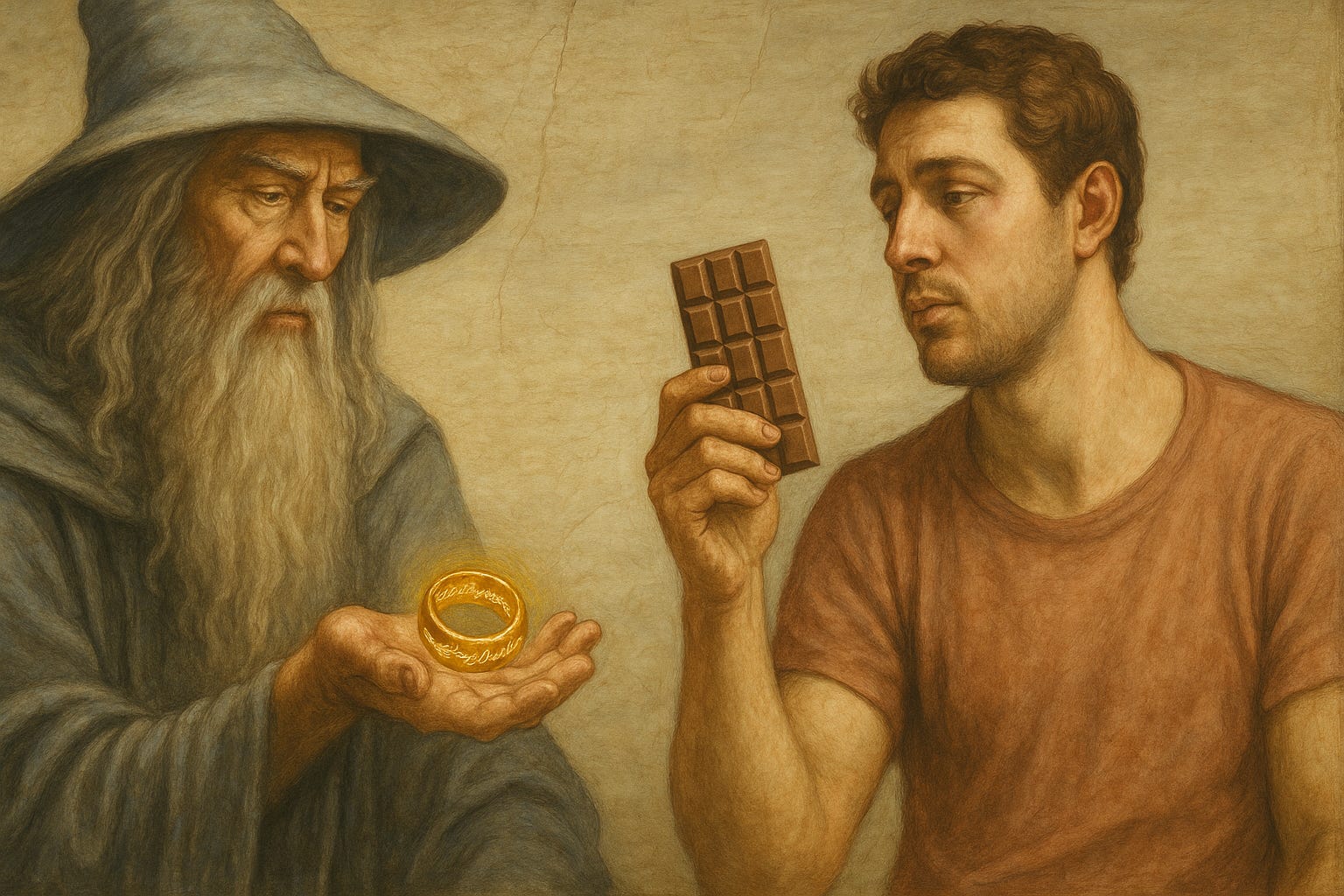
You’ll take the chocolate treats home from the store and only eat them on special occasions in very moderate portions.
This is what you tell yourself in the aisle, eyes gleaming.
There are people who do this. It sounds wise and moderate. But it’s a roll of the dice many people are better off not making. When we try, we often lose.
Our society is full of people failing to eat moderately in our taste utopia, who can’t exercise moderately in our sedentary world. Moderate social media use and screen time? Moderate drug and alcohol use? This stuff is hard, and even those driven by high standards often fail.
There’s something to be said for working on improving our discipline and focus in the face of temptation. It’s critical for the good life, which is why the ancient Stoics had sophrosyne (discipline/moderation) as one of the four cardinal virtues.
But there’s also a reason Tolkien made his wisdom-personified wizard Gandalf avoid the One Ring like it would be the end of him — because in a sense it would. Certain temptations will destroy us, even if they affect others not at all.
This echoes the famous dictum of Greek philosophy — Know Thyself.
If you’ve failed to moderate something three times, maybe it’s best not to test it again, or at least not until you’ve done serious work on yourself. Sometimes, abstinence is the only sane course, even for things others don’t regard as addictive or problematic.
“The better part of valor is discretion, in which better part I have saved my life.”— Shakespeare, Henry IV
Modern research backs up this approach:
Look at your kitchen. One study found that if there’s candy, cereal, sweetened beverages, or dried fruit visible, families were likely to be significantly heavier than those without visibly tempting food. On the other hand, a visible full fruit bowl was associated with lower body weight.
You’ll likely eat what you buy, so don’t buy junk at all unless you have a clear track record of succeeding against lower-stakes food temptation.
Another study gave forty university staff members Hershey Kisses in clear or opaque containers, either on their desks or six feet away. Researchers counted how many candies were eaten after each workday and refilled the jars.
Subjects ate:
* 7.7 Chocolate Kisses when they were in clear containers on their desks.
* 4.6 when the candy was in opaque containers on the desk.
* 5.6 when in clear jars six feet away.
* 3.1 when in opaque jars six feet away.
Out of sight, out of mind. Making mindless consumption harder and less convenient either reduces the temptation or the ability to act on it. These modest choices are what practical wisdom often looks like.
The Stoic Approach To Temptation:
You may imagine every Stoic philosopher was capable of resisting any temptation, but that’s not what the Stoics thought.
“such [failures of moderation] are not cast out by any amount of wisdom. If wisdom could erase all defects, it would have nature itself under its charge. All contributions made by the circumstances of one’s birth and one’s bodily temperament will remain with us after the mind has at length managed in large part to settle” — Seneca, Letters, 11.6
Despite the Stoic valorization of moderation, Epictetus is clear-eyed about how hard moderation is. He suggests we’re often better off discarding desire than trying to satisfy it moderately. His advice to young students was simple:
“…For freedom is not attained through the satisfaction of desires, but through the suppression of desires.” — Epictetus, The Discourses, 4.1.174
You probably already understand the hedonic treadmill Epictetus is talking about. You’ve experienced that sinking feeling that often follows gratification. Discarding desire trumps satisfying it much of the time, and leads to happier lives and better outcomes. Often enough, avoiding a temptation is the first step in being free of it.
The Abstinence Bind:
But this advice leaves us in a bind. While we might decide to forgo drugs, alcohol, and soda, we must eat, and probably have to use the internet. Abstinence won’t remove all temptations.
So what do we do?
* My most powerful moderating techniques are the masts I chain myself to in many circumstances. If you must approach temptation, restrain yourself from utilizing it in an out-of-bounds way.
* Noticing and attention are understated elements of moderation and discipline. If we don’t notice the temptations pulling at us, nor when we discard our dearest values to pursue them, moderation is impossible. One way to rapidly ramp up noticing and beat temptation is to write down our temptations in the moment like this.
We also need to understand the many obesity epidemic/weight gain misconceptions we have floating around in our society, and recalibrate accordingly:
Being led around by the nose by our temptations is a miserable way to live. Better to be in control amid constrained choice than out of control with unlimited options.
However you do it, find a way to take the wheel and hew to your own standards.
Thanks for reading Socratic State of Mind.
If you liked this article, please like and share it, which helps more readers find my work.