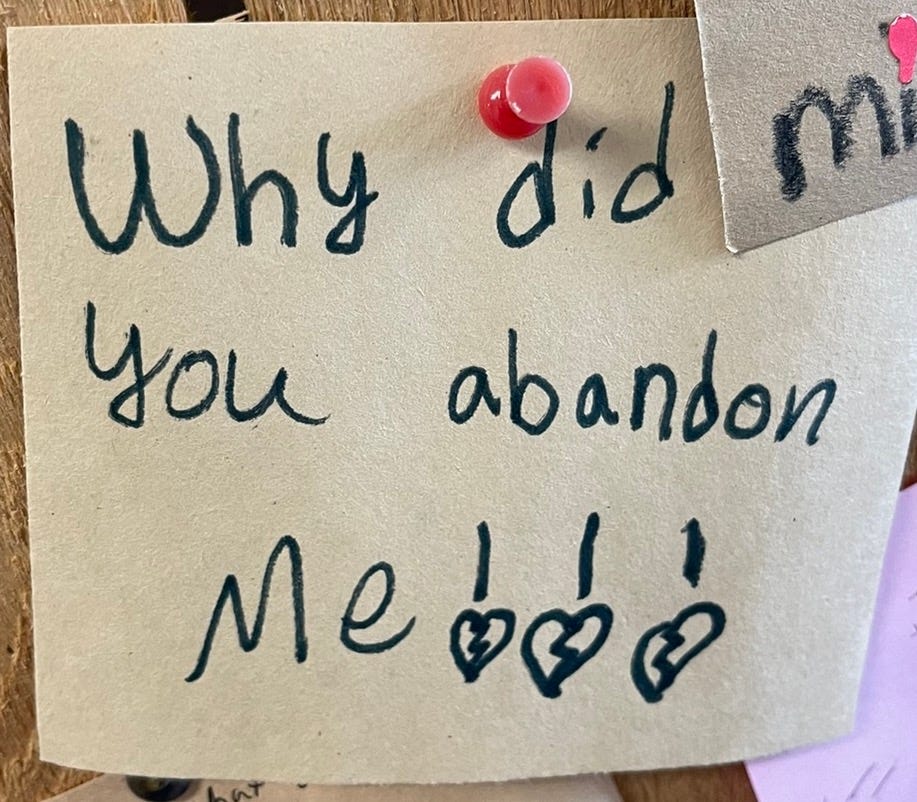
"Why Did You Abandon Me!!!" This heart-wrenching message was written by a child struggling with the grief after the death of a loved one. It was displayed on the wall of Ele’s Place alongside other devastating notes:
* "I am still loveable even though death has touched me"
* "I hate you 4 dying,"
* "Mom, out of everybody you chose me to die on,"
* "love is watching someone die."
When I saw these notes, I knew that I had to join their Board. Ele's Place is a non-profit organization committed to ensuring that no child grieves alone. This outstanding organization serves an incredibly worthy cause and it operates with exceptional efficiency, directing the majority of its donations towards program implementation.
This week, we hosted the "Healing Hearts Breakfast," an event in which board members invite seven friends to learn more about Ele's Place, with the hope of encouraging them to support our mission. More than 350 people attended this weeks breakfast!
During the event, we listened to moving stories from three families who have benefited from the services provided by Ele's Place. It was an emotional rollercoaster.
It is alarming to learn that roughly 10% of children experience the loss of a parent before they turn 16. Ele's Place offers a safe, nurturing environment for these children to share their experiences with skilled counselors and peers who have experienced similar losses.
The breakfast was an incredibly poignant experience. Hearing the tragic and heart-wrenching stories of families who have lost loved ones deeply resonated with me. It's hard to comprehend the magnitude of loss and the accompanying grief that young children face during such challenging times.
When hearing the stories from these amazing kids I feel guilty. Somehow, I had been fortunate enough to go 41 years without experiencing the unexpected loss of a loved one. Although I have lost dear family members, such as my Grandpa Mike Brady, these losses were not sudden or unforeseen. Reflecting on the stories shared during the Healing Hearts Breakfast, I realized how incredibly fortunate I had been to have avoided such a loss, particularly given the sobering statistics.
I’ve been thinking a lot about grief this week because of that breakfast.
One of the things therapists recommend is to write about your feelings and thoughts as a way to get them out of your head. That is one of the reasons I started this newsletter. To write and share as a form of therapy for myself in the small hope that maybe it would help one person out there. I’ve been avoiding this topic but now seems like the time to address it given this weeks breakfast.
As I’ve said before, grief is what propelled me into a year of the opposite. In February of 2022 I lost a dear friend, Joe. A few months later, 2 more friends died. I was incapable of handling the grief and it sunk me into a depression.
I’m embarrassed to admit this but I didn’t really understand depression before experiencing it myself. When it hit me, it hit hard.
On February 21, 2022 I received a text from my good friend Mike saying:
“Really, really crap day boys. Just talked to Joe's sister. He's in really bad shape. Had a heart attack yesterday. In the ICU on a ventilator in Pontiac right now. Trying to figure out my schedule this week. They're only allowing one visitor from 5 - 8 pm. He was supposed to go back to rehab on Thursday.”
Within a few hours I had made the drive over to metro Detroit to be by Joe’s hospital bed. I had never seen anyone hooked up to so many medical devices. Machines were doing almost everything for his body. He was bloated and looked like he had significantly aged since I last saw him only a short 5 months before.
I don't think anyone will benefit from hearing the excruciating details of Joe's passing. As you would expect, it was devastating and profoundly sad. But I do want to mention the aspects that I believe are crucial to understanding my specific grief as it relates to Joes situation in hopes of potentially helping others.
The Visiting Hours
When Joe was in the hospital, it was nearly two years after the start of the Covid pandemic. Vaccines were widely available, and the novelty of the virus had largely worn off. “Novelty” meaning: most people had either been vaccinated or had previously contracted the illness by that time.
Yet, for some inexplicable and frustrating reason, the hospital still enforced a policy that allowed only one visitor to see Joe between 5 pm and 8 pm. Not one visitor at a time, but one visitor per day. His family members and friends had to choose who had the right to see him on any given day. Fortunately, I managed to slip past security and spend about ten minutes with him. If it weren't for my luck that one time, I wouldn't have been able to see him at all.
The hospital's rationale was that they were trying to protect patients and staff from Covid, and I don't blame them. I am confident that they were doing what they believed was in everyone's best interest. However, the policy had a profoundly damaging effect on me and, I believe, on his family.
For months, I couldn't shake the thought of Joe dying alone in his hospital bed with no one there to talk to him, advocate for him, or comfort him by holding his hand or covering him with a blanket.
This thought haunted me throughout my grieving process. I want to clarify that I do not fault the hospital and do not believe there was any malice or ill intent. However, I want to be honest about the personal impact of this policy because I believe these stories should inform future decisions.
With the benefit of hindsight, I think society should reflect on our choices and carefully evaluate whether the benefits genuinely outweighed the harms. Keeping friends and family away from dying loved ones should be done with extreme caution and care. I know firsthand that the damage inflicted can linger for a long time.
The Guilt
Two other aspects of Joe's passing haunted me. Firstly, I grappled with immense guilt. My friends and I had been aware of Joe's struggle with alcohol for years, and we had often considered organizing an intervention or, at the very least, having a serious conversation with him about our concerns and encouraging him to seek help. I felt guilty for never acting on that plan and couldn't help but wonder, "Could I have done more?"
To make matters worse, the last time I saw Joe was at an MSU Spartan Tailgate party, where we were all heavily consuming alcohol. Joe's unexpected arrival, drinking a hard seltzer, caught me off guard as he had been sober the last time we spoke. I didn't confront him about his drinking, believing it would be hypocritical to judge my friend while I was also indulging in excessive alcohol consumption.
These three factors - the hospital visiting hours, the guilt of not intervening, and not addressing Joe's drinking the last time I saw him - were the primary thoughts that tormented me about his loss.
It wasn't until after his funeral that I knew something needed to change.
Joe's funeral took place in a beautiful Catholic church in the metro Detroit area, with a large gathering of friends and family. Afterward, our group of friends went to a local restaurant and bar, where many of us had alcoholic drinks. My friend Ryan had joined us and he asked if he could drive my new car on the hour-long trip home. This was music to my ears because it meant that I didn't have to worry about driving. I now had a designated driver.
Consequently, I had three beers. I wasn't intoxicated, but I wouldn't have indulged if I were driving home. Reflecting on my actions later that night, I thought, "My close friend died from excessive drinking, and I drank at his funeral."
I felt foolish, like a fraud. I had been beating myself up over not organizing an intervention for Joe, yet I couldn't even honor him by abstaining from alcohol at his funeral. I felt like a hypocrite.
My relationship with alcohol has always been complicated.
When I was 12, my parents jokingly s…