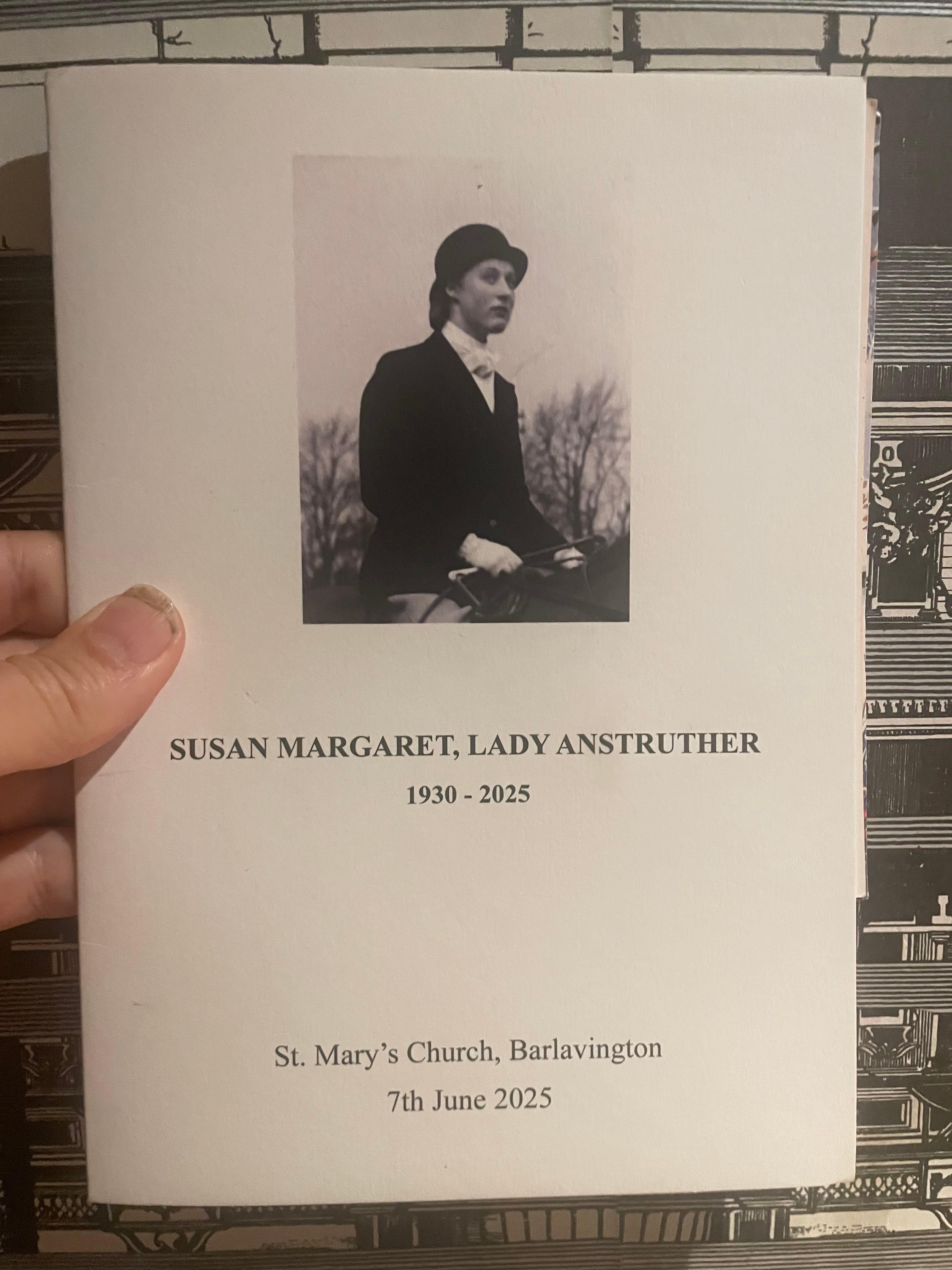
Remarkably, earlier this week a friend of the family found that bowler hat while cleaning out a cupboard. My mother had leant it to her years ago and they’d both forgotten. The friend didn’t know we’d choose that photo for the order of service and we didn’t know the hat still existed, but yesterday, outside the church, she handed it to me. I put it on. It fitted perfectly. I wore it all day. Amidst the profound and sombre shock of death, the presence of goodbye, it brought a touch of clockwork orange to the atmosphere, a dark humour that equally fitted all that has been. I loved it. I’m sure she, or someone, arranged it to be so.
There’s much more I’m going to say about the funeral in the coming days, but for now I’m just going to post a copy of the eulogy and the 1958 protest march to Aldermaston in which she appears at the end.
In a life as long as our mother’s there are bound to be multiple versions, as many as there are stages from daughter of Peggy and Harry to the Dowager Lady A, mistress of the hunt. She was born Susan Margaret Paten on 10th June 1930, the eldest of four, a childhood at Thornfields, the house in Castor just outside Peterborough which her father designed and built. She said being brought up on a building site made her an architect.
She described something idyllic despite the war; a home brimming with claret from the family hotel and wine business, a magnificent garden which informed her sense of scale, a pony and trap, hunting in plaits, feeding the pig which would later be eaten nose to tail, everything but the squeak. Her favourite pony, Rob Roy, her favourite black Labrador, Battle. Picnics at Stonehenge spilling yoghurt on ancient monument, a stop off on the drive to Cornwall, family holidays by the sea. She was stoic in her telling of being sent to school at eight, her suitcase snapping open on her arrival, spilling her childish possessions all over the floor, but the experience made her educate her own children differently. She refused to send us to boarding school, it was a battle she won, unlike that with her own father who insisted she go to secretarial college when all she wanted was to get her out her Rotring pen & set-square and start designing.
Perhaps the only time in her life she did as she was told, she acquiesced to his wishes and learnt to type, a skill preceded by a year sailing on The Black Dragon with her uncle and followed by another on a fruit farm; perhaps it was the experience of picking raspberries and redcurrants that made it an essential of our childhood. But this was long in the future. At 21 years of age she hightailed it to London, to a flat in Eccleston Square shared with those who were to become her lifelong friends. One of only four women at the Middlesex Polytechnic on Regent Street, she qualified as an architect and met her first husband, fell in love with Johnnie and became Susan Walker; not much culinary skill but living in young bliss. Her mother-in-law, worried for their diet, sent roast dinners down from Haywards Heath by train, a plate of chicken and vegetables covered with a cloth and collected from the carriage at Victoria station. Her first job as an architect was in the office of Ernő Goldfinger. It ignited a lifelong love of Brutalism, a unity of form and function which described her working life. Susan Walker was an activist and political firebrand; she joined the Labour party and CND. She walked from Trafalgar Square to Aldermaston in 1958 to protest the nuclear arms race. A film was made of it, she went to the cinema to watch the newsreels and there she was, filling the screen, young and idealistic. Full of belief.
Susan Walker didn’t disappear when Johnnie did. Her marriage ended but the name carried on. I remember her telling me how he was killed in a car accident, and the pain in the room spoke more than she did, it filled in the gaps. Susan Walker Architects, her professional practice in London, was her love letter, a happy place, a determined passion even as she began another. She married our father, Ian Anstruther, introduced by one of the Eccleston Square flatmates. On the day they met he was chopping wood by the shed in his Sussex garden. She didn’t know he’d never done it before nor ever would again. He was an answer. Together they built another life.
As Susan Anstruther she had six children of her own; Lucy, her second daughter who lived for just three days was the only one missing in the noisy, chaotic home she created in Thurloe Square. She moved amongst a wider family of us; mother and architect, her leather attaché case had both initials, one on each side. She once turned up to a flight but was denied travel - while her passport was Susan Anstruther, her tickets had been booked for Susan Walker: this was how closely she ran these parallel lives, although the latter felt dominant. The dining room was taken over, the white round table stacked with her papers, endless meetings for a multitude of committees. The coffee table slipped with piles of Private Eye and the Architect’s Journal. This version of Susan drove a Mini which she regular misplaced and failed to lock; more than once it proved a handy bed for a stranger who sat up in the back on our way to school. Susan Walker was unfazed. She was tenacious and focused, she frequently missed supper only to be found asleep at her desk in Walton Street and later, Cromwell Road. Holidays to France were by way of Corbusier and every Romanesque church from Calais to St Tropez. Simon and Garfunkel on the tape machine, brown bread sandwiches on the side of the road. Even by the pool, she worked.
Yet while she made other people’s houses complete, for her own, string made up for most things. The oven door was made good with bailing twine, the fridge not working was met with a reminder that, The cobbler's children have no shoes, and any complaints from us resulted in being sent for a run round the block. When they married, our father said, One thing you must not do is hoover on a Sunday. Little did he know that she would never hoover at all. With two fingers up to authority, school notes were written on old envelopes and sandwiches wrapped in the innards of Weetabix packets. Clingfilm could perfectly well be hung on the line and the same wrapping paper returned every Christmas. She was an agitator, an environmentalist, a child of austerity and way ahead of her time. Domestic, she was not.
What she was, as Susan Anstruther, was deeply involved in the community and wider world causes. She was a governor, and later Chair, of Marlboro Primary School, an involvement that stretched for over forty years. She was a Trustee of the Georgian Group and Fagus Trust, a founder of the Thurloe Square Leaseholders’ Association and an active voice on the Square Garden committee. But more crucial was her immediate sense of opening her home to anyone in need of care. It was never just us in that tall house in London. She supported a multitude of students, refugees, artists, friends and friends of friends, and many total strangers. She was a flag bearer for the needy and her open door policy meant the house was always full. She loved it like that, and as we left home our rooms were taken by others.
But during those years of our childhood, political discourse was the order of the day at the kitchen table. She had knowingly married a Tory and it made her natural born socialism harden into lines in the sand. Merrily she’d tell me how at weekend parties in the Sussex domain of our father she’d seat Conservative voting guests under the low beam of the dining room so that when they stood up from dinner they’d crack their heads and leave bleeding. Our father said he didn’t mind marrying a socialist because he cancelled out her vote. She didn’t find that funny, but together they upended traditional roles, and arranged what worked for them both. She mostly lived in London with us while our father was mostly down here, in Sussex. At weekends we all got together, w…