Between September 27 and September 30, CISA added four vulnerabilities to its Known Exploited Vulnerabilities Catalog. The affected products include Citrix NetScaler, Apple operating systems, and Cisco Catalyst SD-WAN Manager. Each entry received a three-day remediation deadline, and each requires forensic triage.
During the same week, the United Kingdom’s privacy regulator moved to a board-led governance model, and Microsoft introduced Autopilot, a persistent agent designed to keep working when the user is not present.
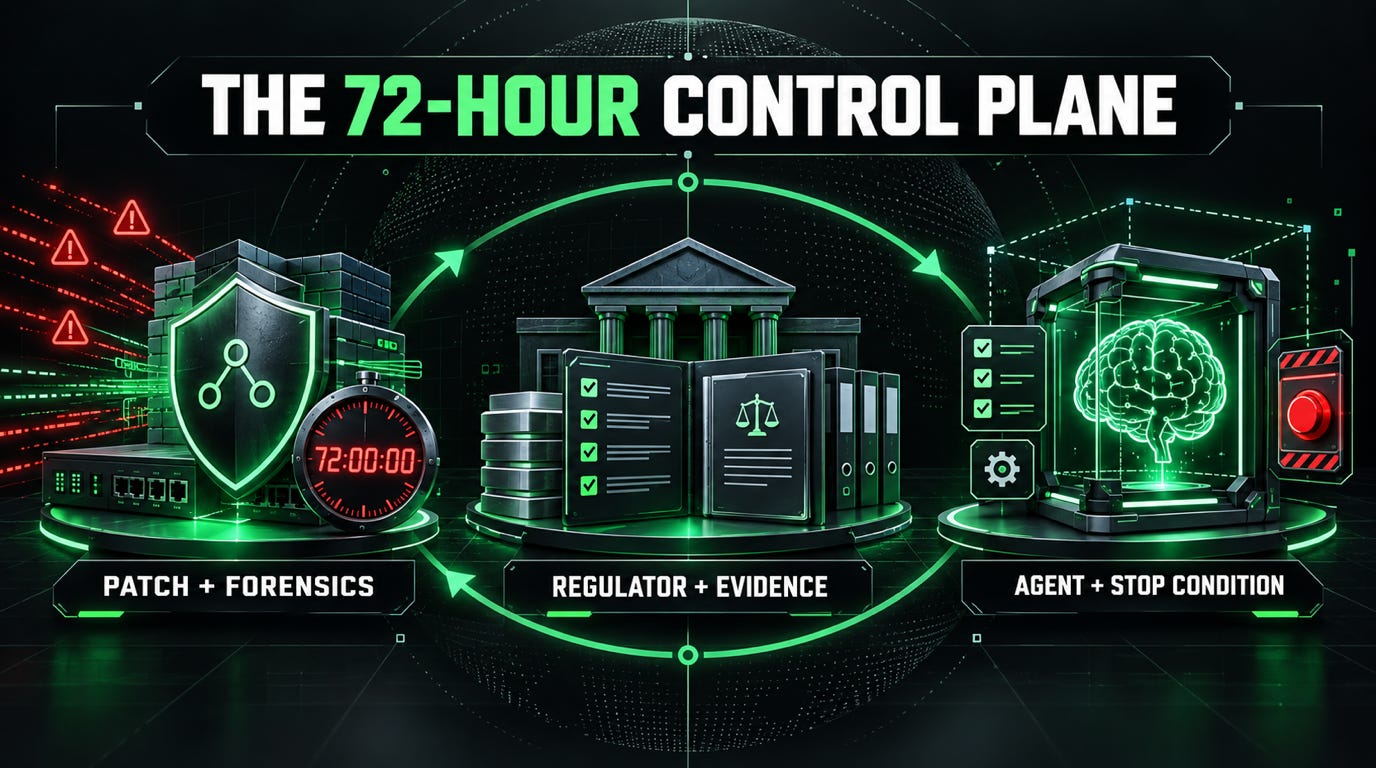
These developments are not the same problem. They do expose the same management gap. Technology can gain reach, authority, and urgency faster than a small business can assign an owner, preserve evidence, or stop the system. The answer is a 72-hour control plane: one short operating loop for urgent security work, regulatory evidence, and persistent AI actions
.
Secure your business with actionable insights tailored for IT and cyber executives. The SMB Tech & Cybersecurity Leadership Newsletter delivers practical risk management strategies straight to your inbox. Subscribe for free to stay ahead of the latest threats, or upgrade to a paid plan to unlock exclusive implementation frameworks and support our community.
1. Four Exploited Vulnerabilities Now Require Patch Evidence and Forensic Triage
CISA added two Citrix NetScaler vulnerabilities on September 27. One can allow an unauthenticated attacker to execute arbitrary commands. The other can lead to remote code execution or denial of service. On September 29, CISA added an Apple CoreGraphics vulnerability that may allow arbitrary code execution. On September 30, it added a Cisco Catalyst SD-WAN Manager flaw that may let an unauthenticated attacker access the system with administrator privileges.
The remediation windows were three days. CISA also marked forensic triage as required for all four entries. The job is not complete when the patch ticket closes. The business needs evidence that the affected system was identified, exposure was assessed, compromise checks were completed, and the owner accepted any remaining uncertainty.
What SMB leaders should do now
1. Compare the four entries with internal assets and vendor-managed systems.
2. Record the owner, product version, internet exposure, remediation time, and evidence source for each match.
3. Preserve logs before changes remove useful evidence.
4. Require a compromise decision, not only a patch confirmation.
5. Escalate any missed deadline as accepted business risk.
When a small team needs to reduce credential exposure during urgent response, 1Password can help separate privileged access and make credential rotation easier to verify: https://1password.partnerlinks.io/j7vr9u77t29s
Affiliate sponsor
2. Privacy Governance Is Becoming More Explicit About Oversight and Accountability
On September 30, the United Kingdom’s Information Commissioner’s Office formally transitioned to the Information Commission. The Data (Use and Access) Act 2025 changed the regulator from a corporation sole to a board-led governance structure. The regulator said its daily responsibilities will continue, while its future strategy will focus on AI, cyber resilience, children’s privacy, and public services.
This change does not create a new checklist for every US-based SMB. It does show where regulatory oversight is moving. Privacy, cyber resilience, and AI are being managed as connected governance issues, with more explicit challenge and accountability at the top.
An SMB does not need a regulator-sized board. It does need a record that can survive outside review. For each high-risk use of personal data, the business should be able to show the purpose, owner, data boundary, retention rule, approval, incident path, and latest control test.
### What SMB leaders should do now
1. Choose the three processing activities that could create the largest customer or employee impact.
2. Confirm that each activity has a named business owner and an independent reviewer.
3. Keep the decision record with the data map, vendor evidence, and test results.
4. Put unresolved privacy and cyber risk on a leadership agenda with a due date.
When a team needs broader detection and response evidence across endpoints and identities, CrowdStrike can help make investigation and containment work more visible: https://crowdstrike2001.partnerlinks.io/crao4gjpq9ga
Affiliate sponsor
3. Persistent AI Agents Need a Tested Stop Condition
On September 25, Microsoft introduced a new Copilot experience that includes Autopilot, a persistent, proactive agent that can keep working when the user is not present. Microsoft also described wider access to business context through Fabric, Dynamics 365, and Power Platform.
The productivity case is clear. A persistent agent can keep work moving across systems and reduce delays. The control question is also clear. An agent that keeps working without the user can repeat an error, use an outdated rule, or act on excessive permissions before a person notices.
The right control is not a general statement that a human remains accountable. The business needs an operating record: approved purpose, allowed systems, maximum authority, review interval, spending or publishing limits, evidence retained, and a stop condition that another authorized person can use.
What SMB leaders should do now
1. Start with one low-risk, reversible workflow and one measurable outcome.
2. Restrict the agent to the minimum systems and actions required.
3. Define events that pause the workflow automatically.
4. Review logs and exceptions before expanding authority.
5. Test the kill switch while the primary owner is unavailable.
When AI workflows need policy, permission, approval, and monitoring boundaries, Airia can help govern the workflow before the agent gains broader authority: https://try.airia.com/hanp3sdhtshf-az7nx
Affiliate sponsor
The Leadership Decision
This week’s three signals support one operating rule: authority must not move faster than evidence.
Use a 72-hour control plane for high-authority technology. Name one owner. Limit access. Preserve evidence. Decide within the deadline. Test the stop condition. If the business cannot do those five things, it should not expand the system’s authority.
Assess Drata With an Advisor Who Knows Your Environment
CPF Coaching is a Drata channel partner. Drata brings GRC, Trust Centers, and Agentic Third-Party Risk Management into one platform. If you are comparing compliance, assurance, or vendor-risk options, contact me for a practical fit review. I will qualify your needs and submit the referral to Drata if the platform fits.
Partner disclosure: CPF Coaching is a Drata channel partner.
Help Other Leaders Secure Their Future
The Network Effect of SMB Security
The most effective way to strengthen our SMB community is to share strategies that work in the field. If you find value in these technical deep dives, helping a fellow leader bridge their tech gap makes the entire ecosystem more resilient. Cybersecurity is a collective effort, and more informed peers lead to a safer environment for everyone’s business.
Why Share This Subscription? When you refer a colleague to this newsletter, you are giving them access to the same specialized insights you use to lead your team:
* Zero-fluff technical execution: No high-level theory, just the steps to implement.
* Cost-saving vendor analysis: An honest look at which tools are worth the SMB budget.
* Direct coaching frameworks: Access to the same logic I use with private coaching clients.
Pay It Forward: Use the button below to share this post or your unique referral link. When your peers join our community, we all benefit from a more secure and tech-forward marketplace.
You’ve seen the "Why" behind this [Cyber/Tech Issue], but knowing the risk is only half the battle. To move from awareness to actual protection, you need a localized execution plan.
The remainder of this deep dive is designed specifically for the SMB leader who needs to move fast without a massive enterprise budget. By upgrading to a paid subscription, you unlock:
* The “How-To” Framework: A step-by-step breakdown of the [Process/Tool] mentioned above.
* Resource Toolkit: Downloadable templates and checklists I use with my private coaching clients.
* The Bottom Line: Direct analysis of the ROI and cost-savings associated with this strategy
Subscribe to Unlock the Full Strategy
Join a community of SMB leaders who stop reacting to tech shifts and start leading them.
Premium Implementation Package: The 72-Hour Control Plane Kit
The free section explains the decision. This package gives the owner the records, procedure, and exercise needed to run it.
Asset 1: 72-Hour High-Authority System Assessment
Purpose: Decide whether a system may continue, must be restricted, or must stop during an urgent security, privacy, or AI event.
Owner: Business system owner, supported by IT, privacy, legal, or the managed service provider.
Inputs: Asset record, permissions, integrations, vendor notice, logs, data map, current controls, and incident history.
Score ownership, authority, exposure, detection, decision window, containment, recovery, and independent review from 0 to 2. Zero means no usable evidence. One means partial or untested evidence. Two means current evidence exists and another person can review it.
Decision criteria:
- 13 to 16: Continue with routine monitoring. Fix any zero before authority expands.
- 8 to 12: Restrict authority and close the largest gaps within seven days.
- 0 to 7: Pause new use or external actions until an executive accepts the risk.
Expected evidence: Completed assessment, named owner, permission export, remediation record, reviewer approval, and stop-test result.
Next action: Score the three systems with the broadest authority before the next leadership meeting.
Asset 2: Urgent Patch and Forensic Triage Procedure
Purpose: Prevent urgent remediation from destroying evidence or ending with an unsupported “patched” claim.
Owner: IT lead or managed service provider, with the business owner approving risk decisions.
Inputs: CISA entry, vendor advisory, asset inventory, exposure record, backups, logs, and change window.
Steps:
1. Confirm product, version, owner, exposure, and affected status.
2. Record the first known exposure time and the remediation deadline.
3. Preserve authentication, administrative, network, endpoint, and application logs.
4. Capture current configuration and permissions.
5. Apply the vendor mitigation or remove the system from service.
6. Run the required indicators-of-compromise and forensic checks.
7. Rotate exposed credentials, tokens, and sessions when the evidence supports it.
8. Validate service recovery and security controls.
9. Record the compromise decision, uncertainty, reviewer, and next monitoring date.
Expected evidence: Version record, preserved logs, change ticket, mitigation proof, triage output, credential action, recovery test, and signed incident decision.
Decision criteria: Close only when remediation and compromise status are both supported. If logs are missing, label the result “compromise not ruled out.”
Next action: Add this procedure to the managed-service agreement and test it against one recent CISA entry.
Asset 3: Persistent Agent Control Standard
Purpose: Define the minimum controls before an AI agent can continue working without an active user.
Owner: Business process owner. IT or security owns technical enforcement. Legal or privacy reviews regulated data use.
Inputs: Approved use case, service identity, data sources, connectors, action list, business rules, and logging configuration.
Steps and controls:
1. Use a dedicated identity. Do not reuse a human administrator account.
2. Deny external publishing, purchasing, deletion, or irreversible changes unless separately approved.
3. Set volume, time, cost, and destination limits.
4. Log prompts, sources, tool calls, actions, exceptions, and approvals.
5. Pause after repeated failures, permission changes, data-source changes, or policy exceptions.
6. Give a second authorized person the ability to stop the agent.
7. Require a fresh review before adding a connector, model, dataset, or action type.
Expected evidence: Approved use case, service identity, permission export, control configuration, log sample, exception report, and kill-switch test.
Decision criteria: No persistent operation begins until the kill switch works and the evidence owner can reconstruct one complete run.
Next action: Apply the standard to one reversible workflow for 14 days. Expand only if the error rate and exception volume stay within the approved threshold.
Asset 4: 30-Minute Control-Plane Tabletop
Purpose: Prove that the team can patch, investigate, and stop a persistent workflow inside a short decision window.
Scenario: This is a fictional composite. A 60-person professional-services firm uses a managed NetScaler gateway and a persistent AI agent that creates internal project records. CISA lists a gateway flaw with a three-day deadline. During remediation, the team finds an unusual administrator session. The AI agent created twelve project records from data accessed during the exposure window.
Owner: Accountable executive. IT, the managed provider, privacy or legal, operations, and the AI workflow owner participate.
Inputs: Current incident plan, vendor contacts, log sources, agent permission map, stop procedure, and notification matrix.
Steps:
1. Name the incident owner and business decision deadline.
2. Preserve gateway, identity, endpoint, and agent activity evidence.
3. Patch or isolate the gateway.
4. Disable the agent’s connectors and preserve its run history.
5. Decide whether the twelve records contain untrusted or exposed data.
6. Determine notification, correction, and recovery actions.
7. Approve or reject return to service with narrower permissions.
Expected evidence: Timeline, role assignments, preserved-artifact list, containment proof, data-impact decision, correction plan, and restoration approval.
Decision criteria: The team names an owner within five minutes, identifies the first five evidence sources within ten minutes, disables the agent within fifteen minutes, and records a return-to-service decision before the exercise ends.
Next action: Run the exercise within 30 days with the primary system owner unavailable for the first ten minutes.
Reusable 72-Hour Checklist
- Name the accountable owner and independent reviewer.
- Confirm the system, version, authority, exposure, and data affected.
- Preserve logs and configuration before making changes.
- Set the decision deadline and escalation path.
- Apply mitigation or reduce authority.
- Complete forensic or impact checks.
- Rotate exposed credentials, tokens, or sessions when required.
- Test the stop condition and recovery path.
- Record remaining uncertainty and accepted risk.
- Schedule the next evidence review.
This post has bonus content for paid subscribers. Upgrade to get full access.
Sources
CISA Known Exploited Vulnerabilities Catalog: https://www.cisa.gov/known-exploited-vulnerabilities-catalog
Cisco advisory for CVE-2026-76504: https://sec.cloudapps.cisco.com/security/center/content/CiscoSecurityAdvisory/cisco-sa-sdwan-webauth-xr8beuuU
Citrix NetScaler security bulletin: https://community.citrix.com/techzone-blogs/110_security-updates/netscaler-adc-and-netscaler-gateway-security-bulletin-for-cve-2026-88771-through-cve-2026-88778
Apple security release reference: https://support.apple.com/en-us/149226
ICO governance transition: https://ico.org.uk/about-the-ico/media-centre/news-and-blogs/2026/09/ico-welcomes-transition-to-new-information-commission-and-marks-new-chapter-with-manchester-head-office-opening/
Microsoft Copilot announcement: https://blogs.microsoft.com/blog/2026/09/25/introducing-the-new-copilot-with-home-code-and-autopilot/