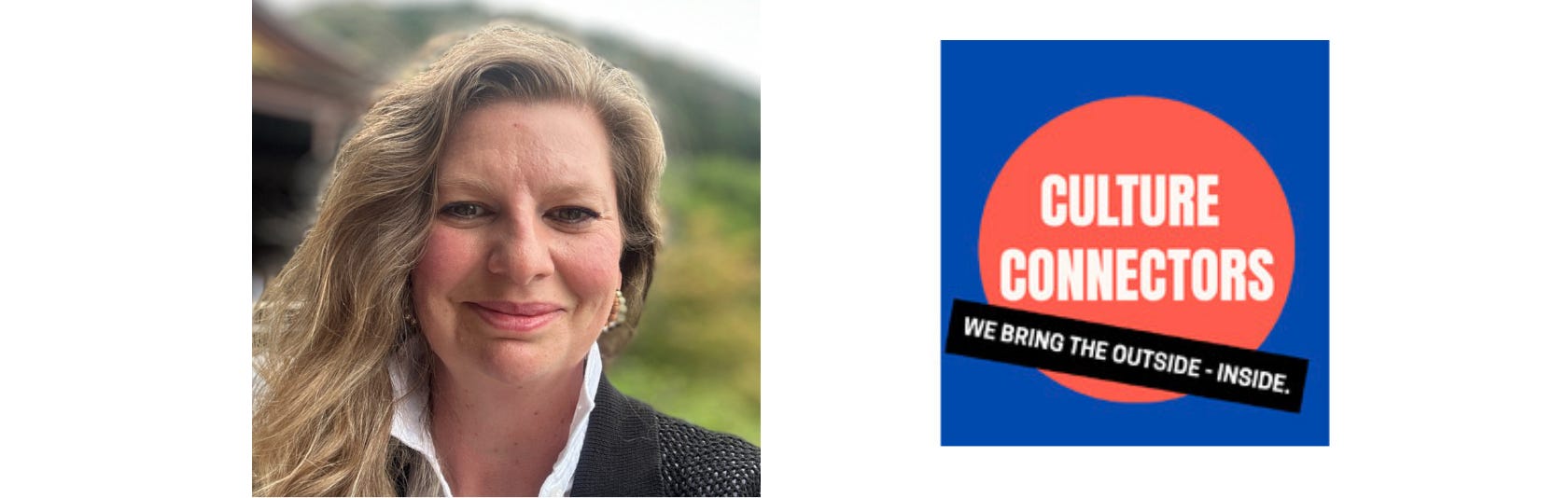
Amy Daroukakis is co-founder of Culture Connectors, a global cultural intelligence collective linking brands to 100+ locally embedded experts. Over 20 years across 60+ countries, she has built strategy for Google, LVMH, Airbnb, and Unilever. Her Trend Galaxy Framework challenges the industry’s habit of mistaking ten cities for the world. She helped the Young V&A win Museum of the Year in 2024, and has spoken at Cannes Lions. She splits her time between Brighton, Athens, and Berlin.
So I start all of these conversations with the same question. I use this in my work too. It’s a question I borrowed from a friend of mine who helps people tell their story — it’s such a beautiful question, which is why I borrow it. But it’s really big. So I over-explain it the way I’m doing right now before I ask it. I want you to know that you are in absolute control and you can answer or not answer any way that you want to. And the question is: where do you come from?
It’s such a great question. And actually, I saw the conversation you did with Katie Dreke and loved it. So practically — I come from Vancouver, Canada.
But I come from a father who was an immigrant who fell in love with what Vancouver was and literally jumped ship and ate pie for too long. Because that was what he could point to until some Greek guys in the kitchen were like, do you want anything else? I think that’s the roots of my roots, because working hard was indoctrinated young.
I started working young within the realm of a restaurant. And it’s still the roots of the roots today because the reason I can talk to anyone and dive into a conversation was from waitressing. From growing up and being able to read a table, anticipate a need, bridge a conversation, help with a lull.
All of that stuff came from waitressing. So that came from working with my father. Not to say that this was a joyous experience — I got fired as many times as I quit. But I can tell people, and I actually look for people who have worked in service. There’s a different level of humanity for people who have had to serve others. And you can tell those who cannot. I’ve ended friendships in a cab once where someone talked to the taxi driver the wrong way. Even in a restaurant, I’ve stopped a friendship. It becomes a real validator of the type of human someone is by how they treat someone else. So I guess I come from service.
Yeah, that’s beautiful. Can you tell us a story about the restaurant where you started — your first job?
So I talked about this initially when I launched Cultural Connectors, because my father was a trapped creative in the realms of the classic Greek restaurant. And that’s what you do as an immigrant, right? You land in things that are known. He landed into that. But he never just served souvlaki. He started tapas in the 90s — he had this Greek dim sum menu where you would pick out different tapas. But people were like, what the hell is this? They would walk out. Or he started whole wheat pizza in the 80s and thought it was the best pizza. So there was always an entrepreneurial edge to this restaurant. It was always served up differently. Experimental. Different.
And I saw this trapped artistic creative within the realms of sameness. I realized in this heightened dizzy when building something at 4 a.m. — how your brain is at its best and worst — that he had given me all the tools to do different, but I had chosen same and started to work away from that.
And what do you mean when you say the different and the same? What were you pointing at?
So I started this thing called Cultural Connectors. In our industry, there’s a sameness and homogeny that’s always been really sold and really sought after. And it tends to be very global north in perspective. There’s a homogeny that comes when cars look the same and hotels look the same and voices look the same. So I did a love letter ask globally and 68 countries responded. And then there are 55 human truth specialists — in grief, loneliness, rest. We’re inside ingredients, and everyone is paid the same postcode rates. It’s community as much as commerce. And our industry hasn’t always been known for that.
So the sameness comes from just getting really tired of hearing things like, this is great for your portfolio, or, well, they’re based in this country, so we should pay that rate. Challenging systems. And my father did that too in his own way, but in a Greek restaurant.
That’s awesome. And I’m so excited to talk more about your work. Before we get to the adult professional stuff, I’d love to ask — do you have a recollection of what you wanted to be, young Amy as a waitress? What did you want to be when you grew up?
Oh, my gosh. I really wanted to design drag queen clothing. I was just obsessed. I would sketch and draw. And I loved Priscilla, Queen of the Desert. I’m now 46, so that was that moment in time when there was this immense creativity. I loved fashion design, all of those things of expression. I remember making hats, designing shirt colors. Just playfulness.
But then I grew up with a very traditional father. If I had said, hey, I want to go to fashion school, he wouldn’t have supported it. But I went for fashion business. And that was supported.
Yeah. So catch us up — where are you now? Tell us a little bit more about the work that you do.
So I’m calling in from Brighton. Postcodes matter in this work because I live between Brighton, Berlin, and Athens. And it gives me this beautiful triangle. Brighton — I live right across from a nude beach. So I can’t take anything too seriously in terms of work. There’s a joyousness right now of how many naked people are out in May. But Greece matters because it’s the home of where my aunt now lives, in the house that was my grandmother’s. So I don’t talk about flying cars, because that contextually isn’t the edge of everyone’s conversation in a Greek home. Or in any home, to be honest. AI is not the lifeblood of every dinner conversation. And I think we need that realisticness — the importance of that.
And then Germany is my husband. So I like to see him. He works for one of Germany’s largest cruise companies, so I’ve gotten to go on all these German cruises, randomly. So when I get asked by a German client, I’m like, I’ve been with 10,000 Germans — I know Germany better than you do. It peaks.
All of this — the thorough thread and the red thread — is one foot in and one foot out. Acknowledging that. Knowing the limitations. I’m not the best expert for Germany, but I know somebody. I think you should always speak to lived experience. Mine is just a little more multicolored. Multi-postcode at the same time.
I have a question — I want to ask about the origins of your cultural connection. But first, I want a little more information about the tradition of nude bathing in... oh my gosh.
Do not think this is the norm and societal norm of the UK. There is still a layer of decorum. But in this one pocket that happens to live right outside my window, there’s this freedom. And the fact that I can see an ass pretty much at all temperatures of the year — I just think it’s really something that roots you in humanity. I once had this really important presenting call, and I heard all this noise. I couldn’t show anyone, but I said, I just have to stop and tell you — there are about a thousand people on bikes. They’re all naked in front of my yard. It adds laughter to the elements. And I think we can get so deep in our heads that — I don’t know, it’s my view of nature. It’s like touching grass, but in a form of nudeness that I really appreciate.
Yeah, that’s remarkable. It must be quite something to preserve this space for people to do that. Everybody’s in agreement that this is...
Yes, there’s an agreement to it. It’s one of those quirks of culture — these microcultures that live within, with written rules. There’s an organic border where people start to wear clothing. And sometimes another favorite hobby — this is the worst — I’ll see more conservative families sta…