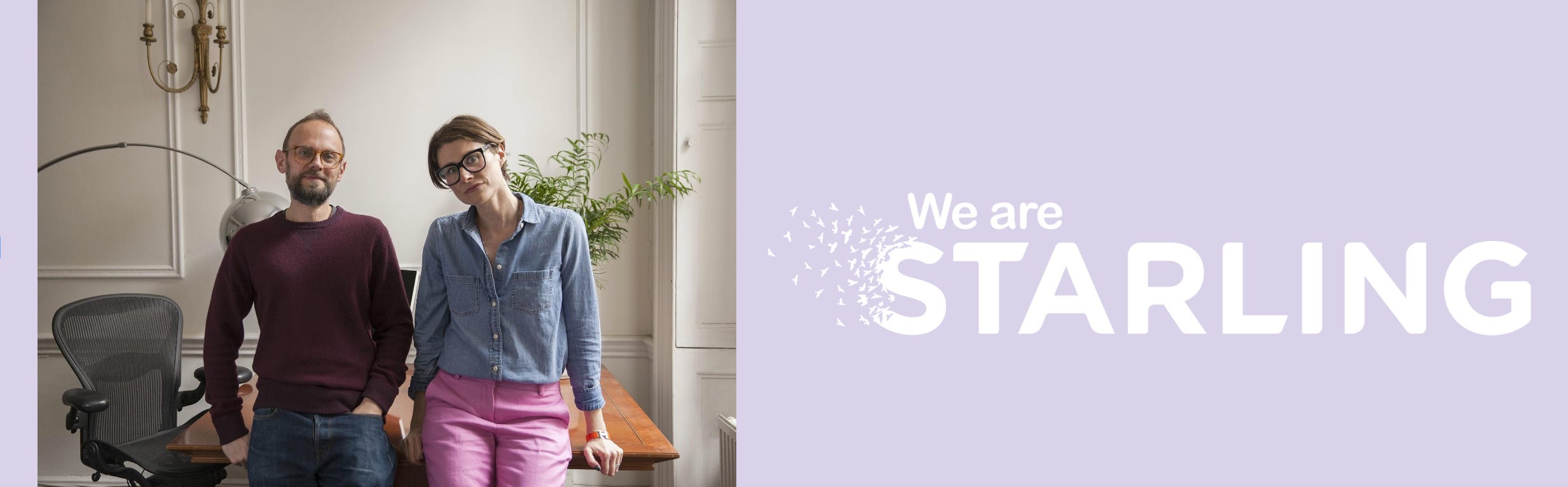
Annie Auerbach & Adam Chmielowski are co-founders of Starling Strategy, a cultural insight and futures consultancy now in its tenth year. They help brands step outside category conventions by mapping the cultural and historical forces that shape how people feel and why.
Annie is a trained historian, journalist, and author of several books including a forthcoming one on collaboration. Adam is a trained historian with a background in international qualitative research. Both previously worked at Flamingo, where they created the Cultural Intelligence unit before founding Starling in 2015.
Their pro bono project The Rift is amazing:
The Rift One: Understanding the growing divide between men and women.The Rift Two: Living in a culture of futurelessness.
Mentioned in the conversation is > Richard Huntington “The Mediocrity of Middle Distance in the Insight”> Ella Saltmarshe on Sociological Stories
So, as you likely know, I start all these conversations with the same question, which is a question I borrowed from a friend of mine, who is also a neighbor, who helps people tell their stories. And I use it because it’s a big question, but because it’s so big, I over explain it before I ask. And I’m going to ask each of you to answer this in turn. And then I’m curious to hear what Starling, your partnership, how that would answer the question too. But the question is, where do you come from? And again, you’re in total control, and you can answer or not answer any way that you want to. And Annie, I’ll start with you.
Annie: Okay, so there’s probably two ways to think about where I come from. The first one is family and heritage. And so my dad’s grandfather came over from Austria to London in about the 1900s, 1910s, and immediately set up shop in the East End of London, in Jewish community, and he was in the schmutter business or he made clothes.
And so my heritage comes on my dad’s side, from this immigrant background and making your way in the world. And big, strong communities, lots of family dinners and jokes. And this core of working hard and trying to better yourself.
And a slightly outsider’s perspective, I think, as well, which I think I have in common with Adam, and I think very much tries to inform our work. So that’s one side, which is this heritage point. And then the second one is academics and where I’ve come from educationally.
And it’s another thing that Adam and I have in common, but we both studied history. And so trained historians and thinking about the past and trajectories, and then I became a journalist, I became a writer. And so very much thinking about what moment are we in, it was a features journalist, I was always thinking about the moment we’re in the present.
And now, of course, Adam and I do cultural futures. So it’s this past, present, future vibe that’s gone with my education and career trajectory.
What was the business, the word that you said for your family?
Oh, the schmutter business.
Yeah, what is the schmutter business?
Clothes, can’t you tell?
I don’t, that’s not a, that’s a, what is that? That’s not a word I’ve heard before.
It’s Yiddish. And it just means in the clothes business. Yeah.
Beautiful. Adam.
Adam: Well, in echoes of what Annie just talked you through, I can’t pull all the strings or the threads together in such a neat way that says something about how we think and what we do. But maybe they’ll come out as I speak. The older I get, where I come from, gets further back in the past.
So most prosaically and more immediately, I come from a really boring, and when I say boring, I mean, the archetypically boring suburb, south of London in the county called Surrey. Nothing happens there. And it’s a place called Carshalton. I’m hoping I’m the only person from Carshalton that’s probably ever been on a podcast at all.
And it’s the sort of place that has a wool shop. It had a wool shop when I was there 40 odd years ago. It’s still got a wool shop there, amazingly.
And I’ve got no idea who buys the stuff from there. It’s probably surrounded by more chain coffee shops now. But it’s still pretty much the same.
And it has that eerie familiarity whenever I go back there. Anyway, that’s the boring British or English, very middle class suburbia is where I’m from, on one level. Further back, but not that further back.
So my parents were Polish. And they escaped Poland. Well, I say escaped, they were forced out of Poland during the war, the World War Two.
So my dad was, his story was, he was ushered out. Ushered is such a light, ushered, please, sir, could you please leave your dwelling and come to us to our gulag? But that’s effectively what happened.
So the Russians came to their door and told them to leave. They had an hour to leave their home, which I never saw again. So him and his two sisters, and their mother, their father, my great grandfather was, sorry, my grandfather was fighting in the war.
So they were taken to Siberia. And eventually, I won’t tell you the story because it will take the whole hour. They found their way via India to London in around 1947, I think, eventually got there.
And my mother, she was forced out by the Nazis. Same story, different enemy. She, through use of fake passports, got to the UK and also London, different part, to my dad, they met.
And then they lived the English middle-class suburban dream. And many immigrants, assimilated into that world seamlessly at the time. And yeah, a few decades later, which sounds a long time, but honestly, it boggles my mind that it’s only what, three decades after that I was born in that really, really boring place called Carshalton.
And actually, that’s where I’m from. And that whole story, I keep wishing to know it a bit more. Because as I say, the older I get, the more interested I am in it.
It’s probably something to do with wanting my kids to understand it more. And historically, we’re just in a time of forgetting that period. And that has its consequences.
So yeah, sorry, slightly long winded. I don’t have any connection to what we do. Maybe we’ll get there at the end of this.
I don’t know. But that’s, yeah. So we talk about being ancestors of immigrants quite a lot, actually, funnily enough. It might be part of our connection of what we’re doing and why we’re still doing it.
That’s so interesting. Yeah, well, then the next question, the third party in the conversation is Starling is your partnership. So where does your partnership come from?
Annie: So we met, funnily enough, we both studied history at the same time at the same place, but never met each other. But we met each other in an agency called Flamingo, which was an international qualitative research agency. And Adam and I found each other.
And we set up a wing of Flamingo, which was called Cultural Intelligence. So specifically around sociocultural trends and futures. And we did that together and we worked really well together.
And then I badgered Adam to leave and set up Starling and eventually he agreed. But yes, we chose the name Starling quite specifically, didn’t we?
Adam: Yeah, well, you said it’s because you were living in Brighton.
Annie: Yeah, so I used to live in Brighton and there’s beautiful murmurations that happen, Starling murmurations that happen over the pier at dusk. And when Adam and I were talking about culture, it just felt like a really good metaphor in the sense that obviously you have these very dynamic choreographed movements of birds all happening at once. It’s incredibly beautiful and awe-inspiring.
So something about culture moving constantly, but also the more we learn about murmurations, the reason for the movement happens because of threats and opportunity of the birds at the edges. So they might see a predator or they might see a food source or a place to rest and they can create these critical transitions of movements to push the entire flock of birds towards or away from something.
We think that’s really interesting when you’re thinking about people and how change happens and how change often co…