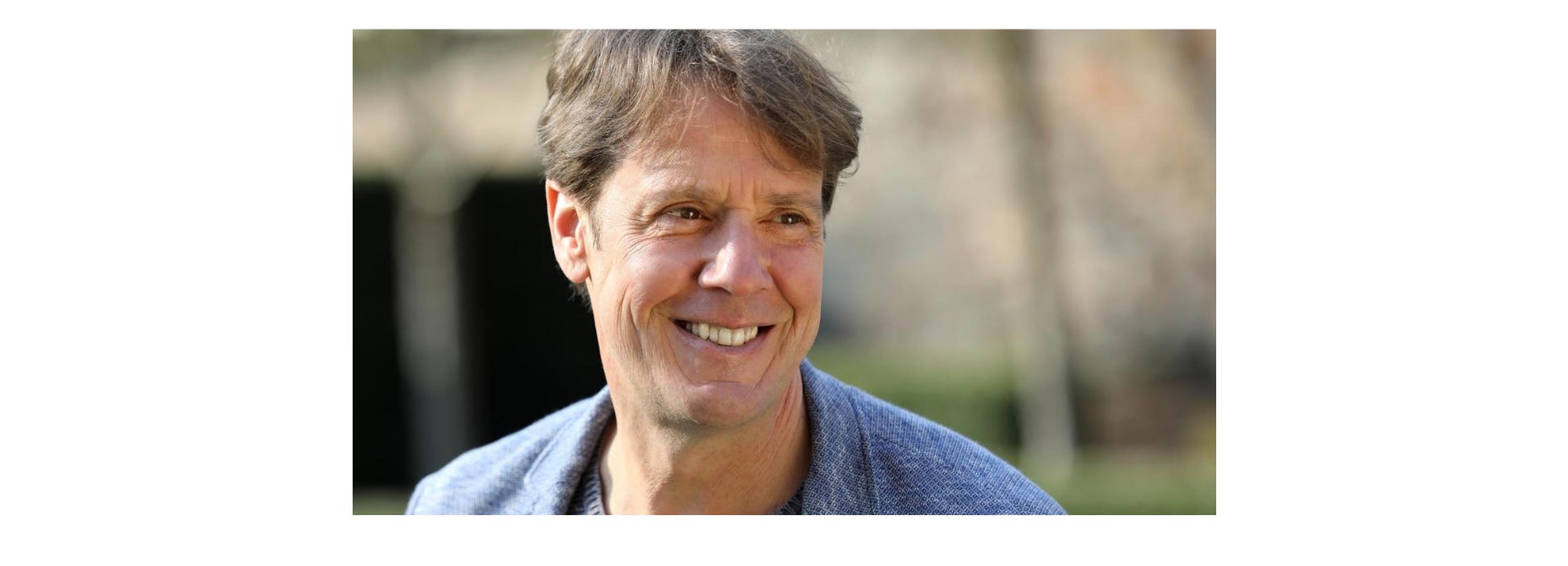
Christoph Quarch is a philosopher and author in Germany. He co-founded the New Platonic Academy, teaches ethics and business philosophy at universities including Danube Private University in Krems. He has written or edited more than 50 books. A handful are available in English, including Plato’s Metaphysics of Soul, The Donkey School for Leadership, and Awaken the Spirit of Europe; his German works include Lebenselixier Schönheit (”Beauty Will Save the World”) and Wahre Wirtschaft (on rethinking economics).
We met in Athens, and I’m really looking forward to this conversation. You may know this or you may not, but I start all of these conversations with the same question, which I imagine you’re going to enjoy. I borrowed it from a friend of mine. She helps people tell their story, and it’s a big, beautiful question, which is why I use it. But because it’s big, I kind of over-explain it the way that I’m doing right now. So before I ask it, I want you to know that you’re in absolute control, and you can answer or not answer any way that you want to. And the question is, where do you come from? And again, you’re in absolute control.
This is an excellent question. So, where do I come from? This is a profound question, mostly for the philosopher, for philosophers for centuries posed this question. I would say I come from the universe. I am part of the universe, some kind of distillation of the universal spirit in an individual form, which will dwell on planet earth for a couple of years before probably my individual form will dissolve again, and I will become part of a greater whole again — without a personal identity, without subjectivity, but nevertheless being part of the cosmic consciousness.
When do you feel like you discovered you were part of the universe, that you came from the universe?
Well, to be honest, this is based on two columns. On the one column, it is philosophical reflection, mostly in conversation with ancient Greek philosophy, because this is a topic that I studied all my life. Mostly Plato, who inspired me very much indeed. But there’s also a kind of personal experience, which resonates with this philosophical reflection.
This comes right from my childhood days, from a period when I was still adolescent. I remember very well the first spiritual experience, even though I don’t like these big concepts. As a young man, I was pretty much influenced and inspired by a kind of Christian congregation, which is called Taizé. It is a congregation located in Burgundy in France, and they practice a very contemplative kind of Christian faith.
As a young man, at the age of 16 or 17, I went to their place very often. And I remember sitting on the ground floor of an old Romanesque church from the 12th century, contemplating, and suddenly it felt like my whole body opened up and a stream of warm energy — I would call it love — flowed straight through my body. This experience really had a huge impact on me. I could feel it for a decade at least, and it was my sincere intention to understand what happened to me in this moment and what it was all about.
So first I studied theology, because I thought it must have something to do with Christian faith. But to be honest, I didn’t find answers in Christian theology, and therefore I proceeded to philosophy, which always attracted me, mostly ancient Greek philosophy. And there I found a concept and a mental explanation for this amazing experience of being fully alive.
And when you were young, what did Christoph want to be when he grew up? Do you have a recollection, maybe before this experience — what was the imagination of Christoph of what he would be when he grew up?
There was no very precise idea of what I was supposed to do in later days. It was about the same period when my spirit started to grow, to unfold itself, to evolve somehow. And in this period, I remember very well standing in front of the bookshelf of my father and finding a book called Plato’s Master Dialogues. I took that book and read a bit in it. I didn’t understand very much, to be honest, but there was something I did understand — namely that this had something to do with me. I became somehow attracted by this mind, this spirit that spoke to me through the lines I read in this book.
And so it was the idea to do something that had to do with spirit, but also with beauty. I had the imagination that one day I could become a kind of poet and photographer who writes books, takes pictures, and through this makes a living. To be honest, this was very optimistic. I think in the 21st century, due to technological revolutions, this project would have failed anyway. So I became a philosopher. And when talking about this, there comes a line to my mind from the German poet Friedrich Hölderlin, who once said that philosophy is a kind of asylum for those who felt attracted by poetry but didn’t dare to become a full-time poet.
That’s quite beautiful. And that resonates with you and your experience.
It does. And to be honest, sometimes it still feels to me that I should give up this philosophy, with these mental operations and dialectics and conversations, and return to poetry. As a young man I wrote a lot of poetry. Sometimes I think, in the time of AI, even philosophy seems to be substituted by automatically generated texts and books. But when it comes to poetry, there always remains something mysterious about it, something that I’m pretty convinced will never be substituted by artificial intelligence, even though it can pretend to write poetry. Real poetry, in my understanding, has to do with that early adolescent experience I was talking about. It has to do with the universal spirit, which sometimes grasps you, inspires you, fills you with inspiration and enthusiasm. And without that, I’m pretty convinced no real poetry will ever come into existence.
So catch us up. What does it mean? Tell us a little bit about your work. What does it mean to be a philosopher? And what do you do? What’s the work that you do?
I’m sitting here thinking all day long. No, I’m just kidding. It’s not that easy to explain, because when I decided to become a full-time philosopher, it was really a challenge. And if I had known at that time what it meant to do this, I’m not quite sure whether I would have decided to take that road. But anyway, what I’m actually doing is a kind of multi-task work.
On the one hand — not that surprising for a philosopher — is teaching. I’m a lecturer at several universities, both in Germany and in Austria. But this is only part-time work. I’m not a professor at university; it’s freelance philosophy, and I’m invited to give some seminars. On the one hand, in a business school, in order to discuss with future entrepreneurs what it takes to reflect on what they are doing, what it takes to reflect on the spiritual dimension of economy, which actually exists. On the other hand, in Austria, I’m a lecturer at a medical school, and it’s about doing the same thing with future doctors. It’s quite inspiring for me to converse with young people and to understand how they look into the world, what kind of ideas they have for their future.
Another thing is that I work a lot in collaboration with a German broadcasting corporation. I have a weekly format in which I reflect in a philosophical way on political topics that are important these days. Another thing is consulting work with corporations, mostly with leadership, when it comes to the question of corporate culture development — what needs to be reflected beyond figures and numbers and the hardcore economy stuff, but is important in order to have a good relationship with employees, all these things we call corporate culture in German.
And the last thing — and this is the fun part of the whole thing — is the philosophical journeys I do in collaboration with a weekly German newspaper called Die Zeit, which is very widespread in Germany. These are philosophical journeys where we stay together with a group of interested, open…