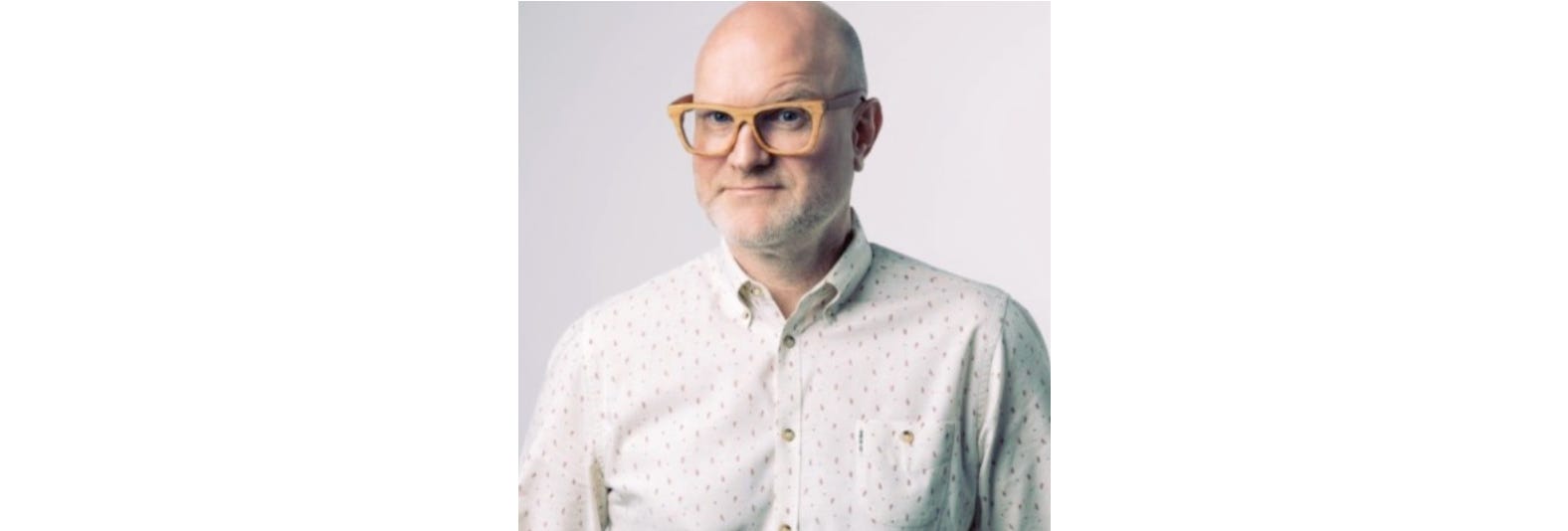
Christopher Owens is the Head of Brand Strategy at TRG in Dallas, Texas, where he has worked for almost 25 years. He also leads the Strategic Planning Boot Camp at Miami Ad School and teaches at the University of Texas at Austin. He joined The Richards Group (now TRG) in 2000, where he helped reshape the agency into a nonprofit-owned creative collective. His award-winning work spans major brands like Alfa Romeo, Dr Pepper, and The Home Depot. I met Christopher at Stratfest NYC, and was super excited to speak with him and hear more about his story.
About halfway through the conversation, I get my facts wrong. I’m so excited to tell the story of the role of planning & qual in the Apple Super Bowl ad, I mess it up. Christopher, saint that he is, does not correct me, but gently directs me to the facts, which Ed Cotton provided:
"Account Planning Panel: The Role of Planning Through the Ages.”
”MT Rainey on the iconic Apple '1984' Super Bowl ad and her career as a master planner.”
Christopher, thank you so much for accepting my invitation.
Thank you so much for welcoming me onto your podcast.
Yeah, so I know that you know this is coming, but I start all my conversations with this question that I borrowed from my friend who helps people tell their story. It's such a big, beautiful question that I use it, but it's so big I over-explain it now. So before I ask it, you are in absolute control. You can answer or not answer any way that you want to. And the question is, where do you come from?
The Midwest. Both the geography and maybe the, let's call it psychography. It's a state of mind. But I think it put me in a position in my life early on, I'm going to say middle school, so we're going to go back to the mid-80s. It gave me one of those cultural clash moments where I started to realize who I'd like to be. And so when I think of the current state me, I go back to that. And I know that moment wouldn't have happened had it not been the Midwest.
So when I was transplanted from Columbus, Ohio, down to Plano, Texas, in the North Texas area during that period of time, my parents being of the, you know, always very trendy, keeping up with things. And there's this thing that was going on in the late 70s and 80s, maybe you heard about it. It's called divorce.
It's a very trendy thing. And my parents decided it's another thing to jump onto. And so I ended up my parents separating and my mom getting married to an electrical engineer who got a job opportunity at Texas Instruments down in the North Texas area.
And I remember learning that we were moving to a place called Plano, P-L-A-N-O, Texas. And back then it was famous for being on the front cover of Time Magazine for Teenage Suicide Capital of the Year, in addition to Hot Air Balloon Capital of the World. So I don't know if there's causation or correlation between those two things.
But I remember at one point reading about this, there was a wonderful little, terribly dark, humorous passage about, listen, if you're a teenager in Plano, everybody's in the garage for probably one of two reasons. You're either in a band looking to be the next greatest, whatever it might be, or you're sitting in your parents' car with the car running and the door shut.
Oh my God. This is just Plano humor?
This was just sort of outside journalistic humor reflecting on what they probably considered a kind of behind the times version of Plano, but Plano was definitely trying to become something more than it was. And Plano was just blockbuster video stores, soccer fields, and just flat concrete, nothing for kids to do. And me coming down from the Midwest, culture shock of Southern Baptist culture in this suburb of North Texas that was trying to grow into something.
And you just had all this pent up youthful energy. This is when I started to kind of see who I probably was and wanted to become given the version of me that was not fitting in to the version of the place that I had just been repopulated to. And I think sometimes for some people, they discovered themselves in moments of collision or clash.
And when you feel that division and you feel that otherness, I think it gives you that dynamic range to then experience maybe who you really are and who you really want to hang with and who you would really call your crew. And that was that moment of time. And there's still a version of me today that very closely ties back to that collision.
And so none of that would have happened without the Midwesterner in me sort of being conflicted with something going on there in the very starkly Southern Baptist North Texas area.
How old were you when you landed in Plano when the clash happened?
Yeah. So actually it would have been after London Calling. So if you want to take the clash reference a bit further, this probably would have been actually just post Rock the Casbah days as well.
So this probably was about 1985, 86. So straight into the new wave period. And I think if I had to go back to one of those quiet moments that you have in your room and you start to realize the music that you're being turned onto and whatever.
And I was always been a big Laurie Anderson fan. So if you're familiar with Laurie Anderson, the performance artist, all the different ways to describe her philosopher and some kind of therapist, was the partner of Lou Reed late into his life. But there is an album.
I want to say 86, 87 is a live album called Home of the Brave. There's a film concert film about it as well that I think she even directed. It's amazing. I had that VHS. I had that record there. It was music that just completely enthralled me, the storytelling, the rhythms.
And whenever I tried to share this music with anyone new that I was meeting in this part of the world, hit the culture collision. That's what takes me back to confirming that was that period of time.
That particular record. In fact, there's a track, on her record, Mr. Heartbreak, she performs it live on this album, but she actually has William S. Burroughs as the voice on this particular track.
And then she performs it with this cool vocoder that shapes her voice and in a really digital way, waveforms it into something that actually sounds William S. Burroughs. But there's a phrase where it's "deep in the heart of darkest America."
And you go "home of the brave. You already paid for this. Listen to my heartbeat."
And then does this thing with this interesting violin she made with tape for the bow and this tape, there was a zero and a one, and she put it over a tape head and just goes. This to me was the fricking coolest thing ever.
You're trying to share it in the lyricism and then the performance of the video and the album and William S. Burroughs and discovering all that with these people I'm meeting and nothing is working.
And anyway, once you experience that, you start to realize, okay, so I am wired a little bit different way and that's okay. Let's let that street flag fly. And it kind of still guides me.
Yeah. Do you have a memory of what you wanted to be when you grew up? In that moment, did you have an idea of what?
Yeah, I was asked this recently and it's in this order. First thing I wanted to be was a cartoonist, first grade, talent show project. I had a photo album where with my little Crayola markers drew each of the key Hanna-Barbera characters one after the other, after the other. And kudos to my mom in that she, in some of the instances, to be honest, she penciled them out and I traced over in those areas, but she saw that I wanted to be a cartoonist and really wanted to support that.
Then I wanted to be an architect because I got really into mechanical drawing and thought these really cool Stettler German mechanical pencils are very cool to own. And there was tools and kit around it. And then it was music, in some ways from the age of 15 for the rest of my life.
Still, it's a big part of my life drummer. And then my goal was to be a jazz studies major. And that's when I went to university, I started off that way.
A…