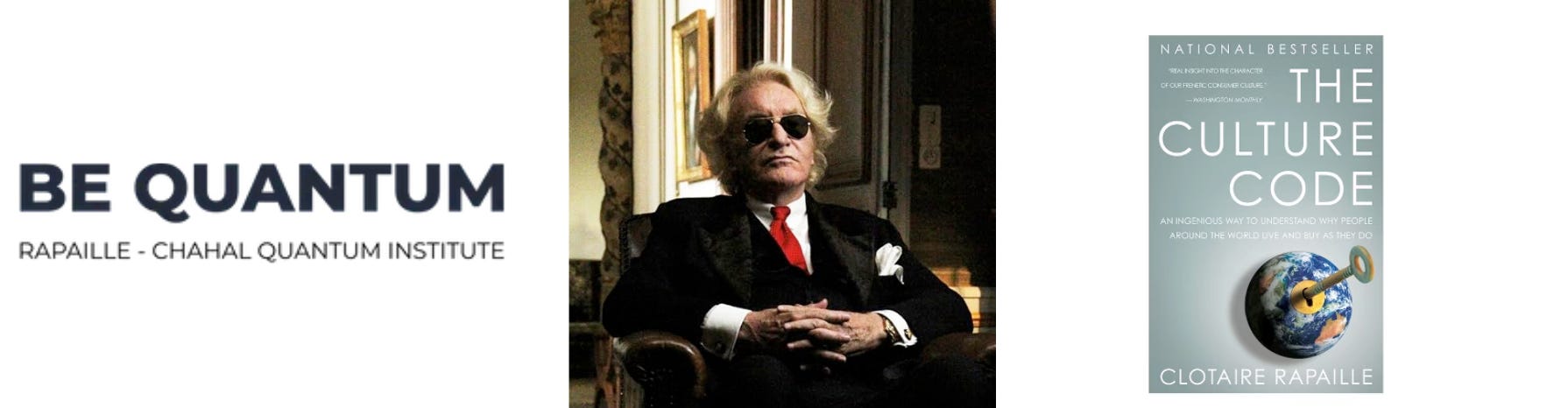
Dr. G. Clotaire Rapaille is the CEO and Founder of Archetype Discoveries Worldwide. His work, made famous in the 2007 book The Culture Code, focuses on understanding cultural codes and uncovering deep-rooted human motivations. He has discovered codes for over half of Forbes’ Fortune 100 companies such as Boeing, LG, P&G and many more. He just launched The Rapaille Chahal Quantum Institute with Ashu Chahal where he continues his research on quantum psychology. Dr. Rapaille has a background in psychology and social sciences from the Université Paris-Sorbonne.
I start all my conversations with the same question—one I borrowed from a woman I know who teaches oral history and helps people tell their stories. It's a big, beautiful question. I always preface it by saying: you have all the control. You can answer or not answer any way you want to. The question is, where do you come from?
I come from the war. I was born during the German occupation of France, and my first imprint of life was that the guy speaking German was in charge, and the ones speaking French were losers. That was my first imprint.
As a little boy, a few days after D-Day, I was in the countryside with my mother when suddenly I saw the Germans stealing bicycles, throwing their guns on the side of the road, and running away. I thought, "Wow, the world is different suddenly. This big guy who was in charge, now they're running away. Why? What is happening here?"
The next thing I saw was a big monster coming out of the forest—an American tank with a white star. I remember everything: the smell, the noise. That was my first imprint. A guy with a big helmet and flowers in the neck took me, gave me some chocolate and chewing gum, put me on the tank, and they took me for a ride.
How can you be that? I said, "Wow, one day I want to be one of these guys." They couldn't stay with me—they had other things to do. But I was waving goodbye saying, "One day I'll be on this tank, one day I will."
I think I've been an American before I became an American. This became my passion in life: discovering the first imprint that people have around the world of anything. It becomes unconscious after a while; I forgot about this story.
But one day I was playing polo at Will Rogers Polo Club in Los Angeles on Sunset Boulevard. After a match, I was riding my horses back to the stable, and I thought, "Wait a minute, why am I here? I'm in America on my horse riding towards the sunset. I made it. It took me a while, but I made it."
I believe we are imprinted at a very early age without being aware of it, and we spend the rest of our life unconsciously trying to accomplish something like that. That became my passion: understanding how people are imprinted in a given culture. What made the Japanese Japanese, what made the Chinese Chinese, what made the American American—this is what really is my passion.
My next question usually is "What did you want to be when you grew up?" But I think you've already answered that.
Well, I have another answer today: I want to be quantum. I want to be Dr. Quantum. I want to be the one who understands the new perspective that quantum physics gives us to see the world.
I believe Western science is like a religion—there's a dogma, and if you disagree, you're excommunicated. The high purpose of Western science seems to be to increase your anxiety. One day they tell you coffee is bad for your health, so you stop drinking it. The next day, research shows six cups a day prevents prostate cancer, so you start drinking it again. They keep changing.
That's the reality of modern science—there's always one hypothesis, then another comes along, then another. Today, the latest wave is quantum physics. When you understand what quantum physics is doing to our way of thinking, you realize we have to start thinking quantum.
I worked for McKinsey in Europe a long time ago. They say when you give a problem to a quantum computer, it solves it in 10 seconds, while a regular computer would take years. So how do you want to think—like an old computer or like a quantum computer? That's my new direction, my new passion. I want to train people around the world to think quantum.
What was your first experience with quantum? When did you first encounter this new way of thinking?
Almost all my life, I wasn't satisfied with how people were thinking. I think I've been quantum before knowing I was quantum. For example, I worked with people in mental health hospitals—people who were supposed to be crazy. I think you're crazy as long as people think you're crazy. But one day you might be crazy and become a genius. My first experience was what I call "crazy genius."
Quantum physics talks about superposition, one of its core principles. When we apply quantum physics knowledge to human resources and human behavior, we realize we've been wrong for thousands of years. I know I'm going to make enemies, and scientists might want to burn me at the stake, but I can't help it—I believe in it.
This is my passion. If we put on quantum glasses and apply that to therapy, for instance—I was trained as a psychoanalyst, went through psychotherapy—they told me you have to fix your past problems, your relationships with your father, mother. But quantum physics tells me the past doesn't exist. It's something you recreate all the time. So let's concentrate on your future. Forget your past, but don't forget your future.
Take education—I have two boys who went to university, and people asked them, "What do you want to be? A doctor? An engineer?" They didn't know, and good for them! Because you can be anything you want, and it keeps changing all the time. We can transform education completely by giving people access to their quantum resources, quantum field, quantum possibilities.
I believe everybody should have the same access to possibilities and opportunities. Quantum gives you so much more. For me, this is one step further in becoming an American—pushing in this direction. It's a new frontier.
The launch of the Rappaile - Chahal Quantum Institute at Delmonico's in the city was wonderful. What's next for the Quantum Institute?
The Quantum Institute launch was a big success. People came from everywhere—Brazil, China, Europe, Mexico. It was amazing. I didn't realize all these people were my friends somehow. I was overwhelmed by that.
Now that we've had this success, the next step is implementation—putting it into practice. I want to design a program to train people to think quantum. Let me give you an example: In quantum physics, there is no opposition. There are no people fighting against each other. There are only complementarities.
If you make a list of all the contradictions in your life—one or two pages in a notebook—and then realize they're not oppositions but complementarities, it opens up new perspectives. For example, "men are from Mars, women are from Venus"—I'm sorry, but that's nonsense. Consider yin and yang: the yin designs the yang, and the yang designs the yin. We cannot understand male without understanding female, and vice versa. We are complementary. Even biologically, you need both to create life.
Looking at things as oppositions or differences is such a waste of time. Let's be creative. My point is that quantum physics creates quantum creativity, and quantum creativity is looking at problems as complementary.
I live in Hudson, New York, just north of RPI in Troy. They have the only IBM quantum system one computer on a university campus. It's in an old church, and it's apparently the coldest place in the world. So tell me, where are you now?
When people ask me where I live, my answer—and it's not a joke—is in an airplane. I have clothes everywhere I can. I think it goes back to when I was a little kid during the German occupation in France. My father was a prisoner, my grandfather was a prisoner, and I just wanted to travel around the world. I made a wish that one day I would travel all the time. Almost unfortunately, my wish was granted.
I'd love to h…