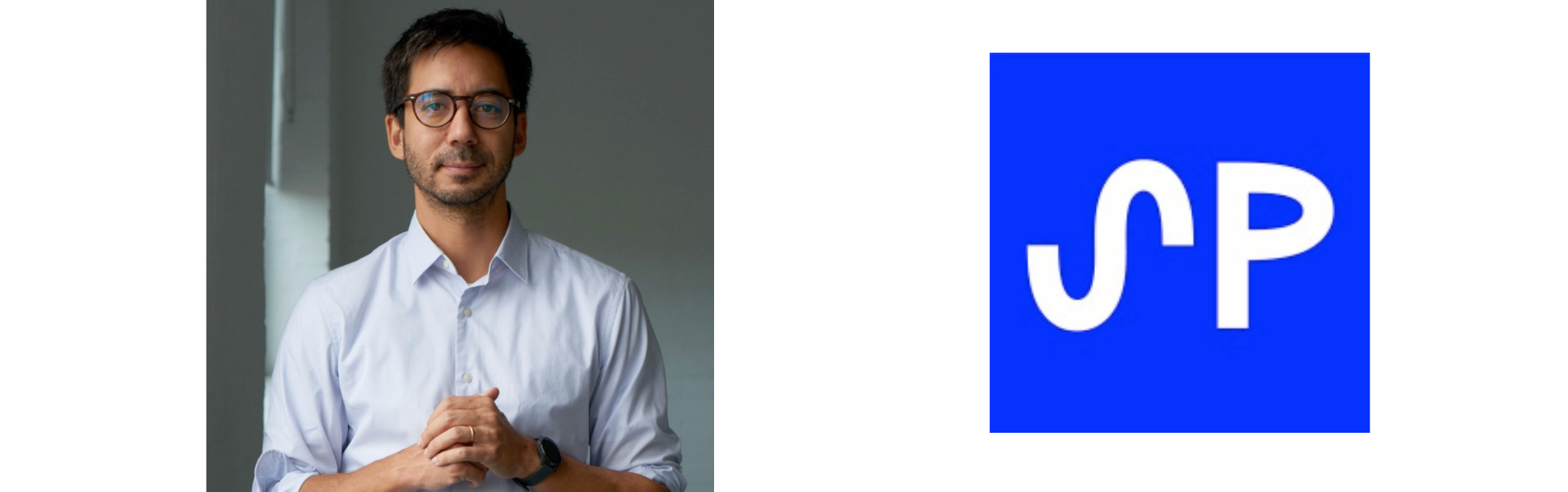
Cyril Maury is a Partner at Stripe Partners, where he leads strategy and innovation work for global technology clients including Meta, Microsoft, and Spotify. Based in Barcelona, he specializes in integrating social science and data to guide product strategy and business model development.
Late in our conversation, we discuss these two pieces: “When place matters again: strategic guidelines for a splintered world” from May 2025, and ”Interpreting Artificial Intelligence: the influence and implications of metaphors” from Sept 2023.
I always start these conversations with a question I borrowed from a friend—someone who helps people tell their stories. It’s a big, beautiful question, and I love it so much that I tend to over-explain it before asking. But before I do, I want you to know you’re in complete control. You can answer however you like, and there’s no way to get it wrong. The question is: Where do you come from?
I come from France, which is the obvious answer. But there’s more to it. My mother is Vietnamese, and my father is French, though with roots in Algeria, another former French colony. In many ways, I’m an unusual product of colonialism—a strange outcome of its complicated legacy.
Maybe because of that background, I became curious about the world early on. I grew up in Grenoble, a provincial city in the French Alps, and I quickly became interested in history, geography, and people. I wanted to see how the world looked beyond my immediate surroundings.
As soon as I could, I pursued exchange programs through university. In France, the typical path is to move from the provinces to Paris. I did that, and once in Paris, I realized there was even more beyond France itself. I spent time in the U.S., doing a year at UC Santa Barbara—an incredibly beautiful place—and then spent a few years in Latin America: São Paulo, Buenos Aires, Bogotá. Eventually, I moved on to the Middle East, to Iran, eager to explore still more cultures.
During that journey, it struck me: what if I could make understanding people my job? What could be better than being paid to do what we all enjoy—being curious about others’ lives and stories? That realization led me into the world of research and consulting. I started my career in Spain at agencies focused on understanding behavior and helping companies develop better products based on that understanding.
After Spain, I returned to France. About five years ago, I joined Stripe Partners, a decentralized agency headquartered in London. We have people working everywhere—from Hong Kong to Edinburgh to Berlin. I’m currently based in Barcelona, which is where I’m speaking from now.
Growing up, I was very aware of the absence of my mother’s Vietnamese heritage in our home. She was born in Saigon, when it was still a French territory. During the war, she left for France. I was born a few years after she arrived, in the early 1980s, a time when France emphasized full integration into the Republic. That meant speaking French and adopting French customs. My mother followed that path. She never spoke Vietnamese to me or my brother—not a single word. I speak English, Spanish, and Portuguese, but I can’t say anything in Vietnamese.
She had very few Vietnamese friends. We would hear her speak Vietnamese on the phone occasionally—mostly with family in the United States—but she would always close the door. It created this strange feeling: a culture present only in its absence. I grew up knowing that something was different, even if I couldn’t name it. As I got older, I came to understand it as a consequence of colonialism, but as a child, it simply felt... odd.
As a kid, I didn’t have a clear idea of what I wanted to be. What I did have was an intense curiosity—about people, about cultures, about how things worked elsewhere. That curiosity led me, step by step, to where I am now. I studied political science to understand ideas and ways of thinking. Then I went to business school to learn the more practical aspects of the world. Along the way, I kept seeking opportunities to live and study abroad.
Toward the end of business school, I met someone—just a friend of a friend—who had started working at an innovation consultancy in Spain. He said, “This seems like something you’d enjoy.” And he was right. On paper, it made sense. That was almost twenty years ago, and I’ve been doing it ever since.
And tell me, catch us up. You're in Barcelona. Tell me a little bit about what you're doing and the work that you're, what are you working on?
Yeah. So I'm based in Barcelona, a partner at Stripe Partners.
What we do at Stripe Partners is, largely, we have a number of methodologies and tools that help us surface and understand people. Originally, what we're known for is ethnography. Some of the founders are PhDs in anthropology, and we really started by trying to leverage that set of tools as much as possible.
As we grew as a company, we added other tools to give us different lenses on human behavior—primarily data science. We now have a healthy and cutting-edge data science practice.
The last pillar of what we do is design. We also have designers who do design research and all kinds of work to, one, understand user insights in different ways, and two, ensure that the understanding we develop can be used to inform digital product strategies in the best possible way.
We also have the tools to ensure that we use these insights to create something that will help stakeholders understand what it is—the human truth—we're trying to make visible. So that's what we do as a company.
Within that, my personal role involves a lot of work on technology projects, because I would say about 75% of our clients are technology companies. That means a lot of projects for Google, Meta, Spotify. In the last couple of years, much of that has focused on AI.
Some of the projects that I found particularly interesting have been about understanding how people engage differently with AI solutions in different markets. It’s fascinating, because there are so many layers of complexity to unpack.
First, the solutions themselves are difficult to understand—even for the people who design and build them. They're the first digital tools that are probabilistic, not deterministic. So that’s one layer of uncertainty.
The second layer is that their behavior depends on the users themselves. Different users can interact with the same AI solution, and it will behave differently for each of them—and even differently for the same user over time. There's this almost dialectical path between the AI and the user, which is hard to understand at scale because it’s so context-dependent.
The third layer is how users make sense of these experiences. That interpretation is shaped by cultural beliefs and narratives. As we've seen in our projects, this is deeply local. Someone in Germany, someone in India, someone in Brazil—they’ll interpret the same interaction differently because they come with different expectations.
So, long answer, but that’s the AI work: a lot of global-scale AI deployment projects.
The other major area I’ve been focused on is healthcare, which I’m helping to develop at Stripe Partners. We’ve done—and I’ve done—a lot of projects aimed at understanding what we call disease areas or therapeutic areas.
These projects are especially interesting because they require understanding multiple layers: the biology of the disease, how particular drugs work, how people experience and make sense of their conditions, how they interpret treatment, and how it all fits into their lived experience. And then, you add the complexity of the healthcare system itself, which differs dramatically between the U.S., Europe, and elsewhere.
Some of the areas I’ve worked on recently include Alzheimer’s disease and dementia—which is absolutely fascinating. Also haemophilia, which is more niche but still quite complex. And we’ve been doing a lot in obesity and weight management—trying to understand how that space is shifting culturally.
One o…